Home / Chungcheong / Yeongguksa Temple, Yeongdong
Yeongguksa Temple, Yeongdong County: a mountain temple and a ginkgo thought to be 1,000 years old
A temple on the slopes of Cheontaesan in Yeongdong, North Chungcheong, dating back to the Unified Silla period, with a ginkgo tree estimated at about 1,000 years old, a stone pagoda listed as a Treasure, and free entry.
- Getting there
- By car: the Korea Tourism Organization lists parking at the Cheontaesan car park. By bus: we couldn't confirm the bus details, so check the live route in Naver Map.
- Cost
- Free (Korea Tourism Organization).
- Time needed
- About 1 to 2 hours including the walk from the car park (estimate)
- Best time
- Not midsummer (I went in July and it was far too hot). For yellow ginkgo leaves, go in autumn: Yeongdong County reported the tree at its golden peak around 11 November 2026. The Korea Tourism Organization lists it as open all year.
Tap any Korean name on this page to hear it. Prefer Naver Map? In the app (set to English), search Yeongguksa Temple Yeongdong, or paste the Korean name:영동 영국사
Short version: Yeongguksa is a temple on the slopes of Cheontaesan mountain in Yeongdong, North Chungcheong. Its information board dates it back to the Unified Silla period. Most people come for the ginkgo tree in front of it, a Natural Monument estimated at about 1,000 years old and about 31 m tall. I didn’t take a photo of the tree, sorry. The temple itself has a lovely atmosphere (my view), a three-story stone pagoda listed as a Treasure, and the Korea Tourism Organization lists entry as free.
Last checked: 16 November 2026. The history comes from the temple’s main information board and the pagoda’s own board, which I photographed and which both have English texts. The ginkgo tree’s size, age and designation come from the Encyclopedia of Korean Culture and the Korea Tourism Organization, the legend from two news reports, and the autumn colour from Yeongdong County, as reported in the news on 11 November 2026. Entry, opening, parking, the walking path and the address come from the Korea Tourism Organization. We couldn’t confirm the bus details. The impressions and the photos are from my own visit. Tell me if anything has changed.
The ginkgo tree
The tree stands in front of the temple, by the path up. It was made a Natural Monument in 1970. The Encyclopedia of Korean Culture estimates its age at about 1,000 years and gives its height as about 31 m and its girth at chest height as about 11 m. The Korea Tourism Organization gives the same size.
The encyclopedia also notes that one of its branches grew down to the ground and took root, so a smaller tree is now growing from it. The Kyunghyang Shinmun and Newspim both report a local legend that the tree cries out when the country is about to face great hardship.
I forgot to photograph it. Silly me. You’ll have to see it for yourself.
A short history
According to the temple’s main board, Yeongguksa goes back to the end of the Unified Silla period. In the Goryeo period the monk Uicheon (State Preceptor Daegak) rebuilt it under the name Gukcheongsa, and it grew into a large temple while State Preceptor Wongak lived here. The temple was buried by a landslide in 1879. In 1934 the head monk Jubong built the main hall, Daeungjeon, and put the three-story stone pagoda back up where it stands today.
The board says the temple has four Treasures and four provincial heritage items, as well as the ginkgo tree and a temple bell. Excavations behind the main hall found that the old buildings were laid out east to west, while today’s are laid out south to north.
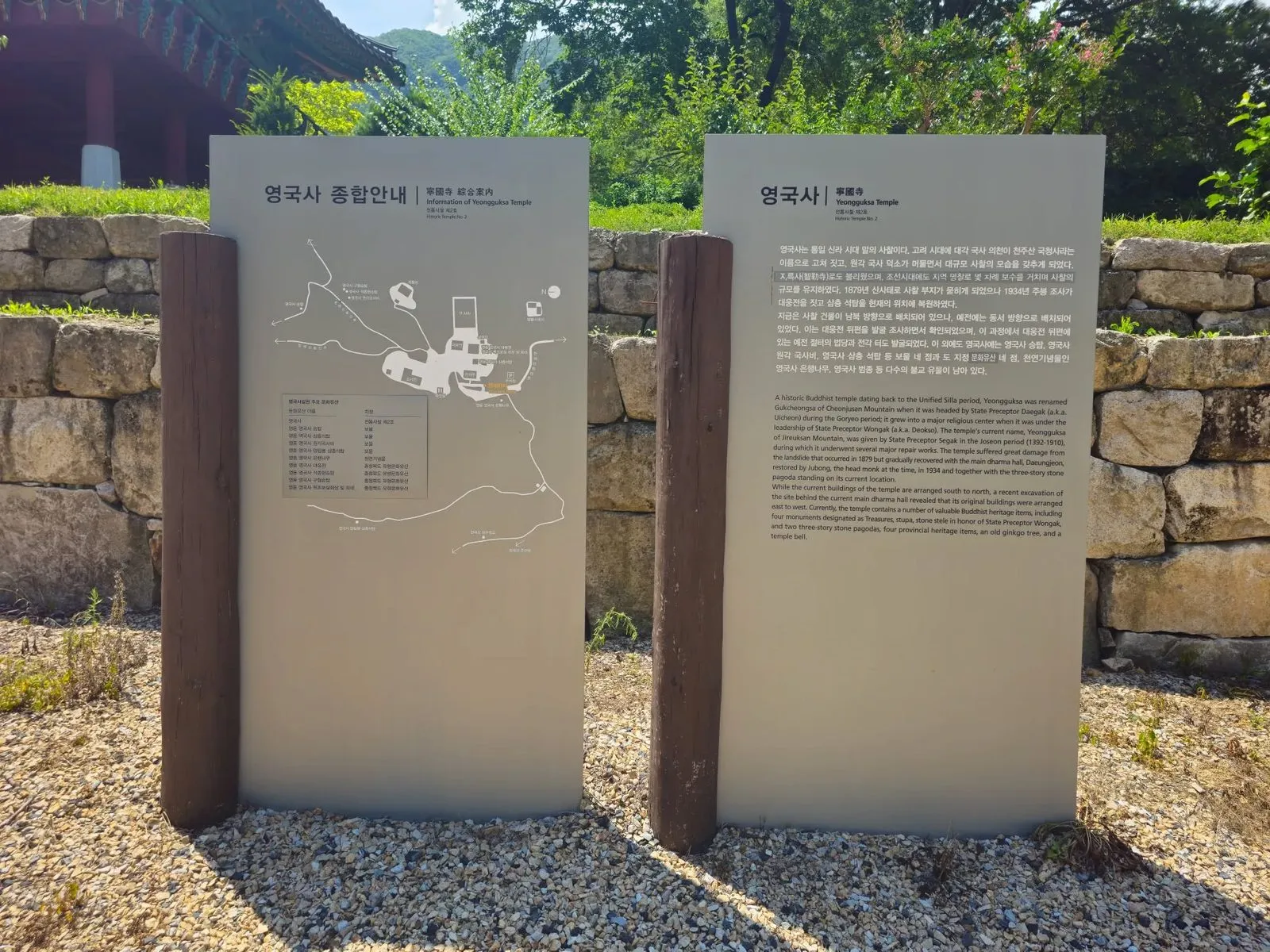 The temple’s two main boards: a map of the grounds, and the history in Korean and English.
Walking around
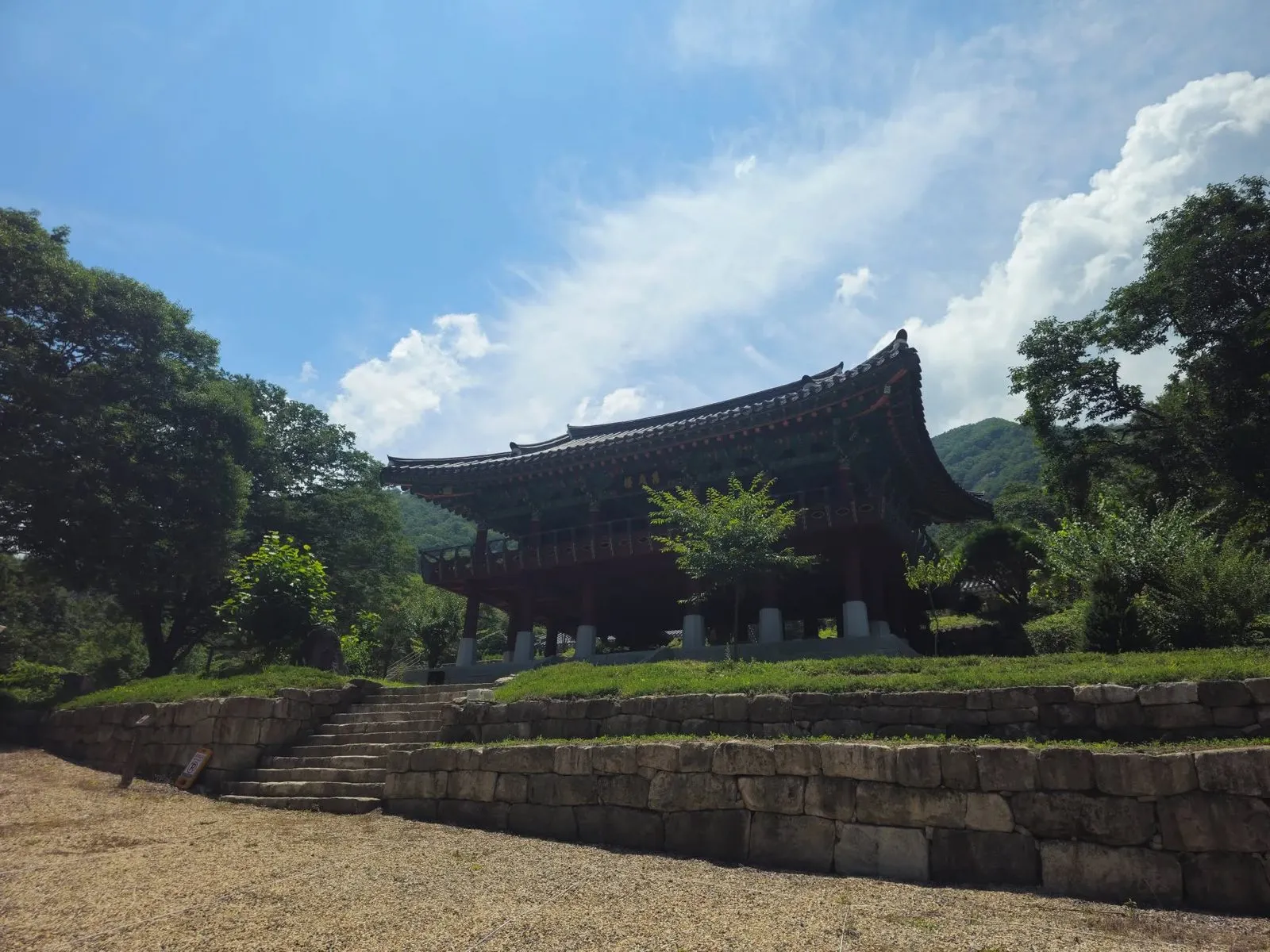
From the gravel yard, stone steps climb two stone terraces to a big two-storey pavilion with a plaque reading Manseru (萬歲樓). You walk underneath it, and through the gap you can already see the main hall.
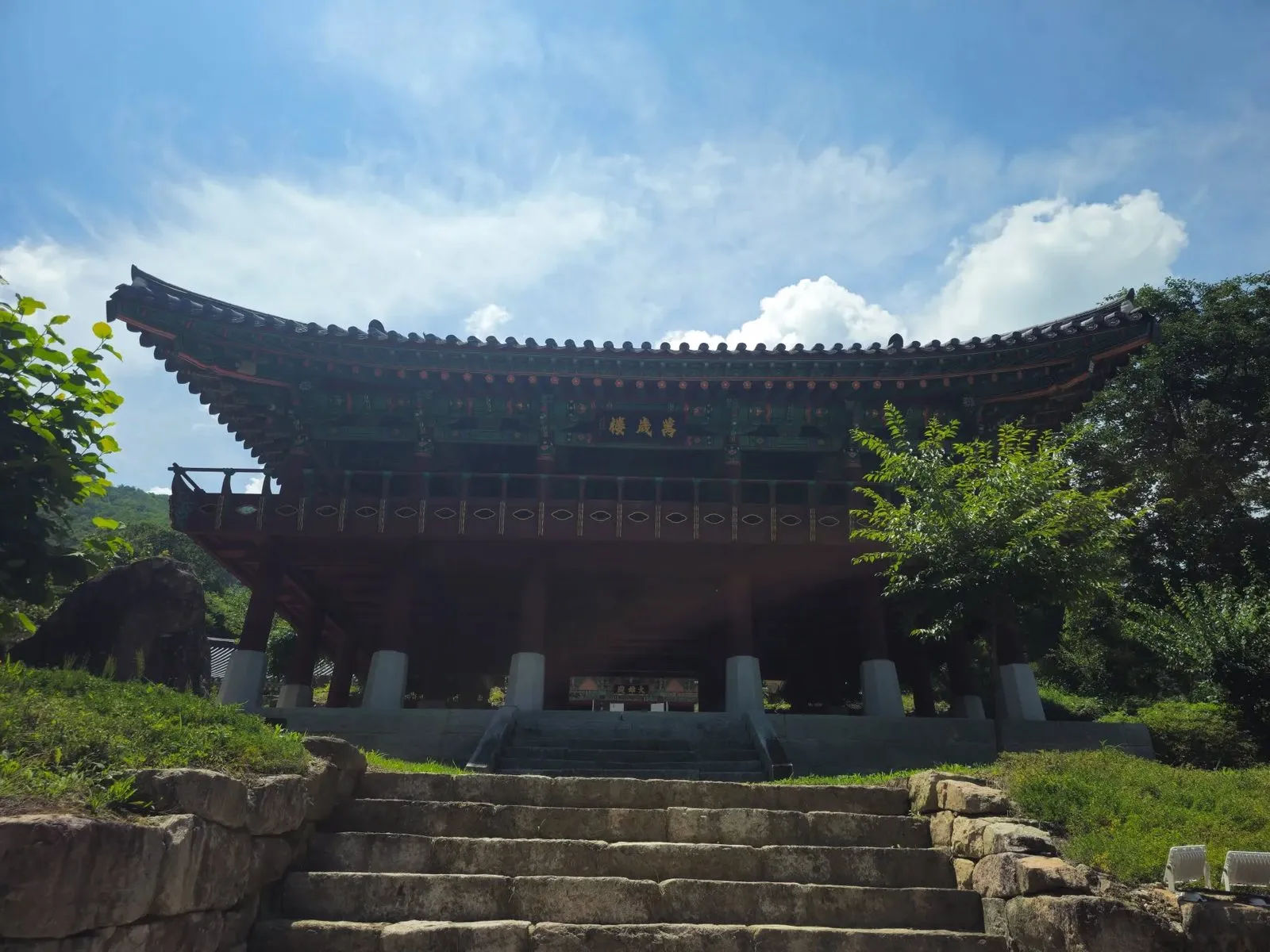 The Manseru pavilion. Look through the bottom and you can see the main hall’s plaque.
Behind the pavilion is a courtyard with the main hall (Daeungjeon) and the three-story stone pagoda in front of it. When I went in July, the courtyard was strung with rows of coloured lanterns. A small mountain-spirit shrine (Sansingak) sits up the grassy slope to the right.
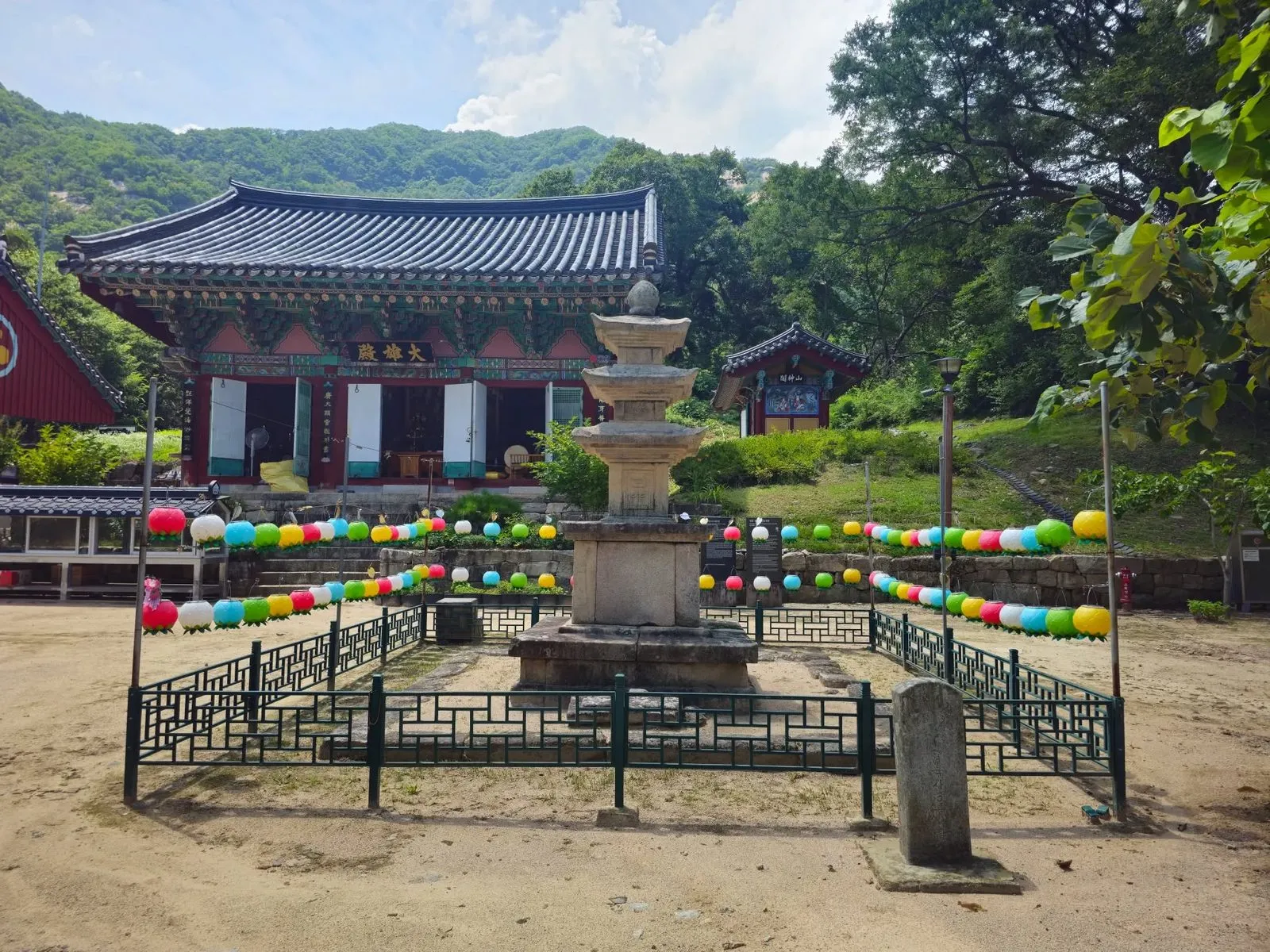 The main hall and the three-story stone pagoda, with lanterns up in July.
The three-story stone pagoda
The pagoda in front of the main hall is a Treasure. Its own board, which also has an English text, says it is made of granite and was probably built around the late 9th century, in the late Unified Silla period. It had fallen down at an old temple site. The monk Jubong moved it here and put it back up. When it was moved, the two layers of its base were swapped by mistake, and this was corrected in 2003.
One thing doesn’t match: this board says the pagoda was moved in 1942, while the temple’s main board says 1934. We couldn’t confirm which year is right, so both are given here.
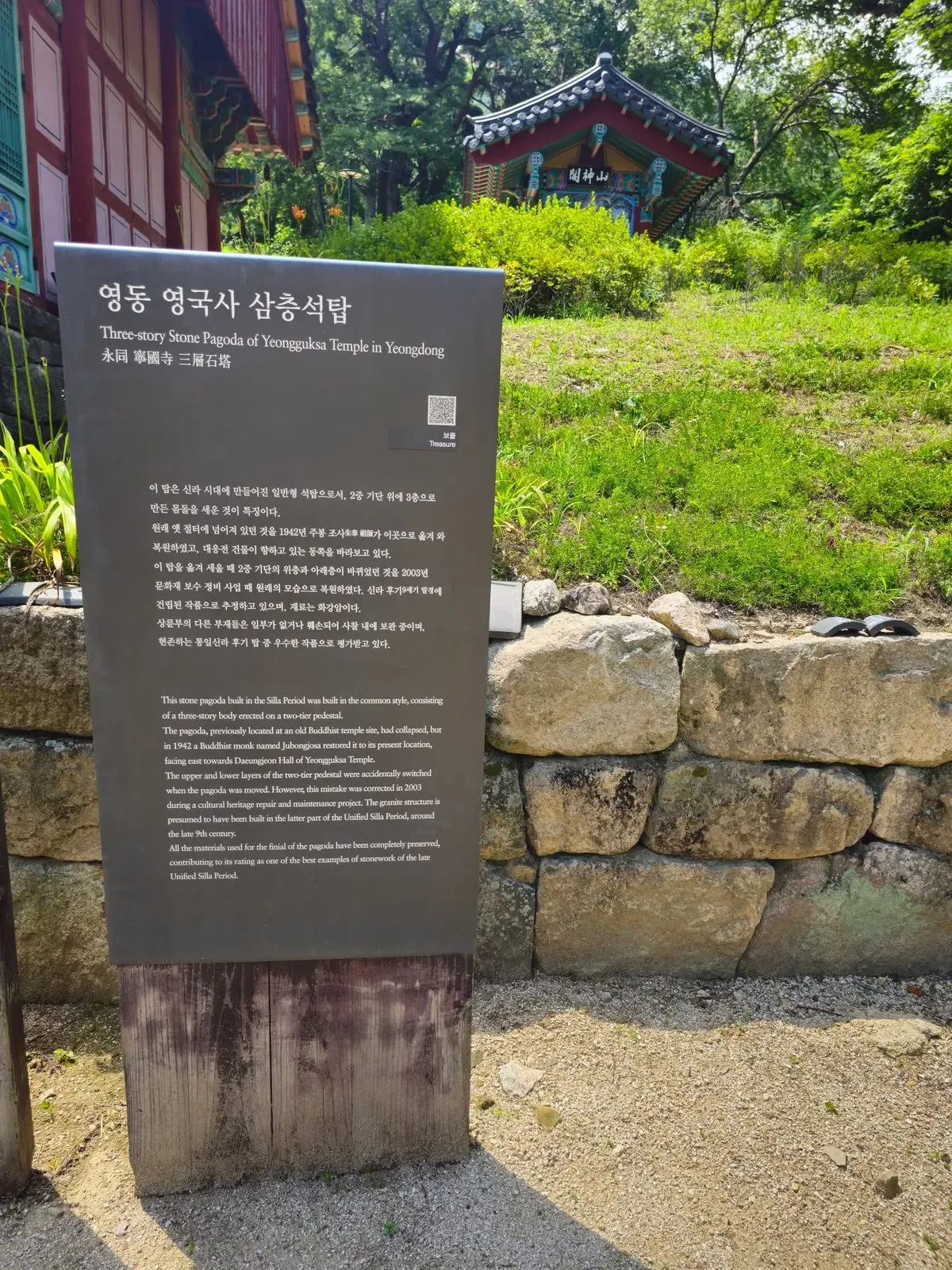 The pagoda’s board, with the small Sansingak shrine up the slope behind.
Visiting
| Yeongguksa Temple | |
|---|---|
| Entry | Free (Korea Tourism Organization) |
| Hours | Always open, all year (Korea Tourism Organization) |
| Parking | Cheontaesan car park (Korea Tourism Organization) |
| Address | 225-35 Yeonggukdong-gil, Yangsan-myeon, Yeongdong |
It’s a working temple, so keep your voice down near the halls.
How to get there
By car: the Korea Tourism Organization lists parking at the Cheontaesan car park. From there its walking route to the temple and the ginkgo tree is 1.1 km and takes about 40 minutes. That matches what I said: not a hard hike, just a walk in the mountain air.
By bus: we couldn’t confirm the bus details, so they aren’t listed here. Check the live route in Naver Map by pasting the Korean name, 영동 영국사.
How to check buses in English: install Naver Map and switch it to English in its settings. When I checked it in October 2026, the English version showed bus routes, stop names and live arrival times (minutes and stops away) in English. Google Maps also gives public transport directions in Korea, but as of late September 2026 it still had no turn-by-turn walking or driving navigation here. Stuck? Call the Korea Travel Hotline: dial 02-1330 from a Korean mobile phone (+82-2-1330 from abroad). It has English-speaking staff. More in our guide to taking buses in Korea in English.
Tips
- Don’t skip the tree. It’s in front of the temple, by the path. Take the photo I didn’t.
- Avoid midsummer. I went in July and it was far too hot.
- Read the English boards. Both the main board and the pagoda’s board have English texts.
- Autumn for yellow leaves. Yeongdong County reported the tree at its golden peak around 11 November 2026. I went in summer.
Who it’s for
Likely to suit (estimate): anyone who wants an easy walk in the mountains with an old temple at the end, people who like big old trees, and road-trippers passing through Yeongdong.
Sources
The temple’s main information board and the pagoda’s board (photographed on my visit: the history, the 1879 landslide, the 1934 and 1942 dates, the Treasures, the pagoda’s details), the Encyclopedia of Korean Culture (the ginkgo tree’s designation in 1970, age, height, girth and rooted branch), the Kyunghyang Shinmun and Newspim (the legend of the crying tree), Yeongdong County via Korean news reports of 11 November 2026 (autumn colour), and the Korea Tourism Organization’s listings for the temple and for Cheontaesan (entry, opening, parking, the walking route from the car park, the tree’s size, the address). The impressions and the photos are from my own visit.