Home / Chungcheong / Seojeong-ri Nine-story Stone Pagoda, Cheongyang
Seojeong-ri Nine-story Stone Pagoda: a Goryeo stone pagoda in Cheongyang's rice fields
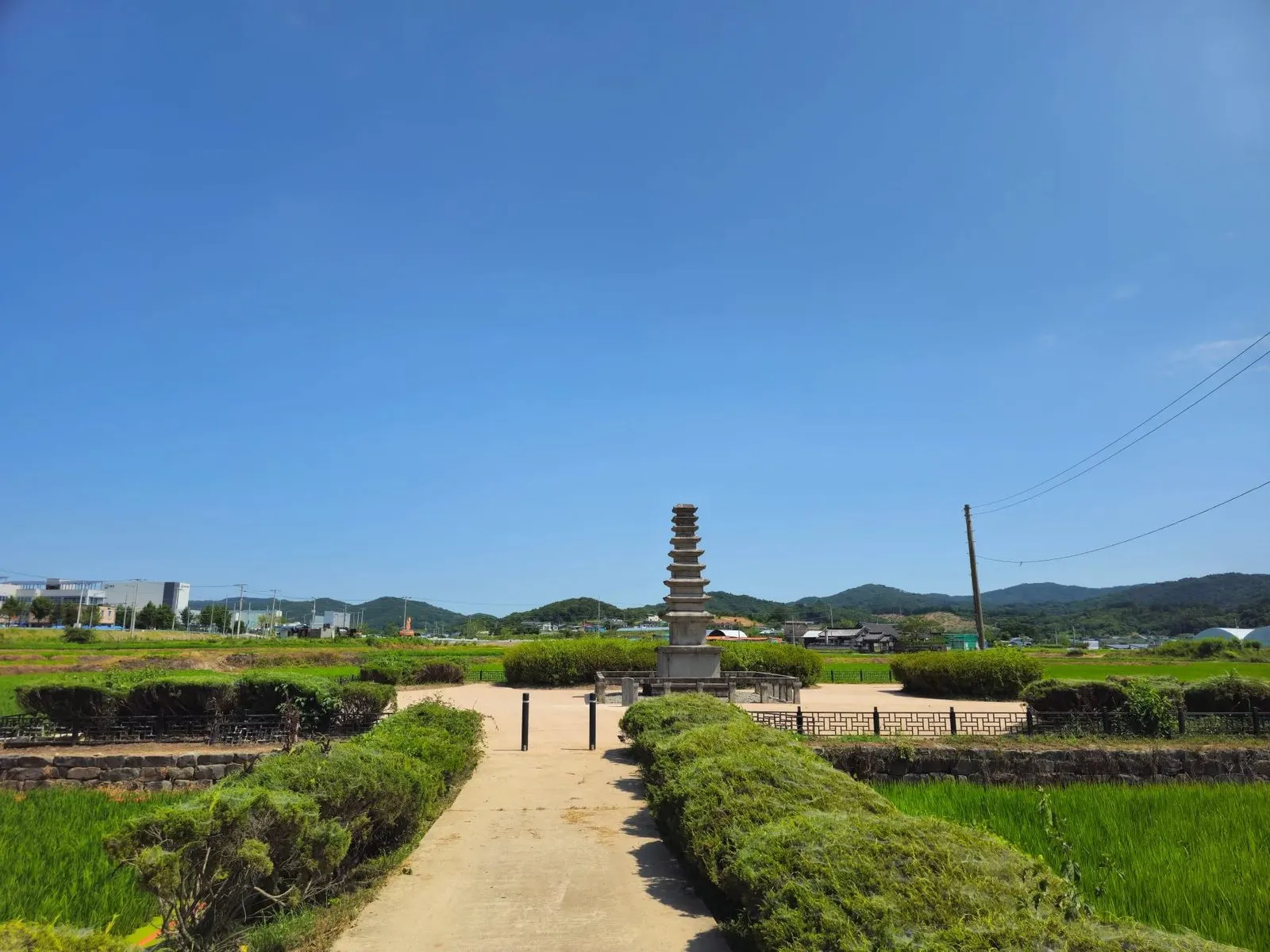
A nine-storey stone pagoda from the early Goryeo period, about 6 m tall, standing alone among rice fields in Jeongsan-myeon, Cheongyang. A Korean Treasure, quiet, with a small car park.
- Getting there
- By car: there's a small car park (my note). By bus: we couldn't confirm the bus details, so check the live route in Naver Map.
- Cost
- We couldn't confirm an entry fee. In my photos there's no gate or ticket booth.
- Time needed
- 20 to 30 minutes (estimate)
- Best time
- A clear day, for the pagoda against the sky (my note).
Tap any Korean name on this page to hear it. Prefer Naver Map? In the app (set to English), search Seojeong-ri Nine-story Stone Pagoda Cheongyang, or paste the Korean name:청양 서정리 구층석탑
Short version: A grey stone pagoda of nine storeys, about 6 m tall, standing on its own among the rice fields of Seojeong-ri in Jeongsan-myeon, Cheongyang. The Korea Heritage Service dates it to the early Goryeo period and lists it as a Treasure. A temple is said to have stood nearby, but little trace of it remains. It’s quiet, open to the sky and has a small car park. It’s too good a place to just pass by (my view).
Last checked: 13 November 2026. The designation, the date and the temple story come from the Korea Heritage Service. The height and the details of the carving come from the county’s information board at the site, which I photographed. The Encyclopedia of Korean Culture gives the same height, carved panels, roof steps and lost finial. We couldn’t confirm the bus details or whether there’s a fee. The impressions, the car park and the photos are from my own visit. Tell me if anything has changed.
What it is
The Korea Heritage Service lists the pagoda as a Treasure (보물), designated on 21 January 1963. It describes it as standing in the middle of open fields about 23 km from Gongju towards Cheongyang. A temple called Baekgoksa is said to have stood nearby in the Goryeo period. The Heritage Service mentions only scattered roof-tile fragments around the site, and the county’s board says no other trace of the temple can be found today.
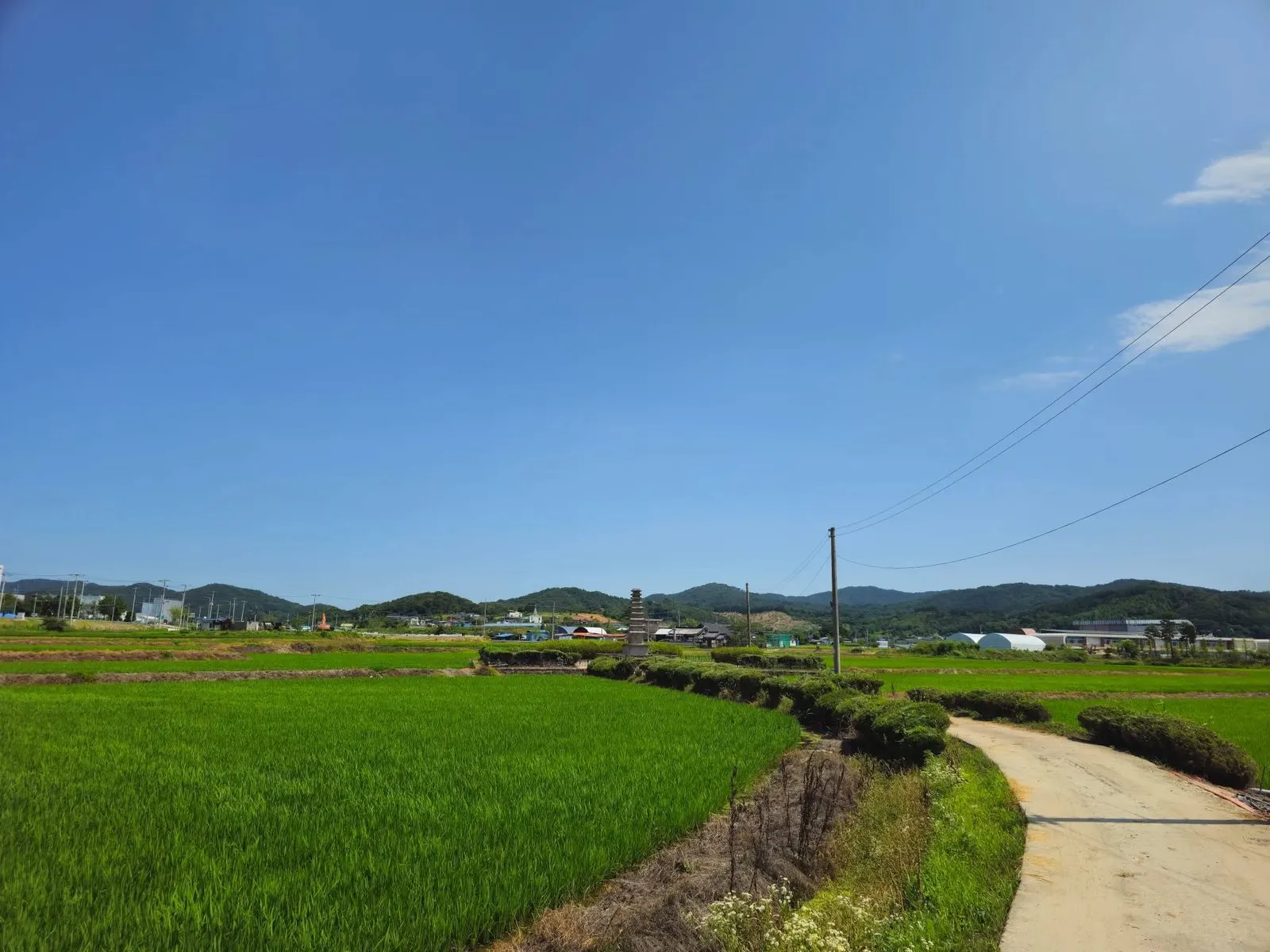 The pagoda in the middle of the rice fields.
The pagoda sits on a two-tier base with nine storeys above it. The Heritage Service says it follows the stone-pagoda style handed down from the Silla period. It also notes that its nine storeys make it very tall, so it lacks a sense of stability. The carving style and the eye-shaped panels on the base are why it’s dated to the early Goryeo period. The Goryeo dynasty began in 918.
What to look at
The county’s board at the site has a full English text alongside the Korean. Read it there. Here’s what to look for:
- The base. Each face of the lower base has two eye-shaped carved panels (ansang).
- The roofs. Each storey is made of two separate stones, a body stone and a roof stone. The undersides of the roofs are stepped, five steps under the first roof and three under the others. The board says there are holes at the tips of the roofs for hanging wind bells.
- The top. The decorative finial that once topped the pagoda has been lost.
The board gives the height as about 6 m.
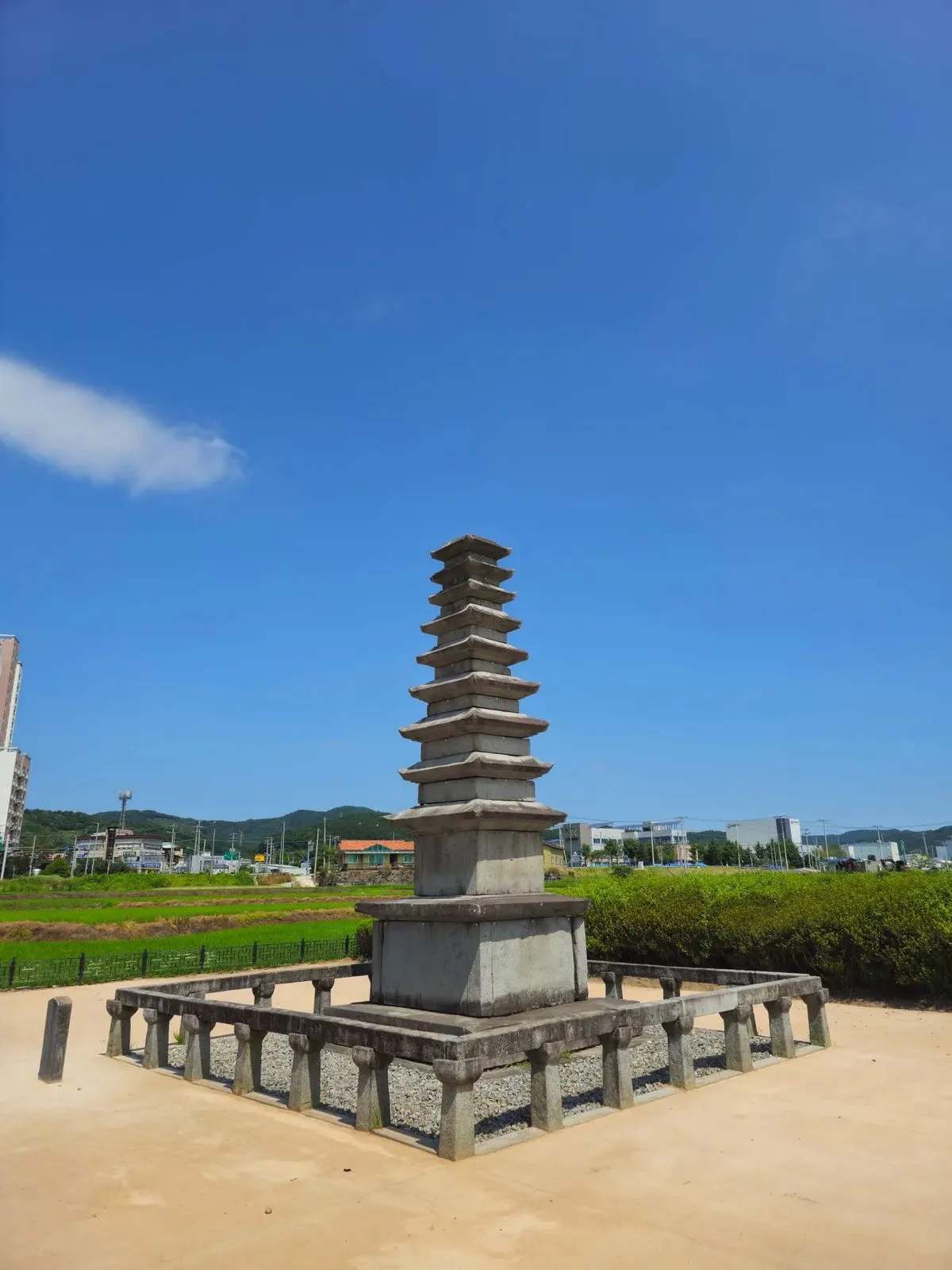 From the corner, showing the two-tier base and the stepped roofs.
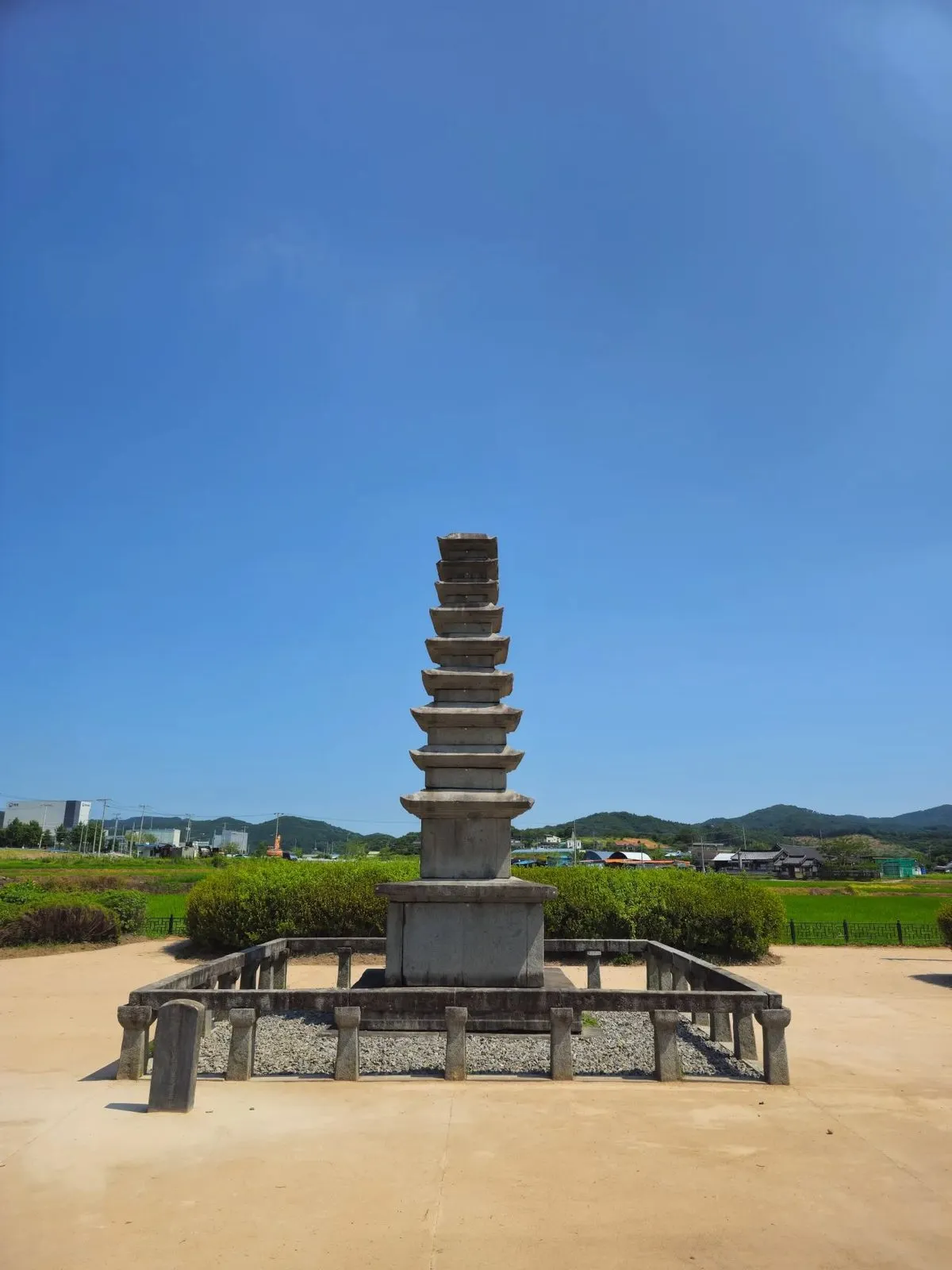 Straight on.
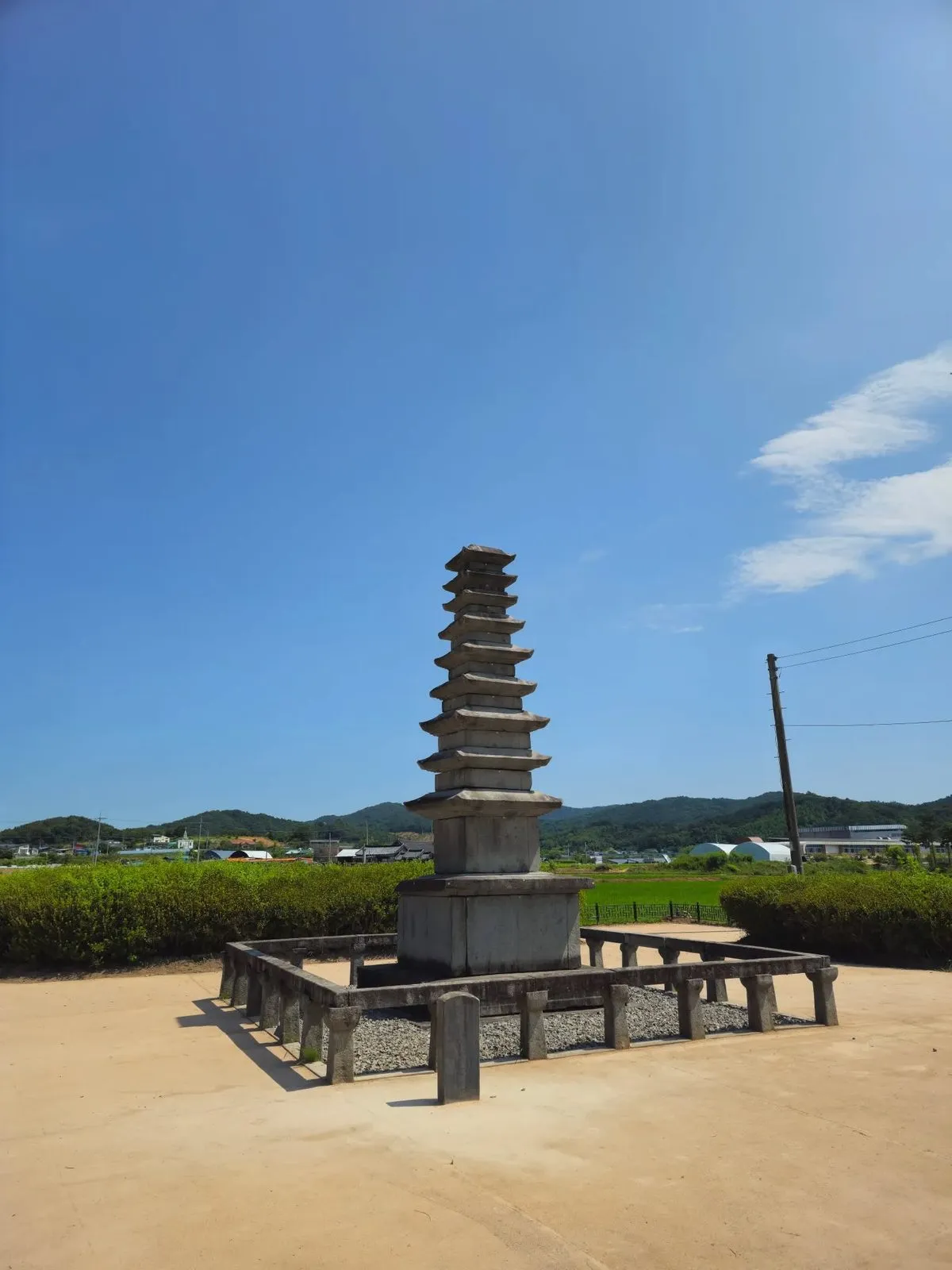 From the side.
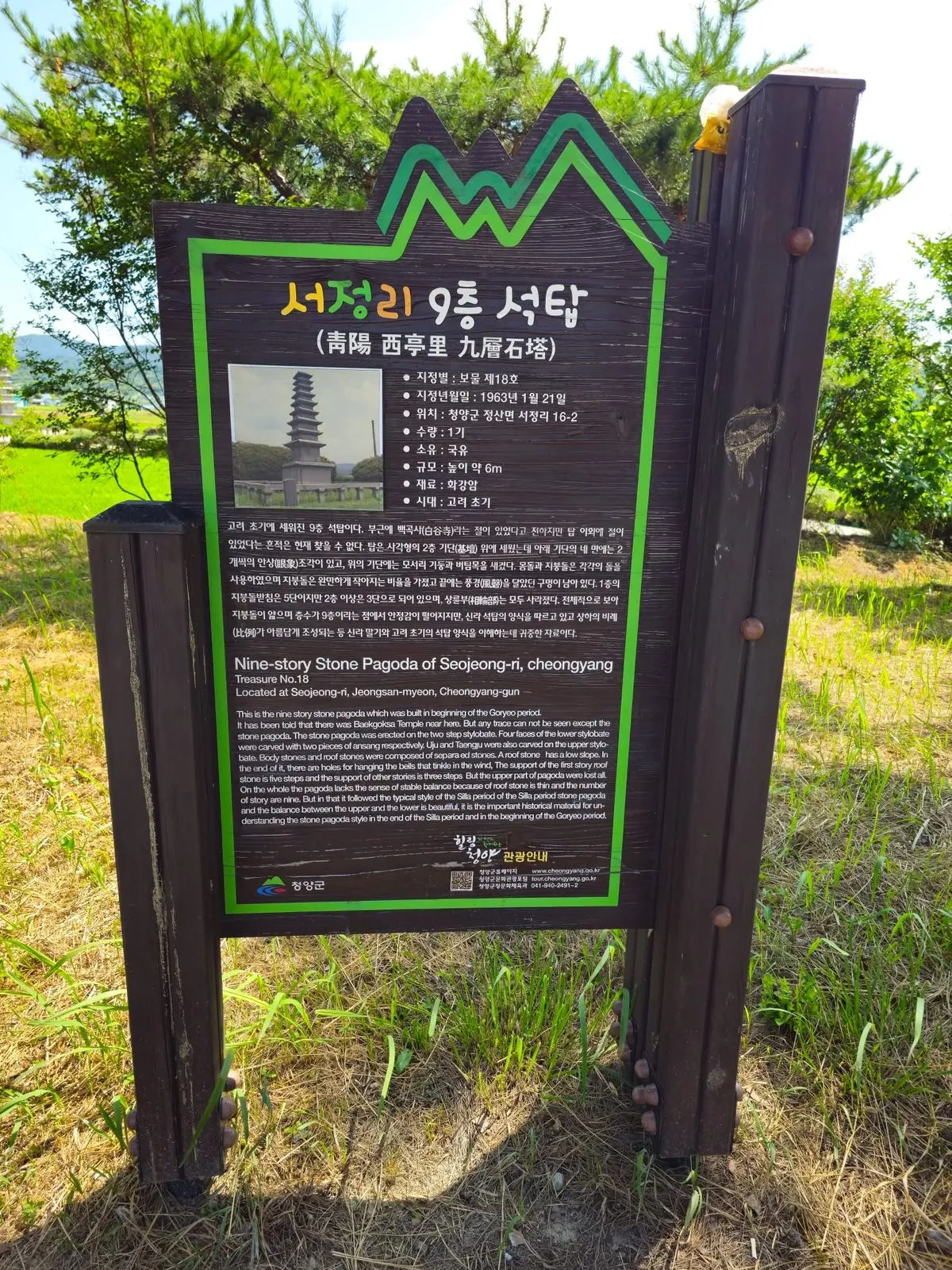 The county’s board, with an English text.
Around the pagoda
The pagoda stands on a sandy forecourt with a low stone railing, reached by a short concrete path between hedges. Across the paddies, a bench under pine trees looks back at the pagoda.
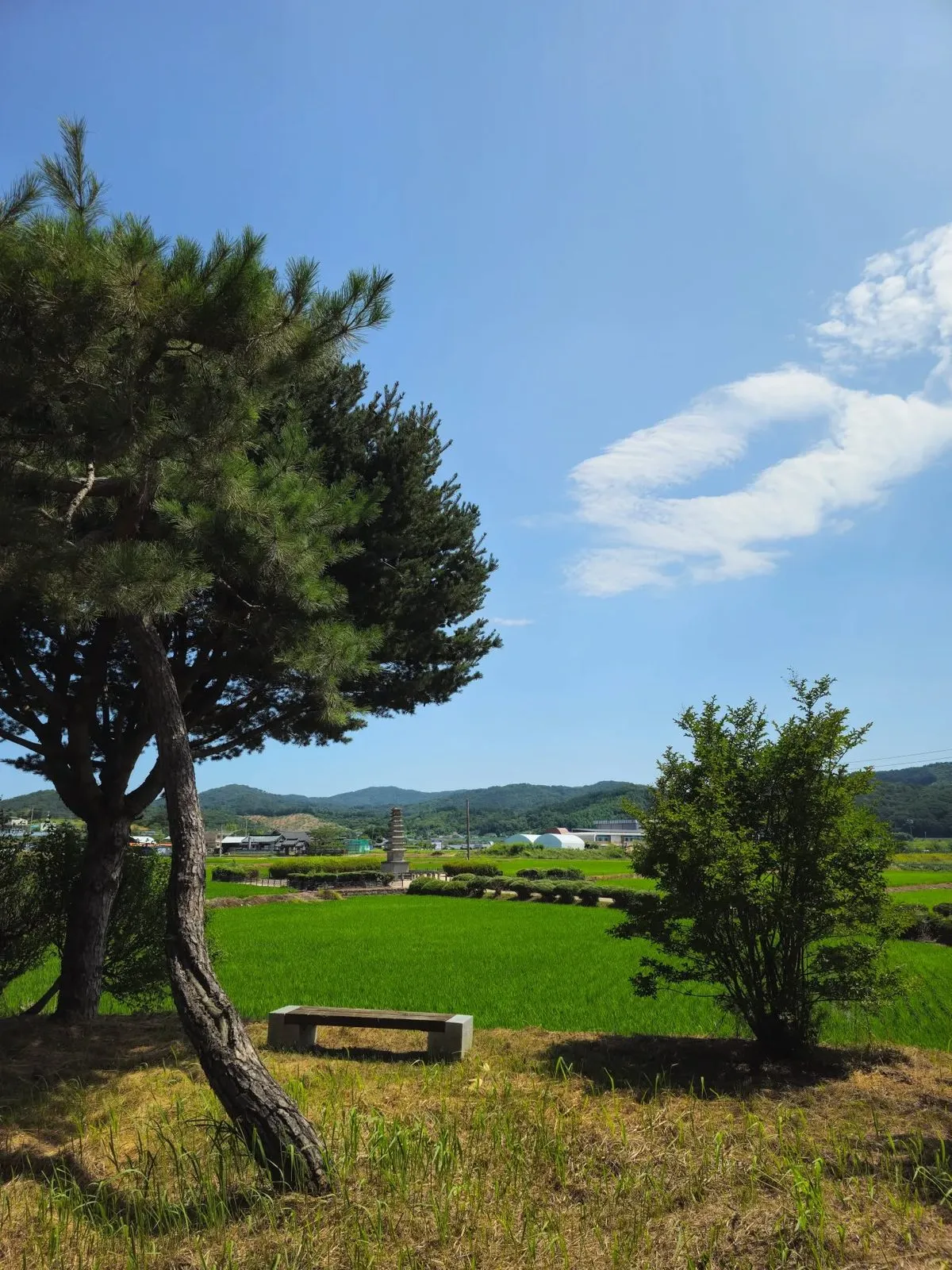 The bench under the pines, looking across to the pagoda.
Visiting
| Seojeong-ri Nine-story Stone Pagoda | |
|---|---|
| Entry | We couldn’t confirm a fee or opening hours. It’s an outdoor site, and in my photos there’s no gate or ticket booth |
| Parking | A small car park (my note) |
| Address | 16-2 Seojeong-ri, Jeongsan-myeon, Cheongyang (lot address) |
How to get there
By car: there’s a small car park.
By bus: we couldn’t confirm the bus details, so I haven’t listed them. Check the live route in Naver Map by pasting the Korean name, 청양 서정리 구층석탑.
How to check buses in English: install Naver Map and switch it to English in its settings. When I checked it in October 2026, the English version showed bus routes, stop names and live arrival times (minutes and stops away) in English. Google Maps also gives public transport directions in Korea, but as of late September 2026 it still had no turn-by-turn walking or driving navigation here. Stuck? Call the Korea Travel Hotline: dial 02-1330 from a Korean mobile phone (+82-2-1330 from abroad). It has English-speaking staff. More in our guide to taking buses in Korea in English.
Tips
- Go on a clear day. The site is wide open, so the pagoda stands out against the sky (my note).
- Read the English board. The county’s board at the site has the history in English.
Who it’s for
Likely to suit (estimate): people interested in Korean Buddhist art and stone pagodas, photographers, and anyone driving through Cheongyang who wants a quiet short stop.
Sources
The Korea Heritage Service’s digital heritage service (designation, date, location in the fields, the Baekgoksa story, the two-tier base and nine storeys, the Silla style, the early Goryeo date), the Encyclopedia of Korean Culture (height, the carved panels, the roof steps, the lost finial), and Cheongyang County’s information board at the site (photographed on my visit: height, carving details, wind-bell holes, lot address). The impressions, the car park and the photos are from my own visit.