Home / Jeolla / Pihyangjeong Pavilion, Jeongeup
Pihyangjeong, Jeongeup: a Joseon-era Korean pavilion by a lotus pond
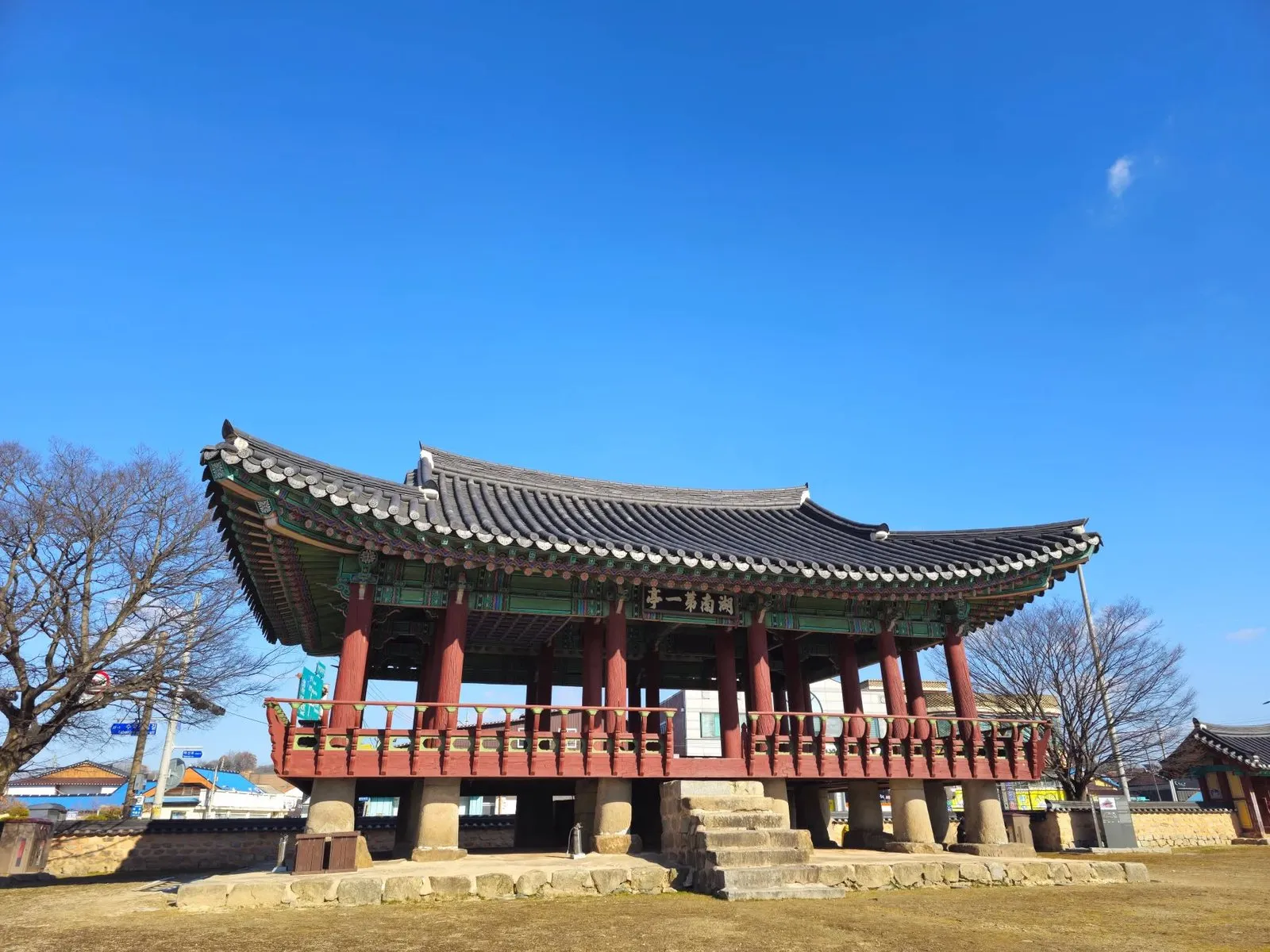
Pihyangjeong in Taein, Jeongeup, Jeonbuk State: a big open-sided Joseon pavilion raised on round stone pillars, signed 'Honam's First Pavilion', beside a lotus pond. Free, always open, with parking. My visit in February.
- Getting there
- By car: there's a free car park (my visit). By bus: check the live route in Naver Map.
- Cost
- Free (Korea Tourism Organization).
- Time needed
- About 20–30 minutes (estimate).
- Best time
- We couldn't confirm when the lotus blooms here. I went on a clear day in late February, when the pond was dry.
Tap any Korean name on this page to hear it. Prefer Naver Map? In the app (set to English), search Pihyangjeong Jeongeup, or paste the Korean name:정읍 피향정
Short version: Pihyangjeong (피향정) is a Joseon-era pavilion in Taein-myeon, Jeongeup, Jeonbuk State. It’s big, open on all four sides and raised on stone-based columns, with a board under the eaves reading “Honam’s First Pavilion”. I went on a clear Monday at the end of February 2025. It’s really impressive, though the lotus pond beside it was dry. Entry is free and there’s a free car park.
Last checked: 17 November 2026. The history, the name, the ponds and the building’s size come from the official heritage sign at the site, which I photographed, and from the Encyclopedia of Korean Culture. Entry, opening, parking and the address come from the Korea Tourism Organization. The impressions and the photos are from my own visit. Tell me if anything has changed.
What it is
The official sign at the site says Pihyangjeong is widely regarded as one of the most beautiful historic garden pavilions left in the Honam region (the southwest of Korea). The sign lists it as a designated Treasure (보물).
There used to be two lotus ponds, one in front and one behind. The front one, Sangyeonji, was filled in during the Japanese colonial period (1910–1945). Only the other, Hayeonji, is left. The name means “pavilion with spreading fragrance”, for the scent of the lotus that filled the area when they bloomed.
The sign also says the pavilion is said to be connected with Choe Chi-won, a famous scholar-official of Unified Silla who briefly served as head of the area. The Encyclopedia of Korean Culture says it was rebuilt under King Gwanghaegun (early 1600s) and enlarged under King Hyeonjong. The pavilion you see today was rebuilt in 1716 by Yu Geun, the local magistrate, according to the sign.
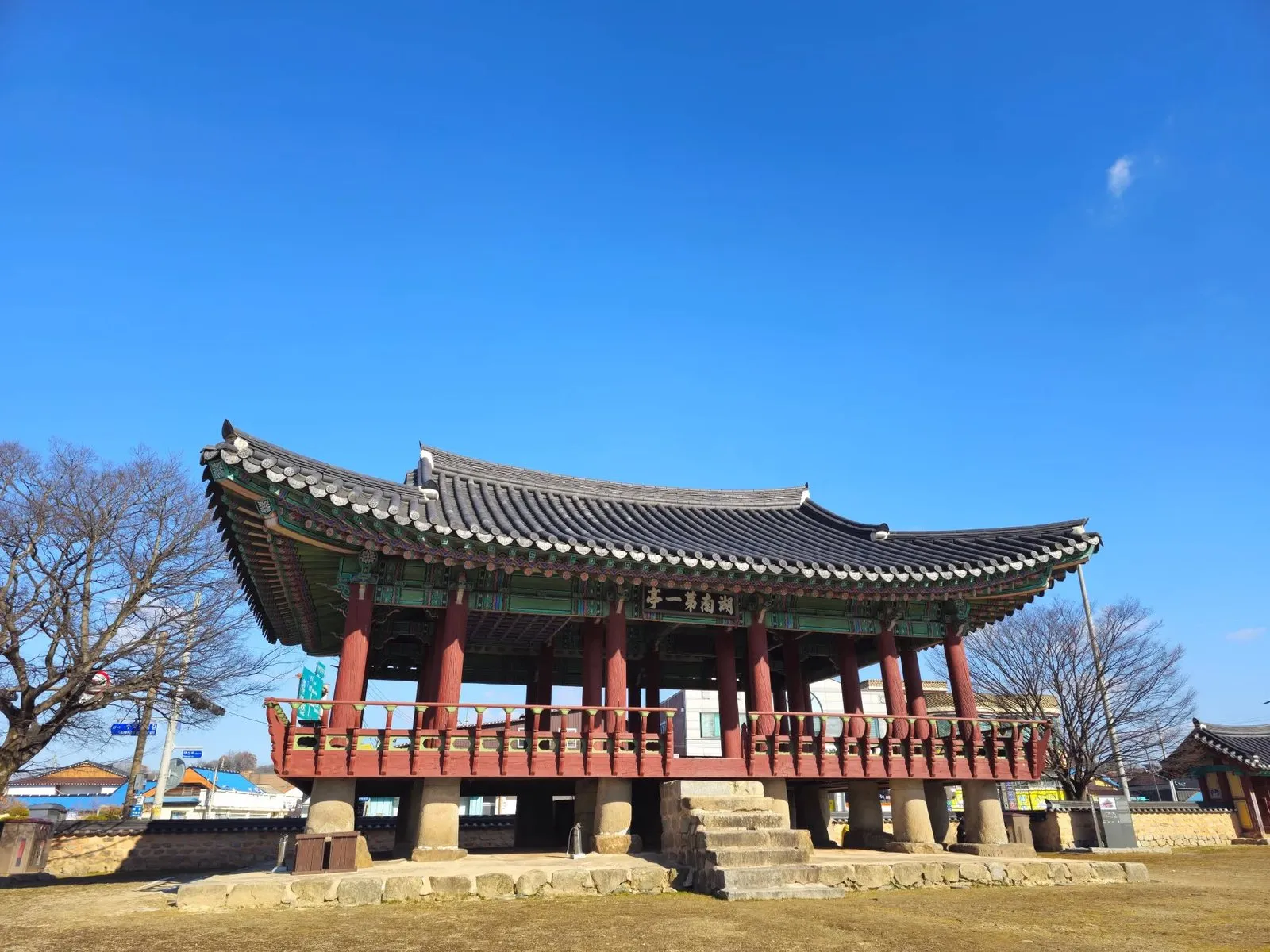 The pavilion, with the “Honam’s First Pavilion” board under the eaves.
The building
The sign gives it as five bays by four, with a hip-and-gable roof and double eaves. The raised floor rests on 28 round stone supports, with round columns standing on them. That count follows the sign’s Korean text and the Encyclopedia of Korean Culture; the sign’s English text says 28 round wooden columns on stone foundations instead. Inside, part of the ceiling is left open with the rafters showing and part is coffered.
The building is simple but feels high-class. It’s open on all four sides, so the view is great. Inside there are boards hung up with poems that poets left.
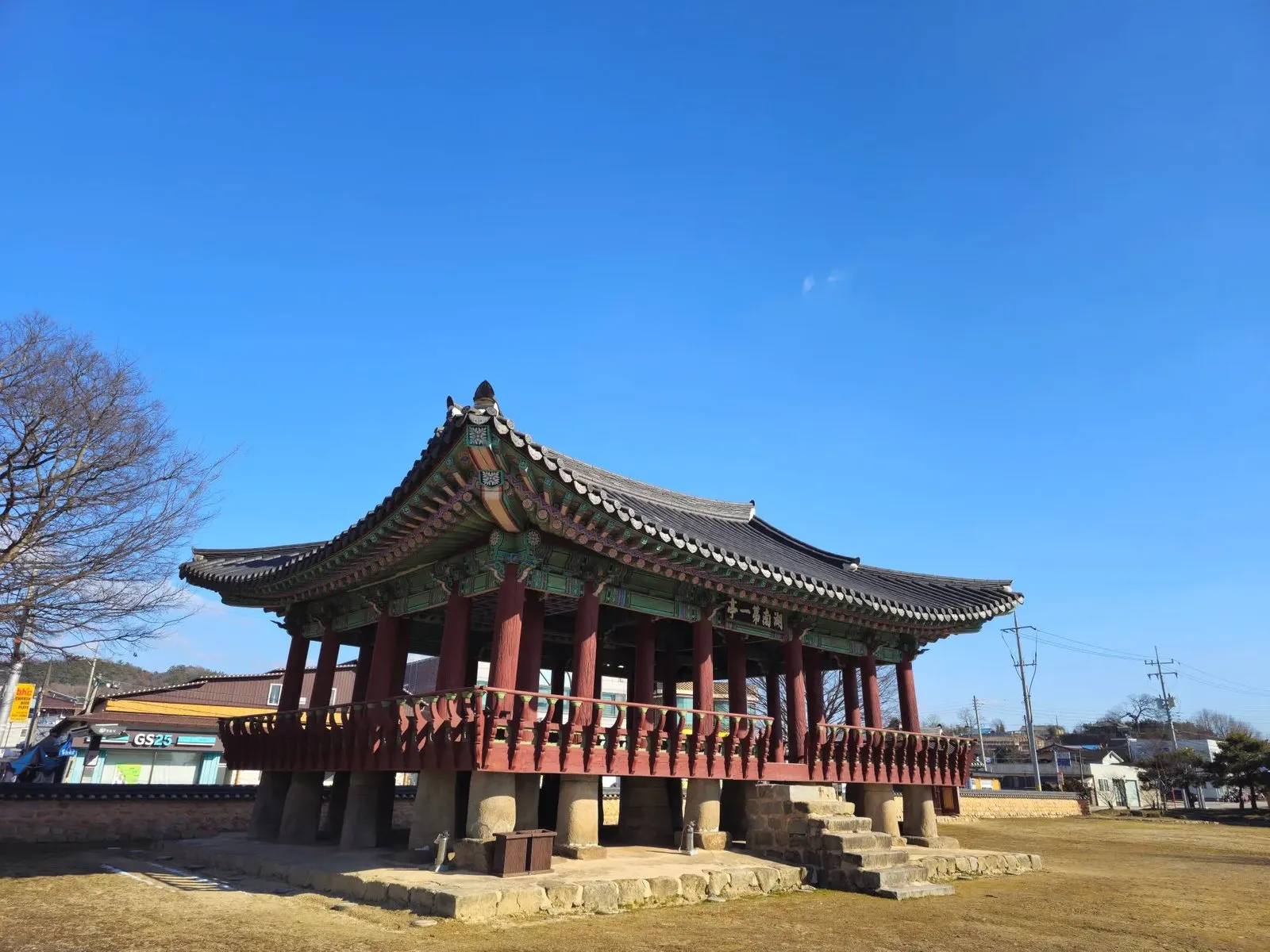 From the corner. It sits right in town.
The pond
Now there’s only one pond left, so some of the old atmosphere has gone, but it still has charm. When I went in February, the pond was all dried up. Maybe it’s different in summer. We couldn’t confirm when the lotus blooms here.
It has the nickname “the best pavilion in Honam”, and it turns out that’s not for nothing.
Visiting
| Pihyangjeong | |
|---|---|
| Entry | Free (Korea Tourism Organization) |
| Hours | Always open, all year (Korea Tourism Organization) |
| Parking | Available (Korea Tourism Organization). Free when I went (my visit) |
| Address | 2951 Taesan-ro, Taein-myeon, Jeongeup |
How to get there
By car: I drove. There’s a free car park (my visit).
By bus: we haven’t listed bus details here. Check the live route in Naver Map by pasting the Korean name, 정읍 피향정.
How to check buses in English: install Naver Map and switch it to English in its settings. When I checked it in October 2026, the English version showed bus routes, stop names and live arrival times (minutes and stops away) in English. Google Maps also gives public transport directions in Korea, but as of late September 2026 it still had no turn-by-turn walking or driving navigation here. Stuck? Call the Korea Travel Hotline: dial 02-1330 from a Korean mobile phone (+82-2-1330 from abroad). It has English-speaking staff. More in our guide to taking buses in Korea in English.
Tips
- Pair it with Taein Hyanggyo. The old Confucian school in the same township is another stop I made on the same day: see Taein Hyanggyo.
- The pond. When I went in late February, it was dry. We couldn’t confirm when the lotus blooms.
- Look up. The board under the eaves reads 湖南第一亭, “Honam’s First Pavilion”.
Who it’s for
Likely to suit (estimate): anyone driving through Jeongeup, people who like traditional Korean architecture, and photographers after a big pavilion against a blue sky.
Sources
The official heritage sign at the site, in Korean and English, which I photographed on my visit (the Treasure designation, the Honam description, the two ponds and which one was filled in, the name, the Choe Chi-won connection, 1716 and Yu Geun, the size, roof, stone supports and ceiling); the Encyclopedia of Korean Culture (the rebuilding under Gwanghaegun, the enlargement under Hyeonjong and the 28 stone supports); and the Korea Tourism Organization’s Korean listing (free entry, always open, parking, the address). The impressions and the photos are from my own visit.