Home / Chungcheong / Chusa Kim Jeong-hui Historic Site, Yesan
Kim Jeong-hui Historic Site, Yesan: calligrapher Chusa's birthplace
The birthplace of Chusa Kim Jeong-hui, the Joseon scholar-artist known for his calligraphy: an 18th-century house, his tomb, a royal red gate and walking paths. Free entry and parking.
- Getting there
- By car: free car park. By bus: we couldn't confirm the bus details, so check the live route in Naver Map.
- Cost
- Free. Parking is free too.
- Time needed
- 1 to 2 hours (estimate)
- Best time
- Hot summer days are hard going: it was hard to breathe when I went. Closed on Mondays.
Tap any Korean name on this page to hear it. Prefer Naver Map? In the app (set to English), search Chusa Kim Jeong-hui House Yesan, or paste the Korean name:추사고택
Short version: In Sinam-myeon, Yesan, South Chungcheong, the house where Kim Jeong-hui was born still stands, with his tomb, a royal red gate, a lacebark pine he is said to have brought from China, and quiet paths around them. Kim, better known by his pen name Chusa, was a Joseon-era scholar and artist best known for his own style of calligraphy. Entry and parking are free, and it closes on Mondays. If you want a quiet walk with history and nature together, few places suit it as well as this (my view).
Last checked: 12 November 2026. Hours, closing days, fees and parking come from Yesan County, the Korea Tourism Organization and local news reports. We couldn’t confirm the bus details. The history comes from the information board at the site, which I photographed, and the Encyclopedia of Korean Culture. The new memorial hall is from Yesan County’s site and news reports. The house address and hours are also checked against the Korea Tourism Organization. The heat, the calm and the photos are from my own visit. Tell me if anything has changed.
Who was Chusa?
The board at the entrance gives the outline. Kim Jeong-hui, also known by his pen name Chusa, was a scholar and artist of the Joseon Dynasty, known for his poetry, calligraphy and painting. In 1809, aged 24, he went with his father, who was travelling to Qing China as an envoy, and met leading Chinese scholars there, staying in touch with them for the rest of his life.
According to the board, he was later exiled to Jeju Island for about nine years after he was caught up in political strife, and it was there that he developed Chusache, his own style of calligraphy. The board says it became popular in Korea and beyond, in Qing China and Japan, and that King Heonjong admired his calligraphy so much that he asked for it even during the exile.
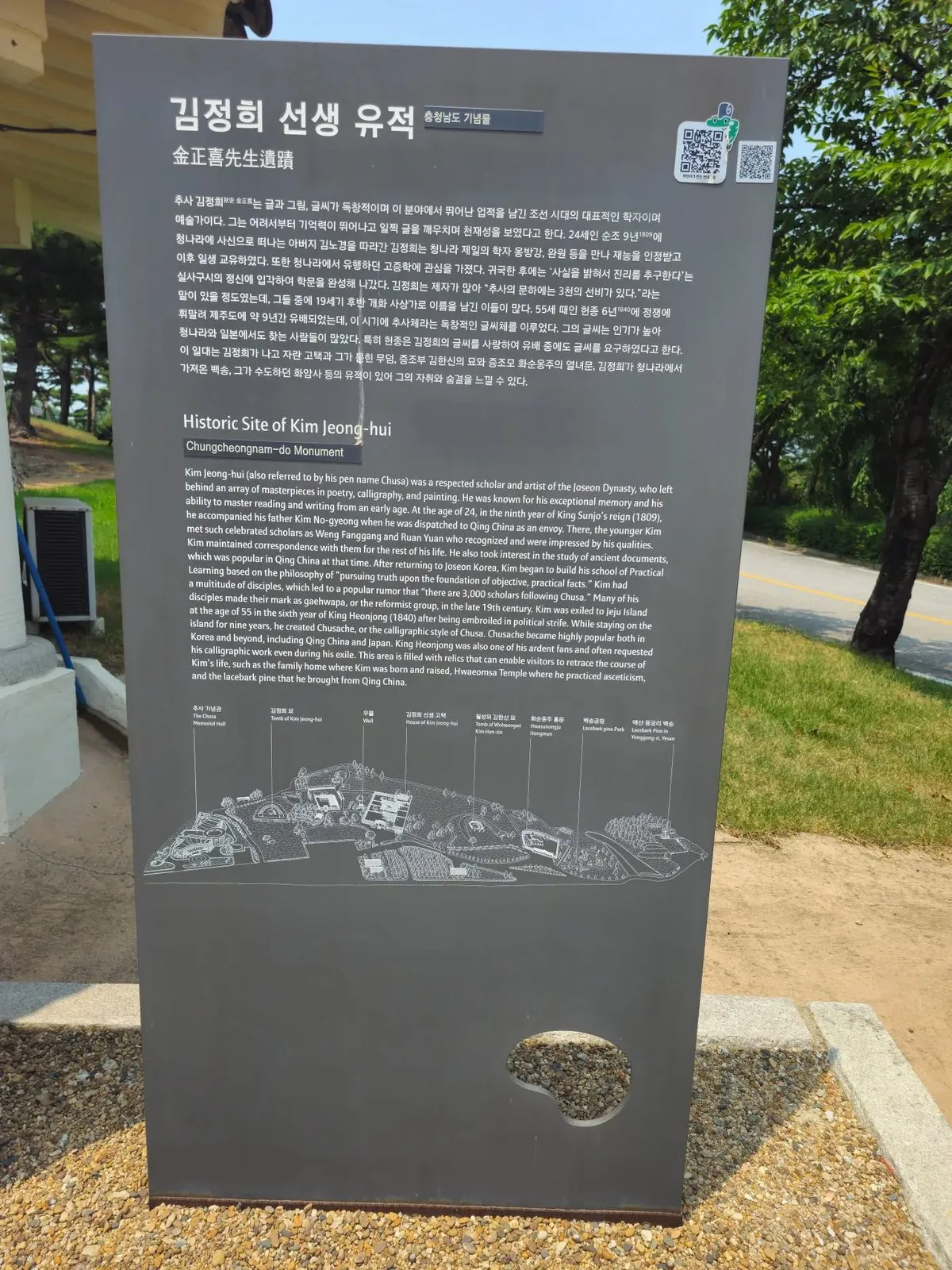 The site board, in Korean and English, with a map of the site.
What’s here
The site is a Chungcheongnam-do provincial monument. According to the board, the area around it holds the family house where Kim was born and raised, his tomb, the tomb of his great-grandfather Kim Han-sin, the red gate, the lacebark pine and Hwaamsa, the temple where he practised (the board’s English spells it Hwaeomsa). The board’s map also marks the Chusa Memorial Hall, his tomb and a well.
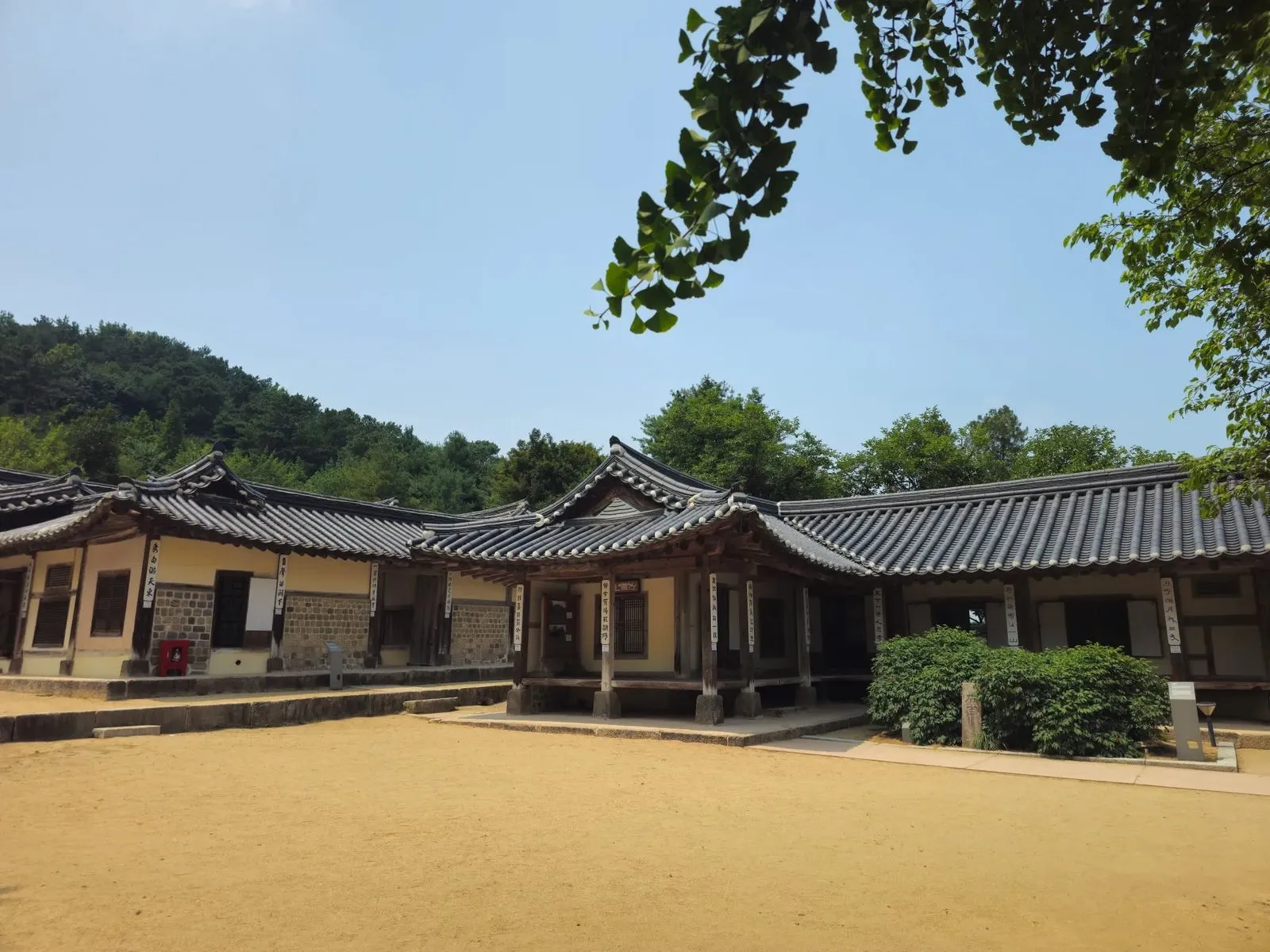
The old house. According to the Encyclopedia of Korean Culture, Kim’s great-grandfather, Kim Han-sin, built the house around 1750. Behind the raised entrance gate there’s an L-shaped men’s wing in front, a square inner wing behind it, and a family shrine on a high terrace at the back.
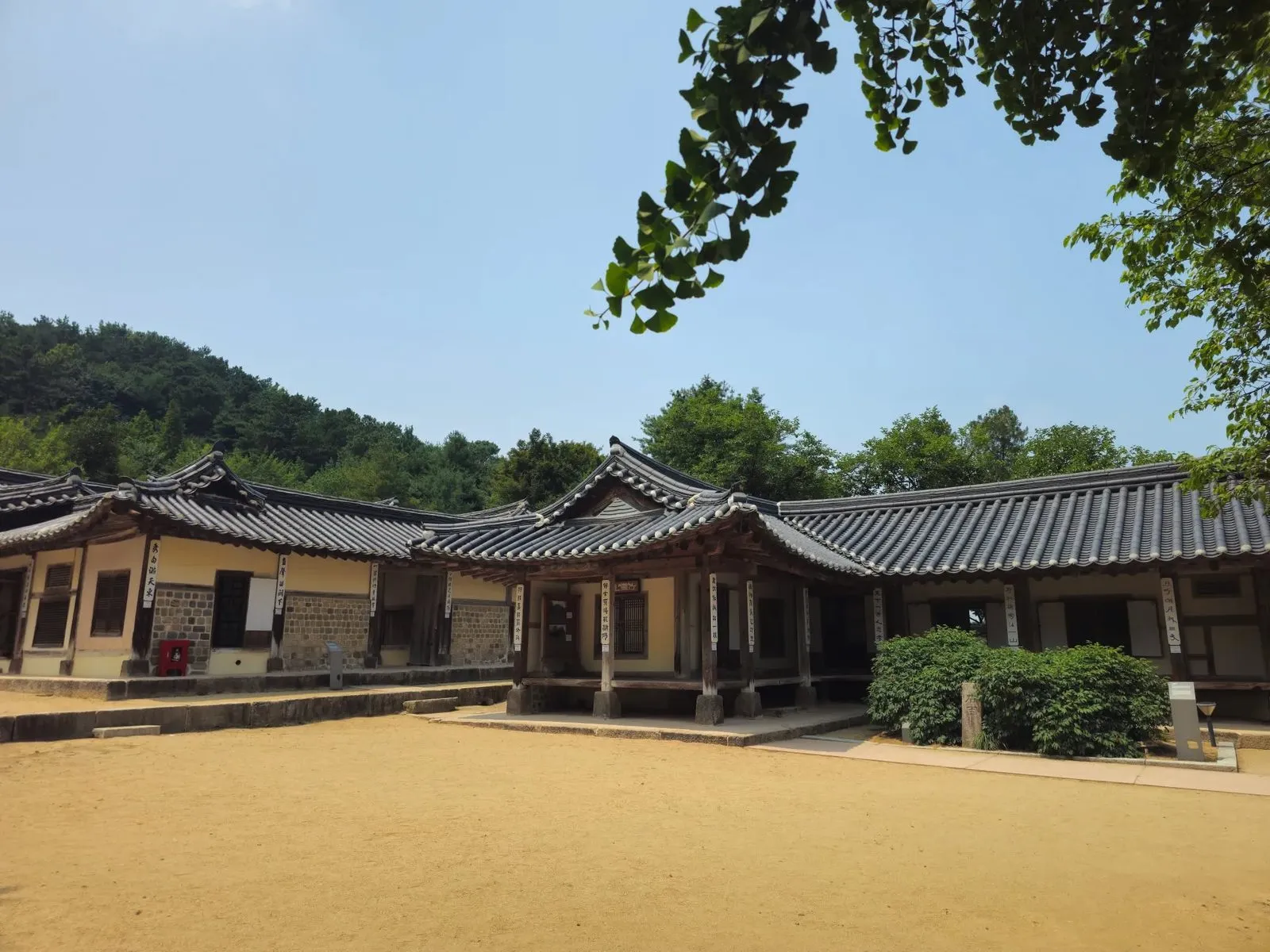 The old house and its sandy courtyard.
The red gate. Kim Han-sin married Princess Hwasun, a daughter of King Yeongjo. The encyclopedia says King Jeongjo granted a red gate honouring her faithfulness to her husband, and the inscription on it is dated to the seventh year of his reign (1783).
The lacebark pine. A lacebark pine (white-barked pine) in the same area is a Natural Monument, designated in 1962. Tradition says Kim brought its seed back from Beijing in 1809 and planted it at his great-great-grandfather’s tomb. I didn’t photograph it.
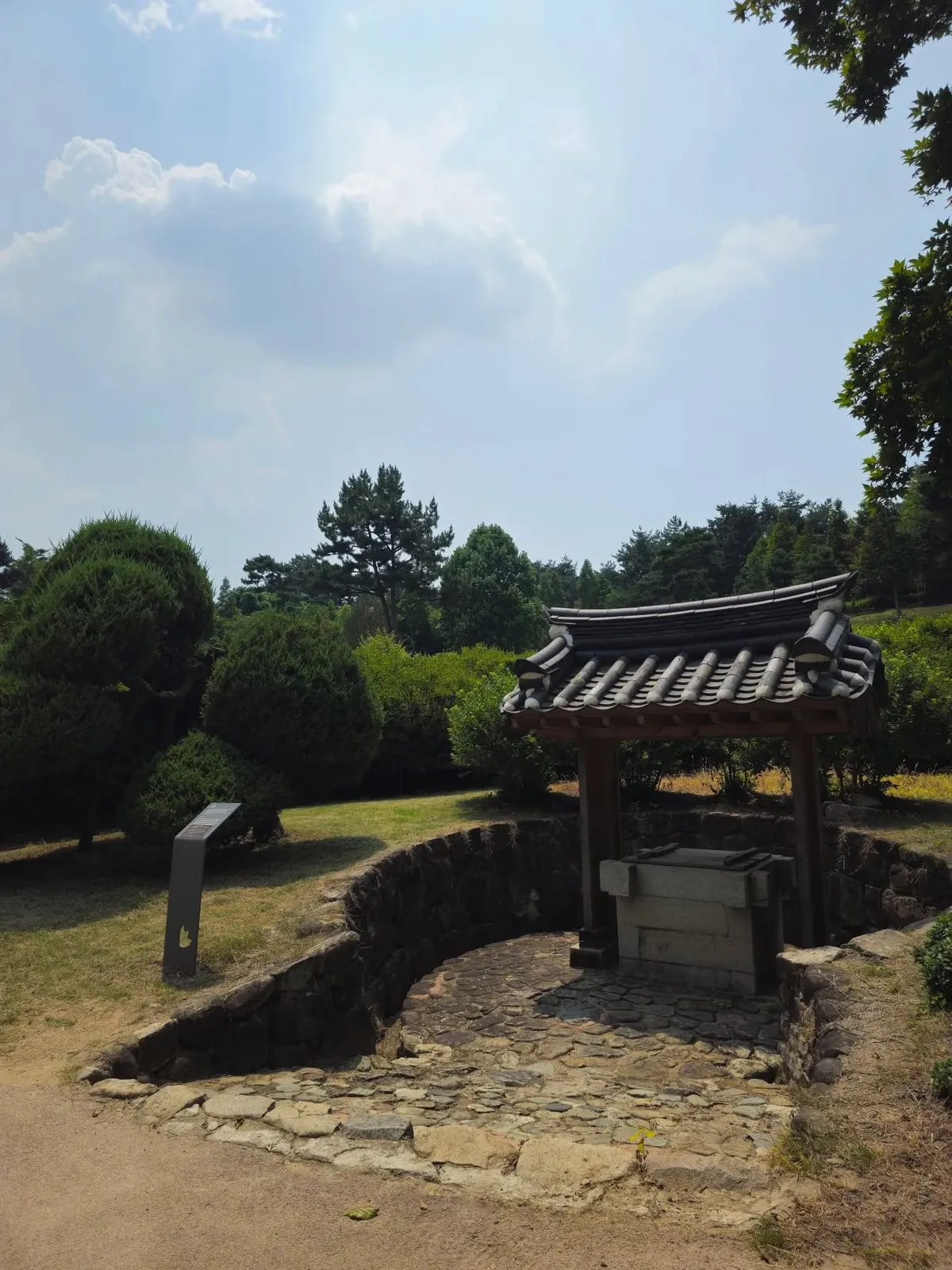 A small roof over a lidded stone box in a sunken hollow, probably the well marked on the board’s map.
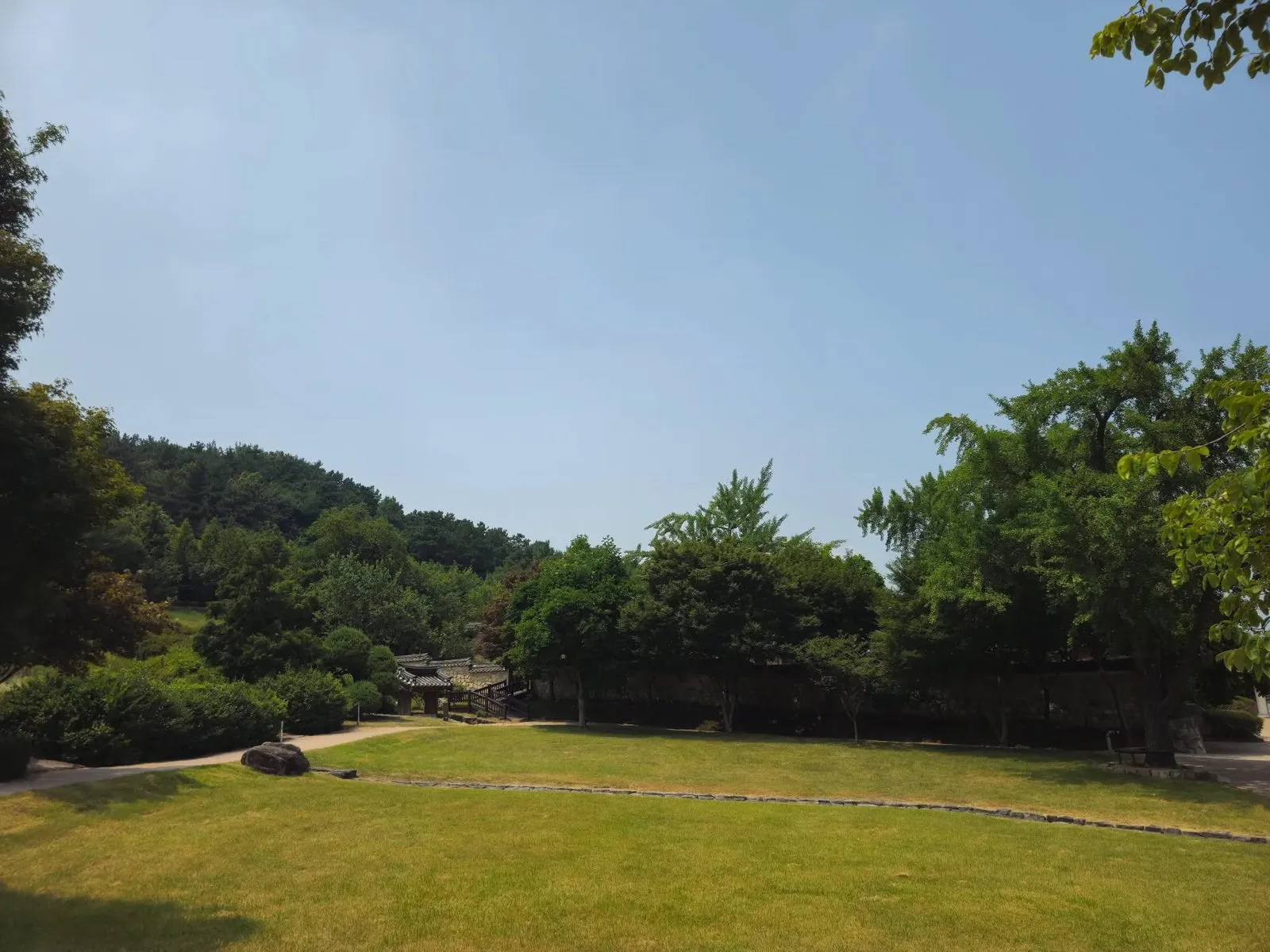 The open lawns around the site.
A new memorial hall. Yesan County opened a new Chusa Memorial Hall near the house on 11 July 2026, after my visit, to mark the 240th anniversary of Kim’s birth. It has a permanent exhibition on his life and work and a media-art room showing the house through the seasons.
Visiting
| Chusa Kim Jeong-hui Historic Site | |
|---|---|
| Admission | Free |
| Parking | Free. It can get busy in the spring high season (my note) |
| Hours | 09:00–18:00 March–October, 09:00–17:00 November–February (Yesan County’s listing for the memorial hall; the Korea Tourism Organization gives the same hours for the house) |
| Closed | Mondays (the next day if Monday is a public holiday), for the memorial hall and the old house, and the main day of Seollal and Chuseok (memorial hall). We couldn’t confirm whether it also closes on 1 January. The Korea Tourism Organization’s listing describes the house as open all year, but Yesan County, local news and my own check say Mondays are closed |
| Address | 261 Chusagotaek-ro, Sinam-myeon, Yesan (the house); the memorial hall is at 295 |
Closing days can change, so check before you go (the Korea Travel Hotline below can help in English).
How to get there
By car: there’s a free car park.
By bus: we couldn’t confirm the bus details, so I haven’t listed them. Check the live route in Naver Map by pasting the Korean name, 추사고택.
How to check buses in English: install Naver Map and switch it to English in its settings. When I checked it in October 2026, the English version showed bus routes, stop names and live arrival times (minutes and stops away) in English. Google Maps also gives public transport directions in Korea, but as of late September 2026 it still had no turn-by-turn walking or driving navigation here. Stuck? Call the Korea Travel Hotline: dial 02-1330 from a Korean mobile phone (+82-2-1330 from abroad). It has English-speaking staff. More in our guide to taking buses in Korea in English.
Tips
- Hot summer days are hard going. I went on such a hot day that I couldn’t take many photos. It was hard to breathe.
- Not on a Monday. That’s the regular closing day, for the house too.
- Spring gets busy. The car park can get busy in the spring high season (my note).
Who it’s for
Likely to suit (estimate): anyone interested in Korean calligraphy or Joseon history, visitors looking for a quiet, free stop in South Chungcheong, and walkers who like old houses and open lawns.
Sources
Yesan County’s official Chusa site (hours, closing days, free admission and parking, and the memorial hall’s address), local news reports from 2025 and 2026 (hours, closing days and free entry), the information board at the site (photographed on my visit: Kim’s life, the 1809 journey, the Jeju exile, Chusache and what the site covers), the Encyclopedia of Korean Culture (Academy of Korean Studies) entries on the house, the red gate and the lacebark pine, the Korea Tourism Organization (house address and hours), and Yonhap, Jaekyung Ilbo and News1 (July 2026) on the new memorial hall. The heat, the calm and the photos are from my own visit.