Home / Gyeongsang / East Three-story Stone Pagoda in Suljeong-ri
Changnyeong, South Korea: a free National Treasure stone pagoda in a quiet park
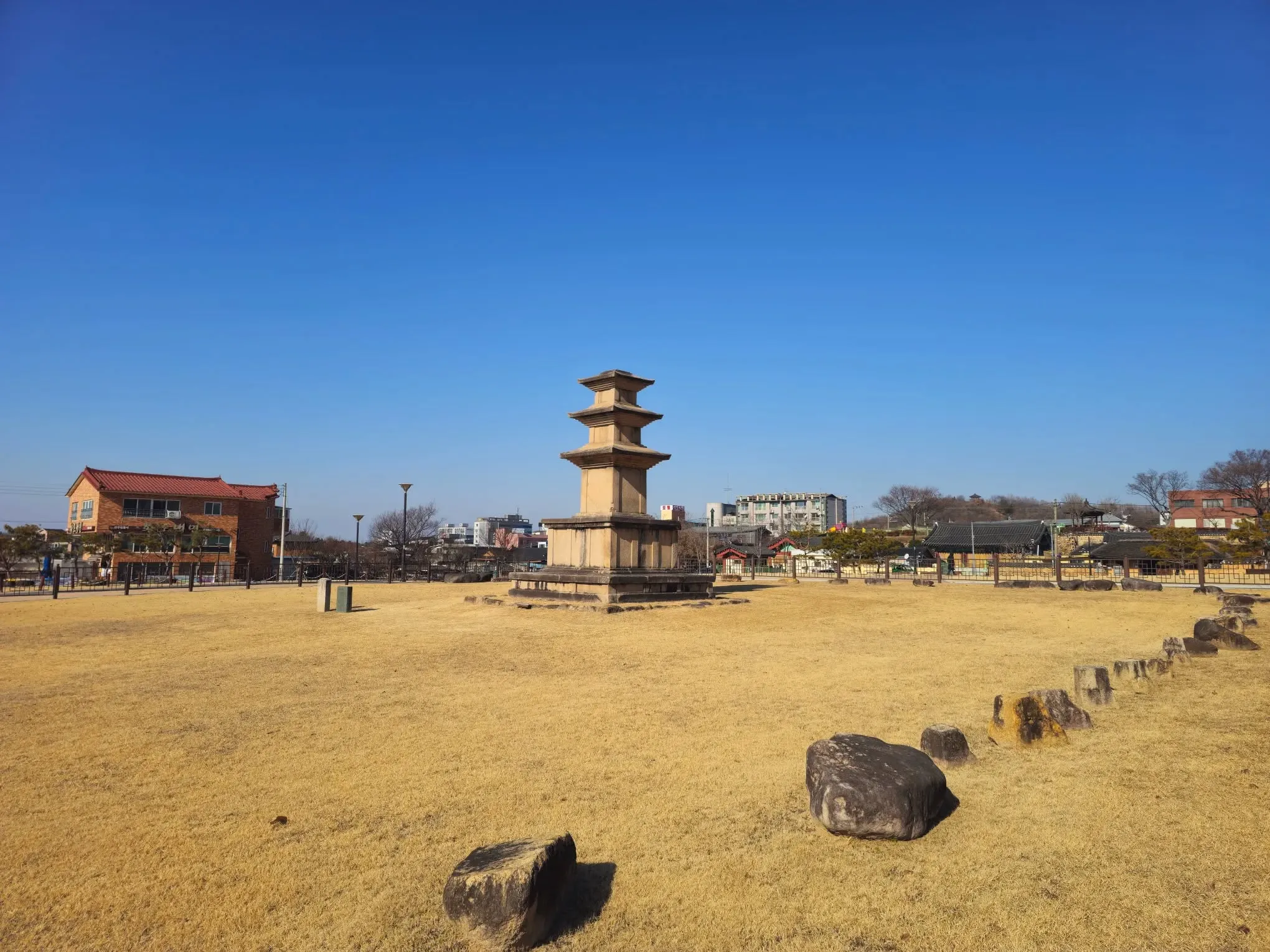
A Unified Silla three-story stone pagoda, a National Treasure, standing on an open lawn in Changnyeong town. Open at all times, free, with a bilingual history board and a quiet park for a walk.
- Getting there
- In Changnyeong town (Changnyeong-eup). I drove; the Korea Tourism Organization says parking is available. I couldn't confirm bus connections.
- Cost
- Free (Korea Tourism Organization).
- Time needed
- 30 minutes to 1 hour (estimate)
- Best time
- Open at all times, every day (Korea Tourism Organization).
Tap any Korean name on this page to hear it. Prefer Naver Map? In the app (set to English), search East Three-story Stone Pagoda Suljeong-ri Changnyeong, or paste the Korean name:창녕 술정리 동 삼층석탑
Short version: In Changnyeong town, South Gyeongsang, a stone pagoda from Korea’s Unified Silla period stands alone on a wide lawn. It’s a National Treasure, it’s free and open all the time, and a bilingual board beside it tells you its story. When I went it was quiet, with few people around, and the park around it is good for a slow walk. If you’re near Changnyeong, go and see it once.
Last checked: 30 October 2026. The history comes from the boards beside the pagoda (photographed January 2026), checked against the Korea Tourism Organization (KTO), the Academy of Korean Studies heritage wiki and the Encyclopedia of Korean Culture. Opening hours, admission and parking come from the KTO listing (updated September 2026). What it was like is from my own visit. Tell me if anything has changed.
What it is
The pagoda is a National Treasure, designated in 1962 (Encyclopedia of Korean Culture and Academy of Korean Studies heritage wiki; the board confirms its National Treasure status). The board beside it says it was presumably built in the Unified Silla period (668–935) and has a two-tier base with three sets of body and roof stones; its decorative top is missing. The KTO listing calls that form typical of Unified Silla pagodas.
The Korean text of the board calls it a typical pagoda of Unified Silla’s heyday. According to the board, its carving and proportions are good enough to compare with the pagodas of Gyeongju, the Silla capital, so it’s thought that artisans were sent from the capital to build it. The board says that’s what makes it valuable: it shows pagoda-building spreading out from Gyeongju to the regions around the 8th century. The KTO listing calls it comparable to the three-story pagoda (Seokgatap) at Bulguksa temple in Gyeongju, and estimates it was made around the same time.
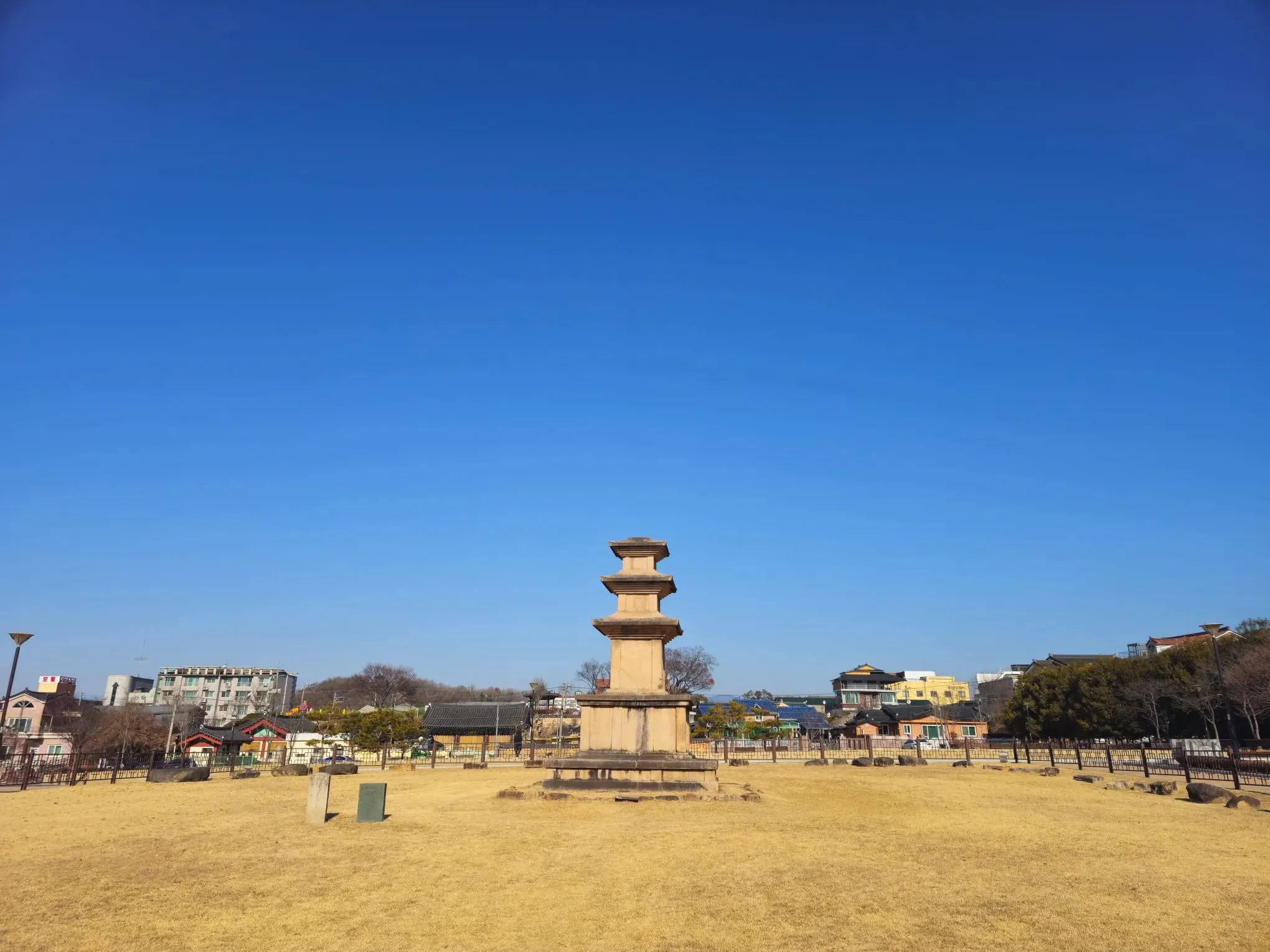 The pagoda from the front.
What was found inside
When the pagoda was taken apart and put back together in 1965, a reliquary set was found inside: a cup-shaped metal reliquary (the board says copper, the KTO listing bronze), a yellow glass relic bottle, seven relic (sarira) pieces, incense fragments and small glass beads (the board; the KTO listing also mentions the 1965 restoration).
Nobody had a clear record of which temple stood here. The board says excavations by the Gaya National Research Institute of Cultural Heritage, from October 2008 to July 2009, found a roof tile inscribed with the name Songnimsa, suggesting the pagoda stood in the grounds of that temple.
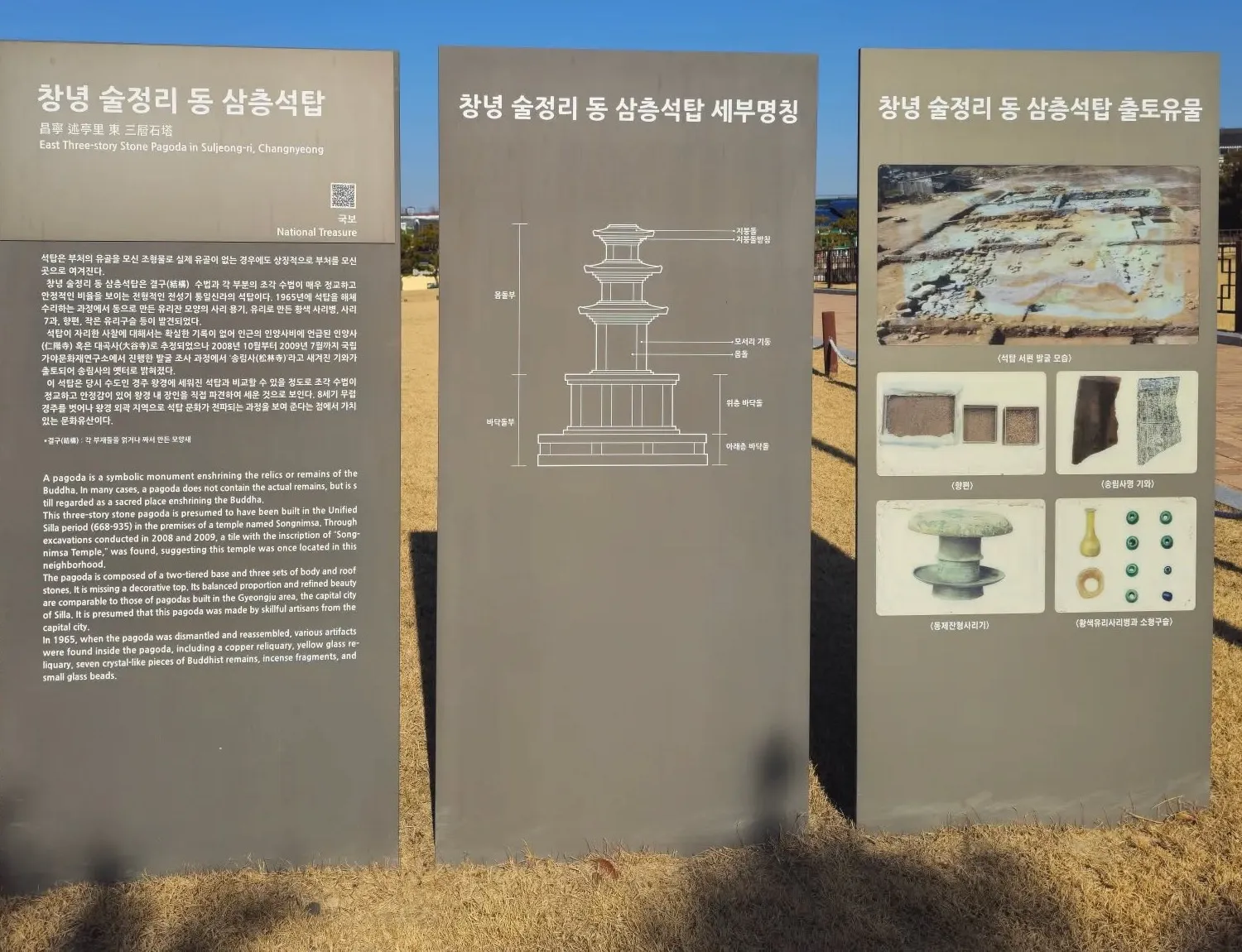 The boards beside the pagoda: its history in Korean and English, the names of its parts, and photos of the excavation and the objects found inside.
The park around it
The pagoda stands on its own on a fenced lawn, with a path, street lamps and a curve of low stones around it, and the rooftops of Changnyeong town all around. The park is well laid out and good for taking a slow look around on a walk.
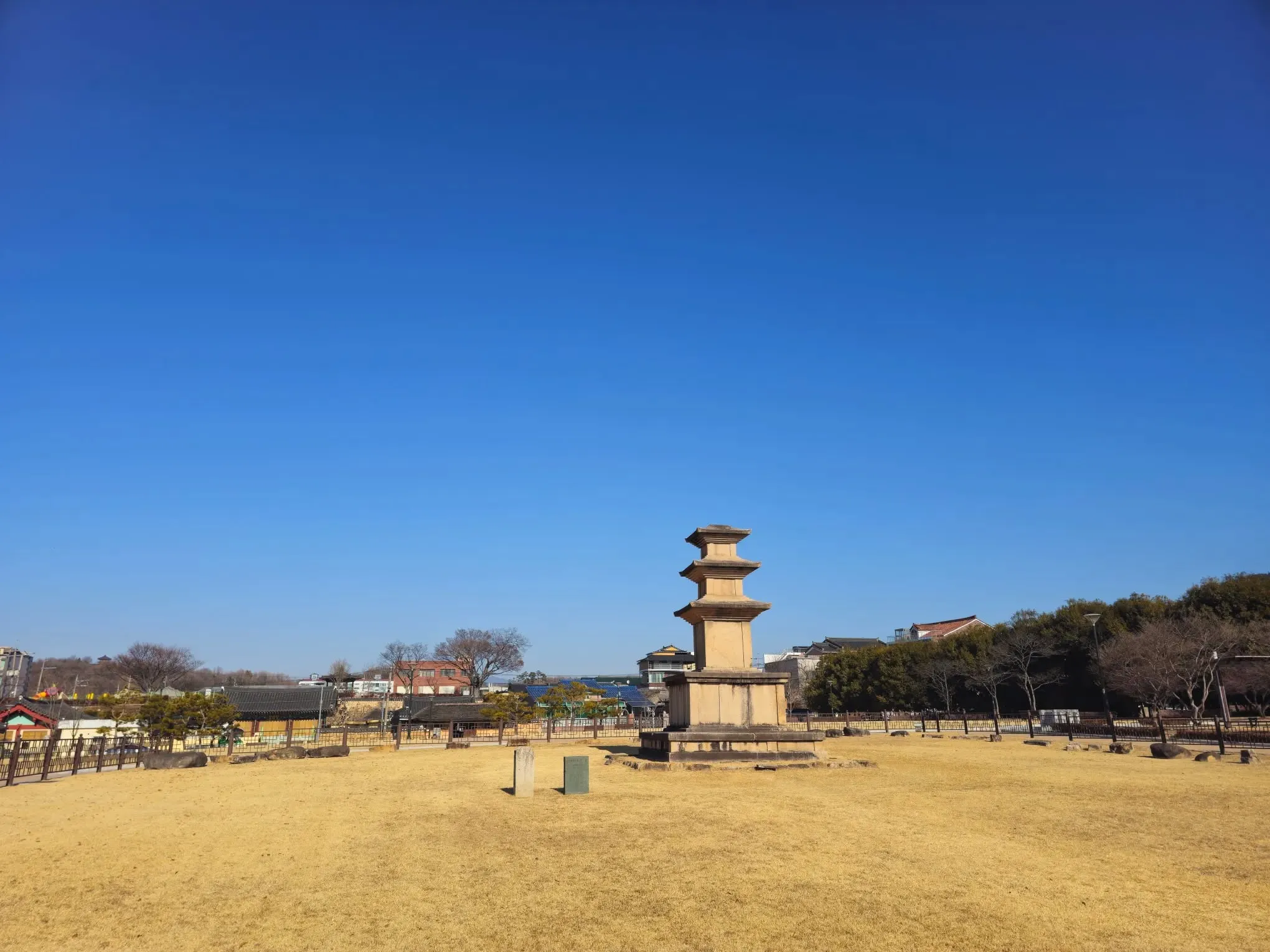 From the side.
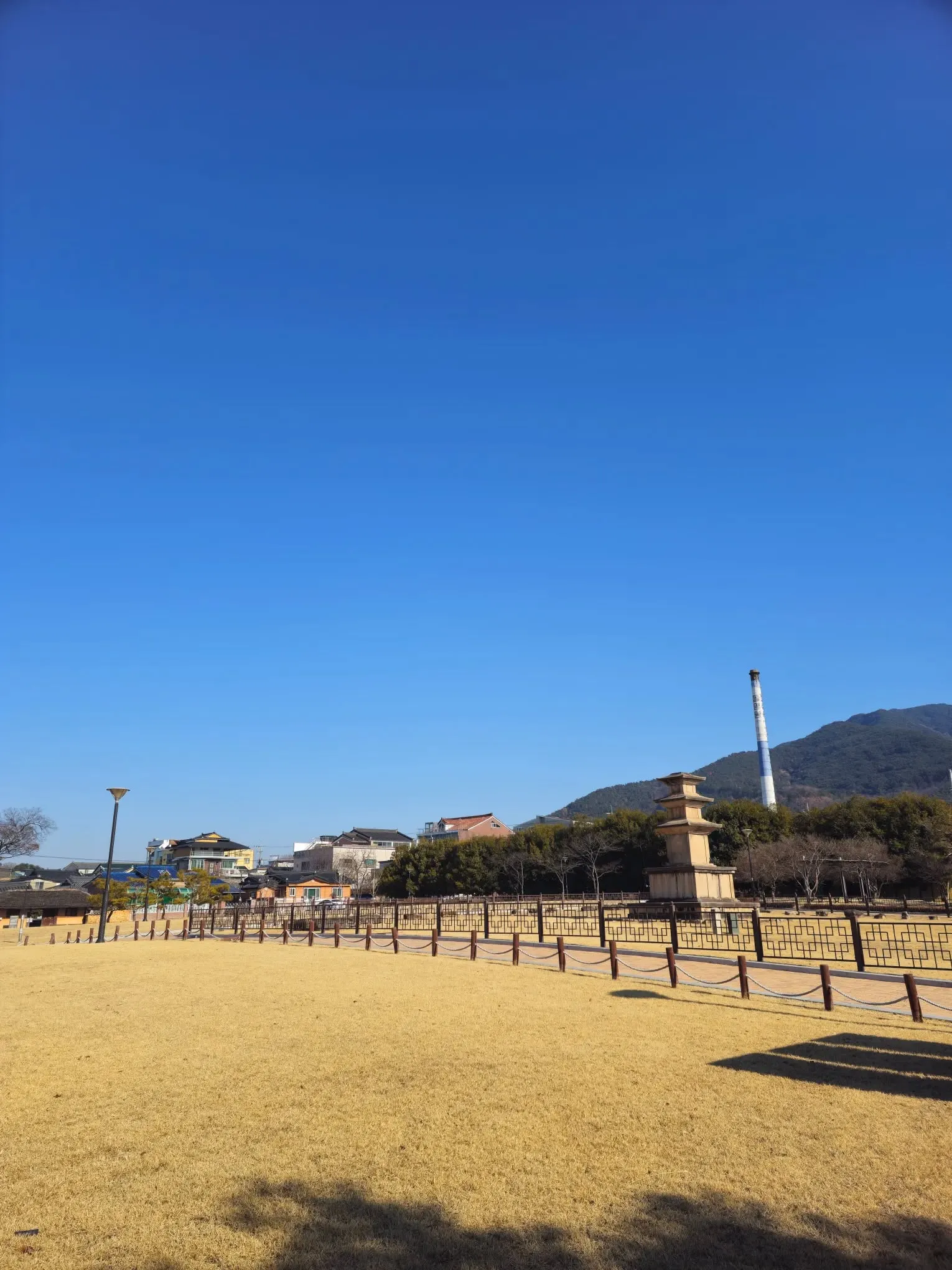 The park, with the pagoda in the distance.
Visiting
| East Three-story Stone Pagoda in Suljeong-ri | |
|---|---|
| Hours | Open at all times (KTO) |
| Closed | Open every day of the year (KTO) |
| Admission | Free (KTO) |
| Parking | Available (KTO) |
| Address | 37 Sijang 2-gil, Changnyeong-eup, Changnyeong-gun (KTO) |
- English: the main board has an English text too.
- Crowds: there weren’t many people when I went, on a Monday in January.
- There’s a west one too: a separate West Three-story Stone Pagoda in Suljeong-ri has its own KTO listing, at a different address in town.
How to get there
By car: the pagoda is in Changnyeong-eup, among houses. The KTO listing says parking is available.
By public transport: I couldn’t confirm bus connections, so I haven’t listed any. Check the live route in Naver Map before you go: search the Korean name, 술정리 동 삼층석탑, and check it’s the one in Changnyeong.
How to check buses in English: install Naver Map and switch it to English in its settings. When we checked it in October 2026, the English version showed bus routes, stop names and live arrival times in English. Google Maps also gives public transport directions in Korea, but as of late September 2026 it still had no turn-by-turn walking or driving navigation here. Stuck? Call the Korea Travel Hotline: dial 02-1330 from a Korean mobile phone (+82-2-1330 from abroad). It has English-speaking staff.
Tips
- Take your time. When I went it wasn’t crowded like a tourist spot, so I could enjoy it quietly and walk around the park at ease.
- Read the boards. The history board is in English too.
- Nearby: I visited Gwak Jae-u’s birthplace in Uiryeong the next day.
Who it’s for
Likely to suit (estimate): anyone interested in Korean Buddhist art and Silla history, road-trippers in South Gyeongsang, and travellers who prefer quiet places to busy sights.
Sources
Checked against the boards beside the pagoda (photographed January 2026: the name, National Treasure status, the Unified Silla date, the structure, the Gyeongju comparison, the 1965 finds, the 2008–2009 excavation and the Songnimsa tile), the Korea Tourism Organization listing (updated September 2026: the address, open at all times, every day, free, parking, the form typical of Unified Silla pagodas, the 1965 restoration and the reliquary, the comparison with Bulguksa’s Seokgatap; and a separate listing for the west pagoda), the Academy of Korean Studies heritage wiki and the Encyclopedia of Korean Culture (National Treasure, designated 20 December 1962; the board text; the Songnimsa tile). What it was like is from my own visit.