Home / Gangwon / National Mountain Museum
National Mountain Museum, Sokcho: free entry, Himalaya exhibition
A free mountaineering museum in Sokcho, with expedition gear and, when I went, a Himalaya special exhibition. How much English there is, hours and getting there.
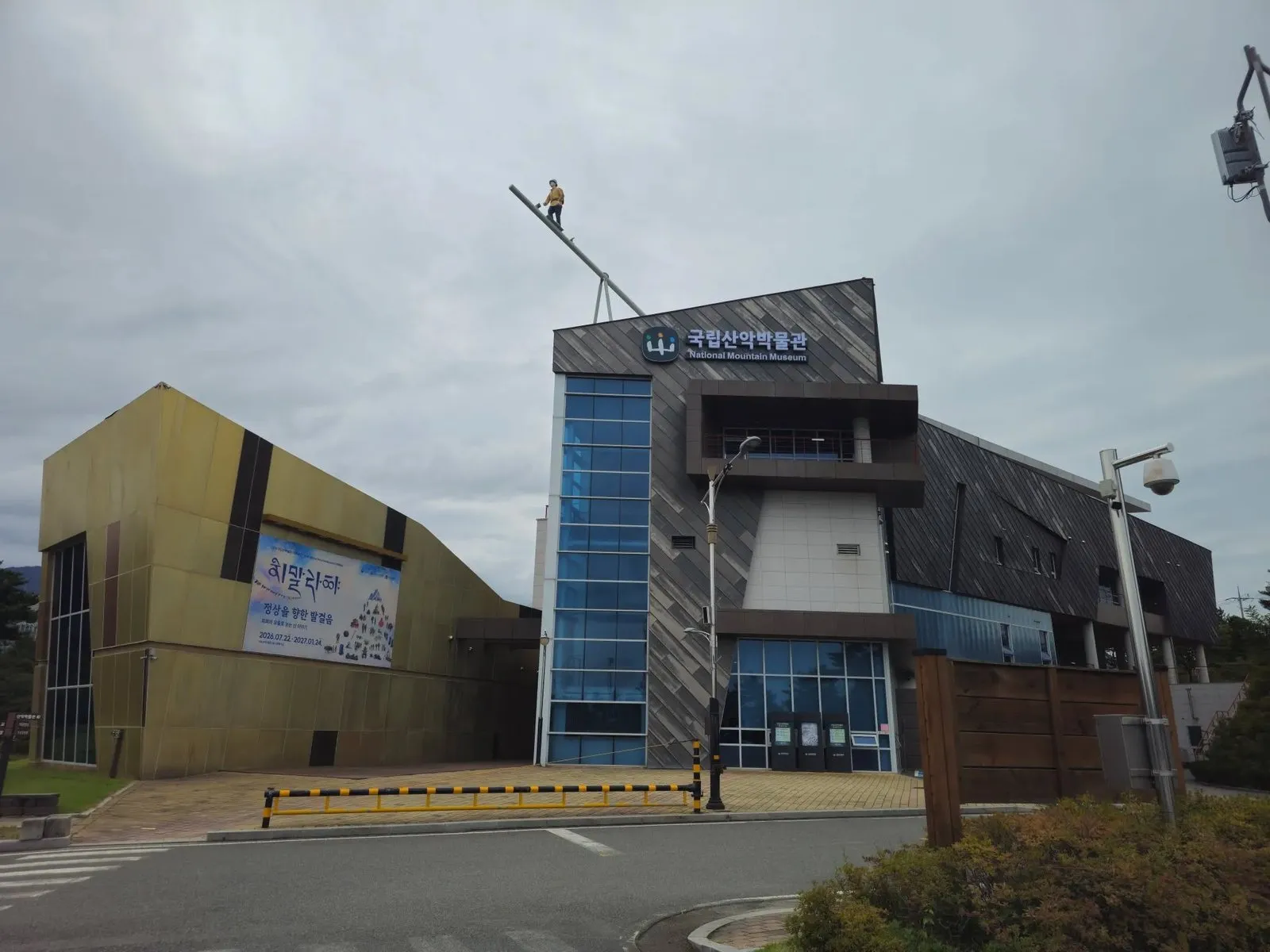
- Getting there
- In Sokcho, about 15 minutes by car from Sokcho City Hall (the museum's own page). The museum lists the Hanok Village (Sokcho City Museum) bus stop, then a walk of about 10 minutes. For buses, check the live route in Naver Map (in English).
- Cost
- Free (the museum's own page). Extras such as catalogues or programmes may cost a little.
- Time needed
- 1 to 2 hours (estimate)
- Best time
- Open Tuesday to Sunday, 9:00 to 18:00. Closed on Mondays (unless it's a public holiday), 1 January, and the Seollal and Chuseok holidays. Check the special exhibition's dates before you go.
Tap any Korean name on this page to hear it. Prefer Naver Map? In the app (set to English), search National Mountain Museum Sokcho, or paste the Korean name:국립산악박물관
Short version: The National Mountain Museum in Sokcho is a free museum about mountaineering. I went in without expecting much. What I found was old climbing gear, objects from real expeditions, Himalayan photos and records, and, when I went, a special Himalaya exhibition. It’s open Tuesday to Sunday and closed on Mondays (unless the Monday is a public holiday). Some signs have English, but a lot of the text is Korean only, so read the English section below before you go.
Last checked: 12 October 2026. Opening hours, closed days, admission, address, the bus stop and bus numbers, drive times and the special exhibition’s dates come from the museum’s own pages (Korean only). Other exhibition details come from what I photographed and one Korean news report. Free parking is from my own visit; the museum’s pages don’t mention parking. For public transport, use Naver Map’s live routes. Tell me if anything has changed.
What it is
It’s a national museum, as the name on the front says, and it’s about mountains and mountaineering. The floor guide in the entrance hall lists its rooms in English as well as Korean: on the third floor, Exhibition Hall 1 – History of Modern Mountaineering, Exhibition Hall 2 – Acclaimed Mountaineers and Exhibition Hall 3 – Mountain Culture, plus two Mountain Collection rooms. The second floor has an Alpine Experience Room, a Mountaineering Class, Indoor Climbing Walls and a Book Cafe. On the first floor there’s a Special Exhibition Hall, an Auditorium, a sculpture listed as Everlasting Adventure and a Welcome Zone, and on the fourth floor a Sky Garden and The Four Seasons of Mt. Seorak.
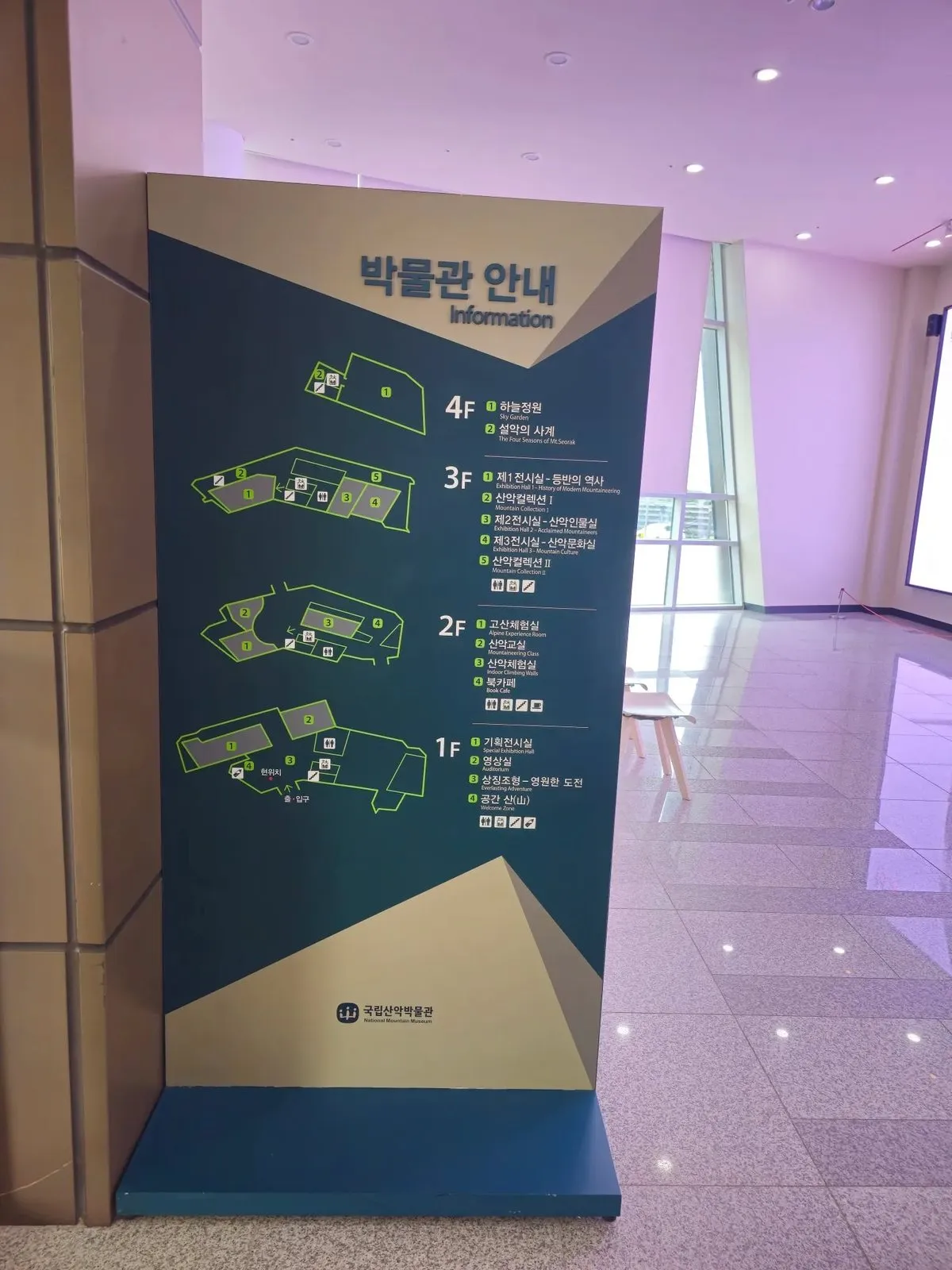 The floor guide, with English names under the Korean ones.
This note only covers what I photographed: the entrance hall and the Himalaya special exhibition. I haven’t described the other rooms.
The entrance hall
In the entrance hall, a big sculpture of a climber on an upside-down mountain hangs from the ceiling. Beside it there’s a wall of donors’ names with an English label, and below the sculpture two cartoon cut-out characters wave at visitors.
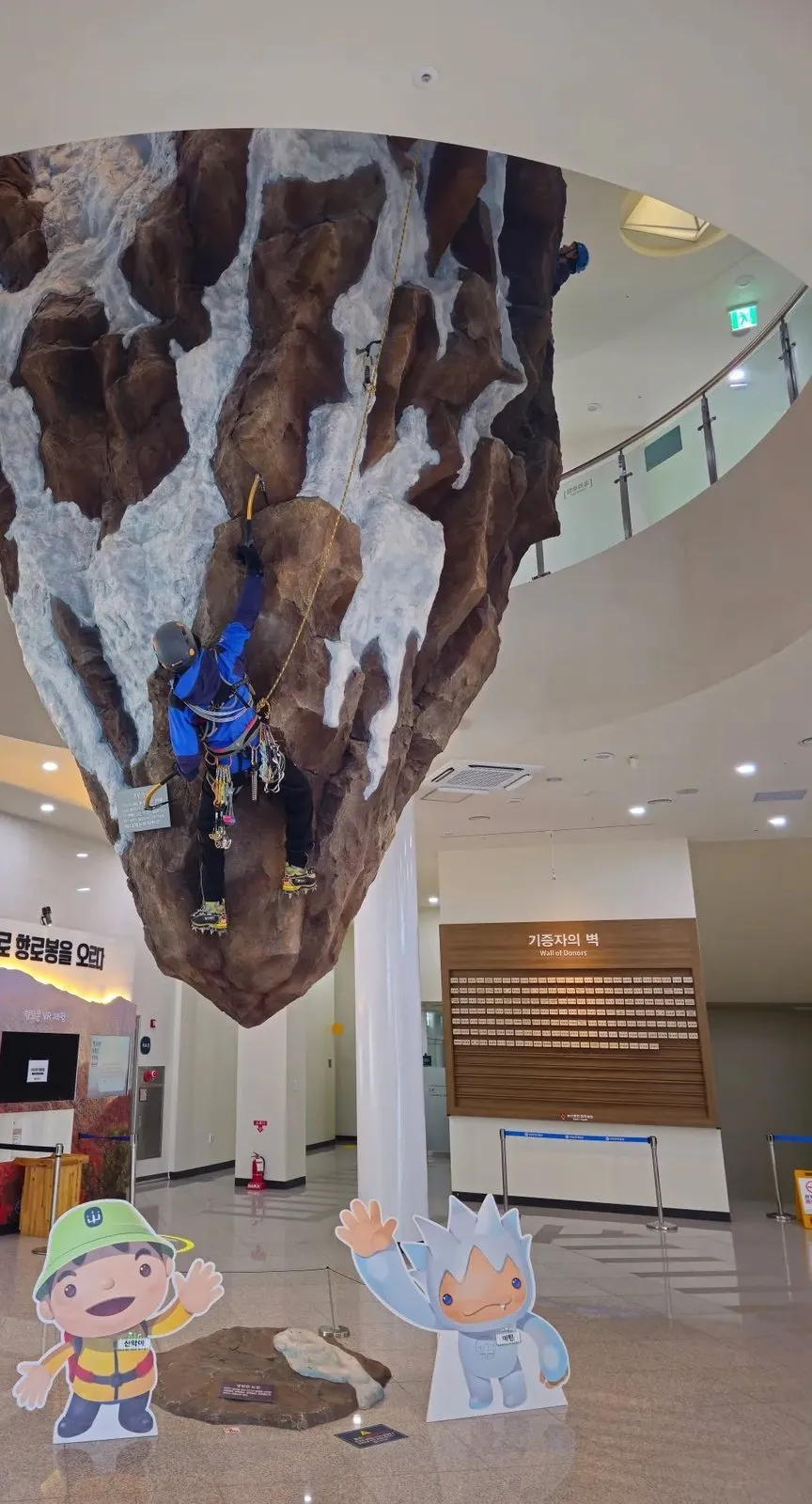 The lobby sculpture. The climbers on it are models, not people.
The Himalaya special exhibition
The special exhibition hall had a Himalaya show when I visited. The banner outside has its title in Korean. The title translates as “Himalaya: Steps Toward the Summit”, with the subtitle “mountain stories through paintings and artefacts” (my translation). The banner and the museum’s own list of exhibitions both give the dates as 22 July 2026 to 24 January 2027. A July 2026 news report gave an earlier end date, 27 December 2026, so check the dates before you plan a trip around it.
According to the news report, the show pairs paintings of the Himalayas, which it says are by Nepali artists, with expedition objects from Korean climbers, and it includes materials from the 1977 Korean Everest expedition and equipment from the 1980 Manaslu expedition. The hall I saw is divided into numbered parts. I photographed the signs for Part 2: Beyond the Ridge of the Gods and Part 3: The Mountains’ Legacy, both of which have English text next to the Korean.
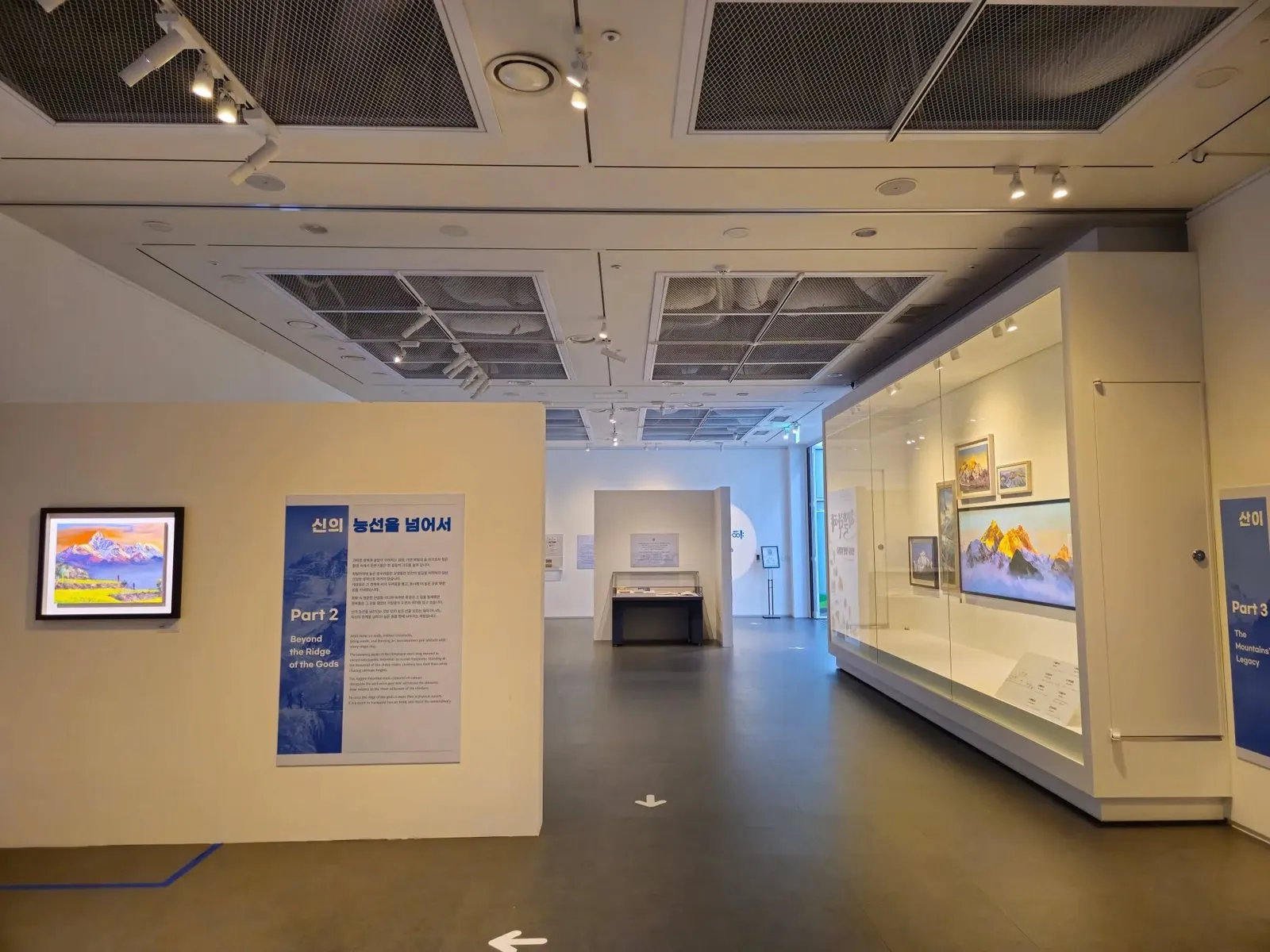 The start of Part 2. The panel is in both languages.
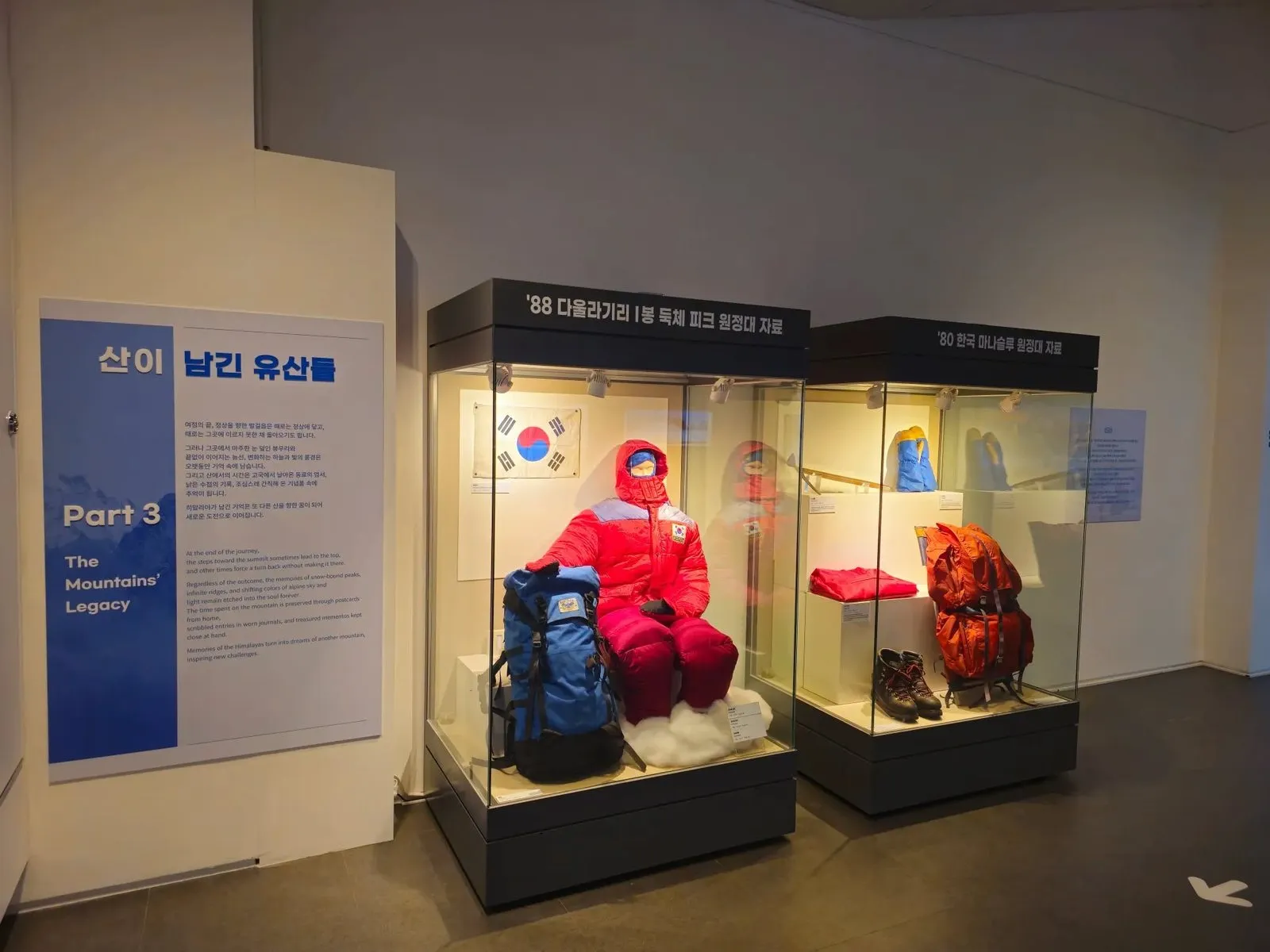 Part 3 and two cases of expedition gear. The cases are labelled in Korean as materials from the ’88 Dhaulagiri I / Dukche Peak expedition and the ’80 Korean Manaslu expedition.
One case holds expedition records: postcards, a red pennant for an Annapurna I expedition marked 1975, and notebooks. The small labels have an English title under the Korean one, for example “Expedition pennant, Annapurna I Expedition” and “1991 Everest South Ridge Expedition logbook”. The longer text on the labels and the big wall panel is Korean only. As I read the panel, it says that the 1977 Korean Everest expedition made the first Korean ascent of Everest, that the press made big news of it, and that the climbers returned home to a car parade and were awarded state decorations.
 A case of expedition records.
The panel that surprised me
This is the panel that caught my attention. In Korean only, it says that on an 8,000 m peak the temperature falls tens of degrees below zero even in a relatively warm season, so it’s hard to stay there long. Climbers set out from the last camp in the middle of the night, reach the summit around morning, and start down straight away. The time spent on the summit, it says, is “ten-odd minutes at most”. It adds that not every expedition reaches the top: weather, snow conditions, wind and the state of the team all matter, and sometimes climbers turn back for safety with the summit in sight.
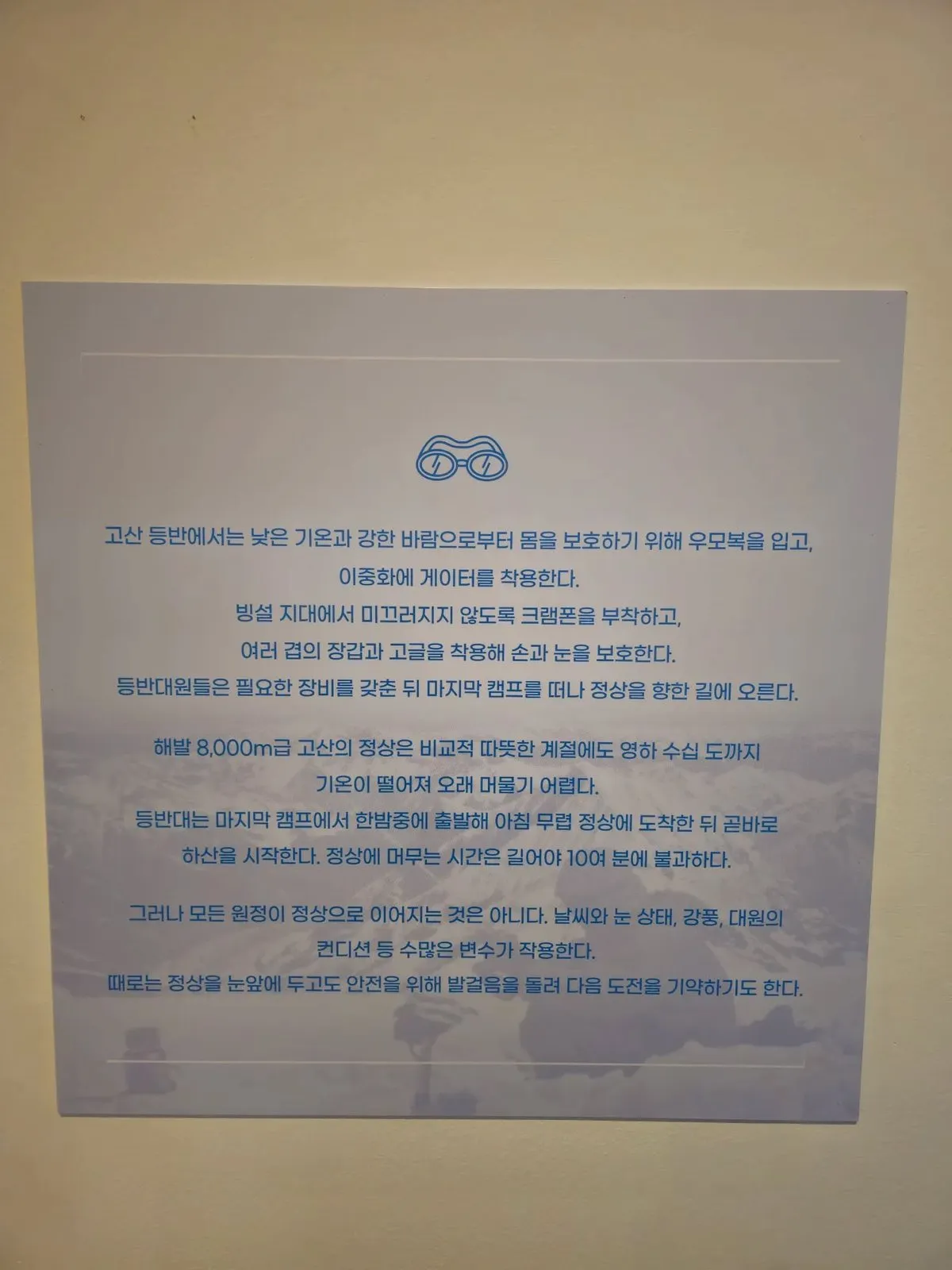 The summit-time panel. Korean only.
English at the museum
Here is what I could confirm:
- In English: the floor guide, the names of exhibition parts and the main panels I photographed (Part 2 and Part 3), and a short English title on some object labels.
- Korean only: the longer panels and label texts, such as the summit-time panel above and the record-case panel.
- Website: I couldn’t find an English version of the museum’s own website.
For the Korean-only panels, translating them with your phone’s camera is the easiest way (my suggestion).
Visiting
| National Mountain Museum | |
|---|---|
| Hours | Tuesday to Sunday, 9:00 to 18:00 (the museum’s own visitor page; it says the director may change the hours) |
| Closed | Mondays (open if the Monday is a public holiday), 1 January, and the Seollal and Chuseok holidays |
| Admission | Free (the museum’s own visitor page). Extras such as brochures, catalogues and programme fees may cost a little |
| Parking | Free when I visited (September 2026). The museum’s own pages don’t mention parking |
| Address | 3054, Misiryeong-ro, Sokcho-si, Gangwon Province (lot-number address: 735-3 Nohak-dong) |
The museum’s page also says the director may change the opening hours when needed, and it doesn’t give a last-entry time, so arrive well before 18:00 (my advice).
The museum’s page says you may not take photos in the exhibition rooms using lights or stands. It doesn’t give any other rule that I could find, so look for signs and ask a member of staff if you’re not sure.
How to get there
By bus: the museum’s own page lists the Hanok Village (Sokcho City Museum) stop (in Korean, 한옥마을(속초시립박물관)), then about 10 minutes on foot, and it names regular buses 3 and 3-1 and village buses 1-1, 2-1, 2-2 and 3. Check the live route in Naver Map (switched to English): search National Mountain Museum Sokcho, or paste the Korean name, 국립산악박물관.
How to check buses in English: install Naver Map and switch it to English in its settings. When I checked it in October 2026, the English version showed bus routes, stop names and live arrival times (minutes and stops away) in English. Google Maps also gives public transport directions in Korea, but as of late September 2026 it still had no turn-by-turn walking or driving navigation here. Stuck? Call the Korea Travel Hotline: dial 02-1330 from a Korean mobile phone (+82-2-1330 from abroad). It has English-speaking staff.
By car: the museum’s page says about 15 minutes from Sokcho City Hall, and about 1 hour 58 minutes from the Namyangju tollgate on the Seoul–Yangyang Expressway, via the Donghae Expressway to Sokcho IC. Those are its estimates, so allow extra time for traffic. Parking was free when I went.
Tips
- Don’t go on a Monday. It’s closed, unless the Monday is a public holiday.
- Check the special exhibition’s dates. The museum gives 24 January 2027 as the end date, but a news report gave an earlier one.
- Prepare for Korean-only text. Camera translation on your phone helps (my suggestion).
- Plan about 1 to 2 hours (my estimate), longer if you read everything.
Who it’s for
Likely to suit (estimate): hikers and climbers, anyone curious about the Himalayas, and visitors to Sokcho who want an easy indoor stop on a wet day. If you want every panel in English, it may frustrate you.
Sources
Checked against the information boards and signs at the museum (photographed on my visit), the museum’s own visitor-information, directions and exhibition-list pages (Korean only; address, hours, closed days, admission, bus stop, bus numbers, drive times and the exhibition dates), and a Kukin News report from July 2026 on the Himalaya exhibition (its contents, and a different end date). The visit itself, free parking, the summit-time panel and the impressions are from my own visit.