Home / Incheon / Ganghwa Christian History Memorial Hall
Ganghwa Christian History Memorial Hall: hours, fee, bus from Seoul
A museum on Ganghwa Island about the 1890s Methodist and Anglican missions, with a boat-baptism replica. Hours, fee, Sunday closing and bus 3000 from Seoul.
- Getting there
- From Seoul, bus 3000 from Sinchon Station to Ganghwa Bus Terminal. From there, check the local bus in Naver Map (in English). There is a large free car park.
- Cost
- Adult admission 2,000 won (as I noted on my visit). Car park free.
- Time needed
- About 1 hour (estimate)
- Best time
- Daytime, Monday to Saturday. Closed on Sundays.
Tap any Korean name on this page to hear it. Prefer Naver Map? In the app (set to English), search Ganghwa Christian History Memorial Hall, or paste the Korean name:강화기독교 역사기념관
Short version: The Ganghwa Christian History Memorial Hall is a museum in Ganghwa, an island county of Incheon, about the history of Christianity on the island, including the Methodist and Anglican missions of the 1890s. Outside the building there’s a replica of a baptism carried out on a boat, a restored thatched hall that its board calls Ganghwa’s first church, and an old bell, each with an information board. According to the museum’s board, it opened in March 2022.
Last checked: 10 October 2026. The history and the layout of the museum come from the information boards at the site, which I photographed on my visit. I couldn’t find an official English page, so the English name above is my own translation of the Korean name, 강화기독교 역사기념관. Hours and the fee are what I noted on my visit, and I couldn’t confirm them from an official English source, so check before you go. Tell me if anything has changed.
What you’ll see outside
The museum is a long grey-and-brown building on raised ground. Below it there’s a small paved square with three things to look at.
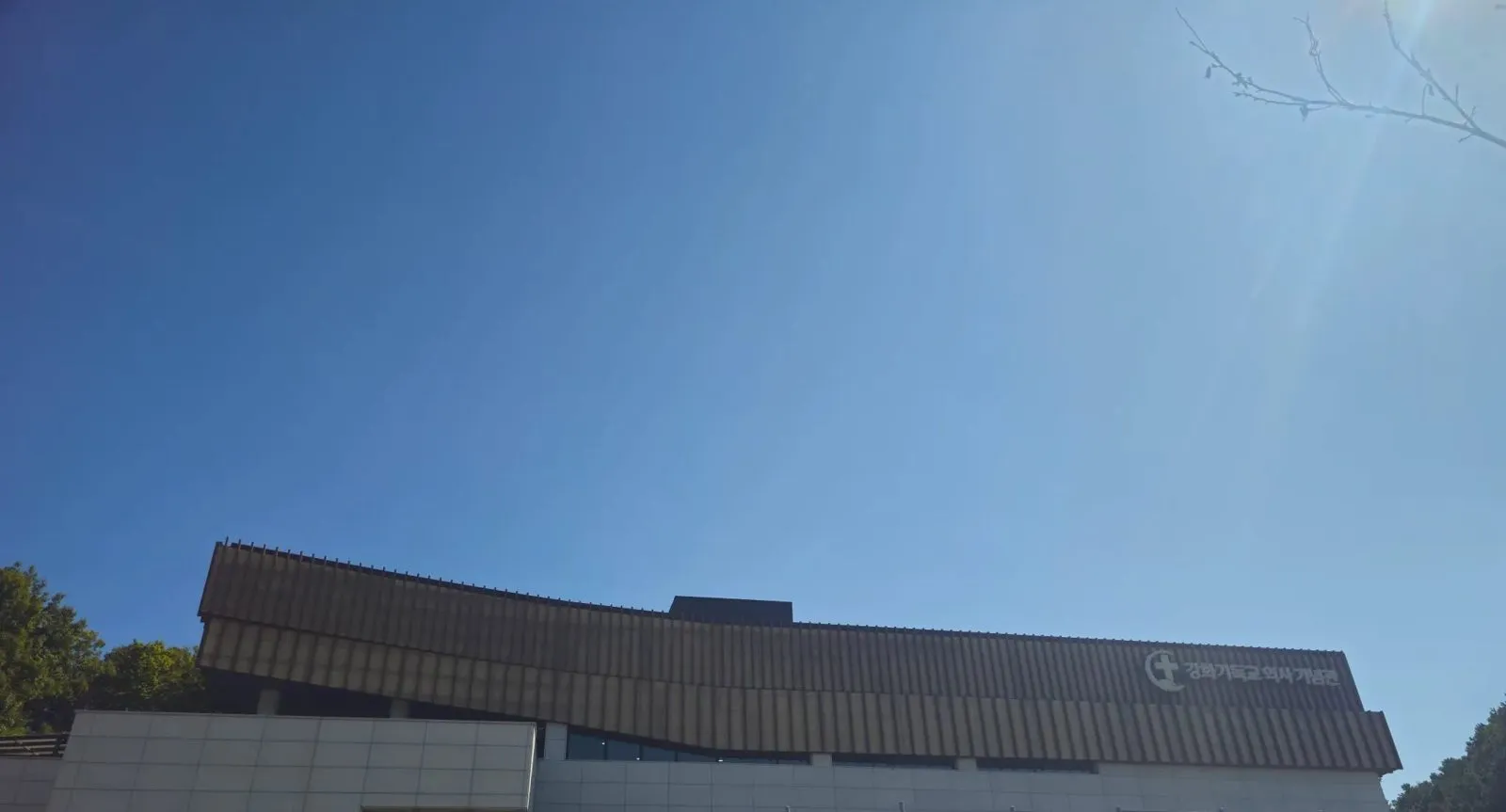 The museum building. The name is written in Korean on the upper façade.
The boat baptism
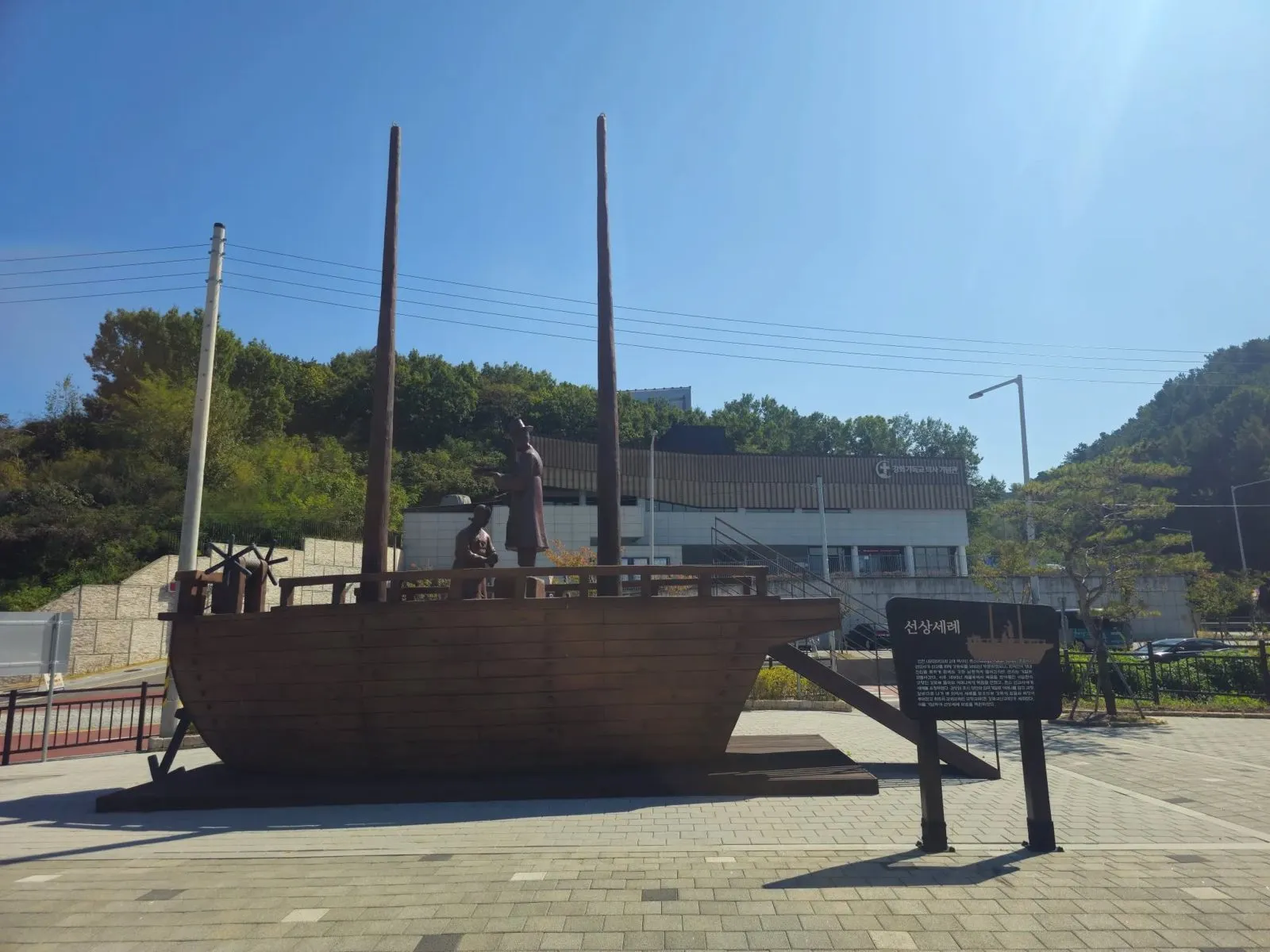
A wooden boat with two masts and figures on deck stands in the square. The board beside it, titled 선상세례 (“baptism on a boat”), says the boat recreates a real event.
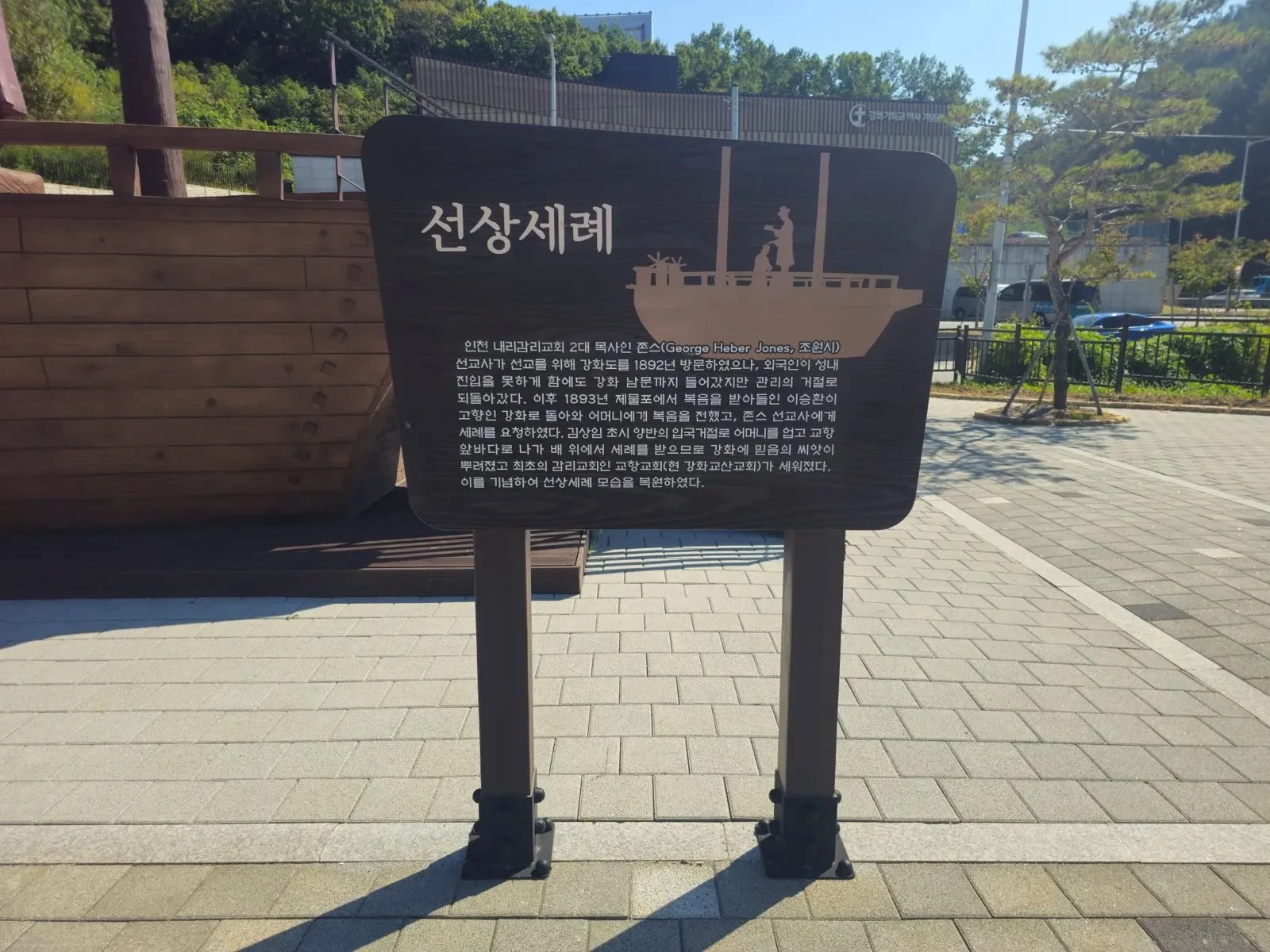 The board for the boat. It’s in Korean apart from the missionary’s English name.
According to the board, the Methodist missionary George Heber Jones visited Ganghwa in 1892. Foreigners weren’t allowed inside the walled town, and when he got as far as the South Gate, an official refused him and he turned back. Later, a man named Lee Seung-hwan, who had accepted Christianity in Jemulpo (now part of Incheon) in 1893, returned to his home town of Ganghwa, told his mother about it and asked Jones to baptize her. When a local gentry man, Kim Sang-im, refused to let Jones in, Lee carried his mother out to the sea off Gyohang and she was baptized on a boat. The board says this planted the first seeds of faith on Ganghwa, and that the first Methodist church on the island, Gyohang Church (now Ganghwa Gyosan Church), was founded afterwards. The replica is built to commemorate it.
St Nicholas Hall and the bell
Nearby is a small thatched, hanok-style building with stone-patterned lower walls. Its board is titled 성니콜라회당 (St Nicholas Hall) and calls it a restoration of the first church on Ganghwa. It tells the Anglican side of the story: in 1893 an Anglican bishop chose Ganghwa as a mission field, and since foreigners couldn’t enter the town, the mission bought a hanok beside Jinhaeru, on Ganghwa’s outer wall at Gapgot, and began its work there with five orphans. The board says the house was blessed as St Nicholas Hall on 20 January the following year, making it the first church on Ganghwa, and that the mission later moved to a building inside the town’s east gate in 1897.
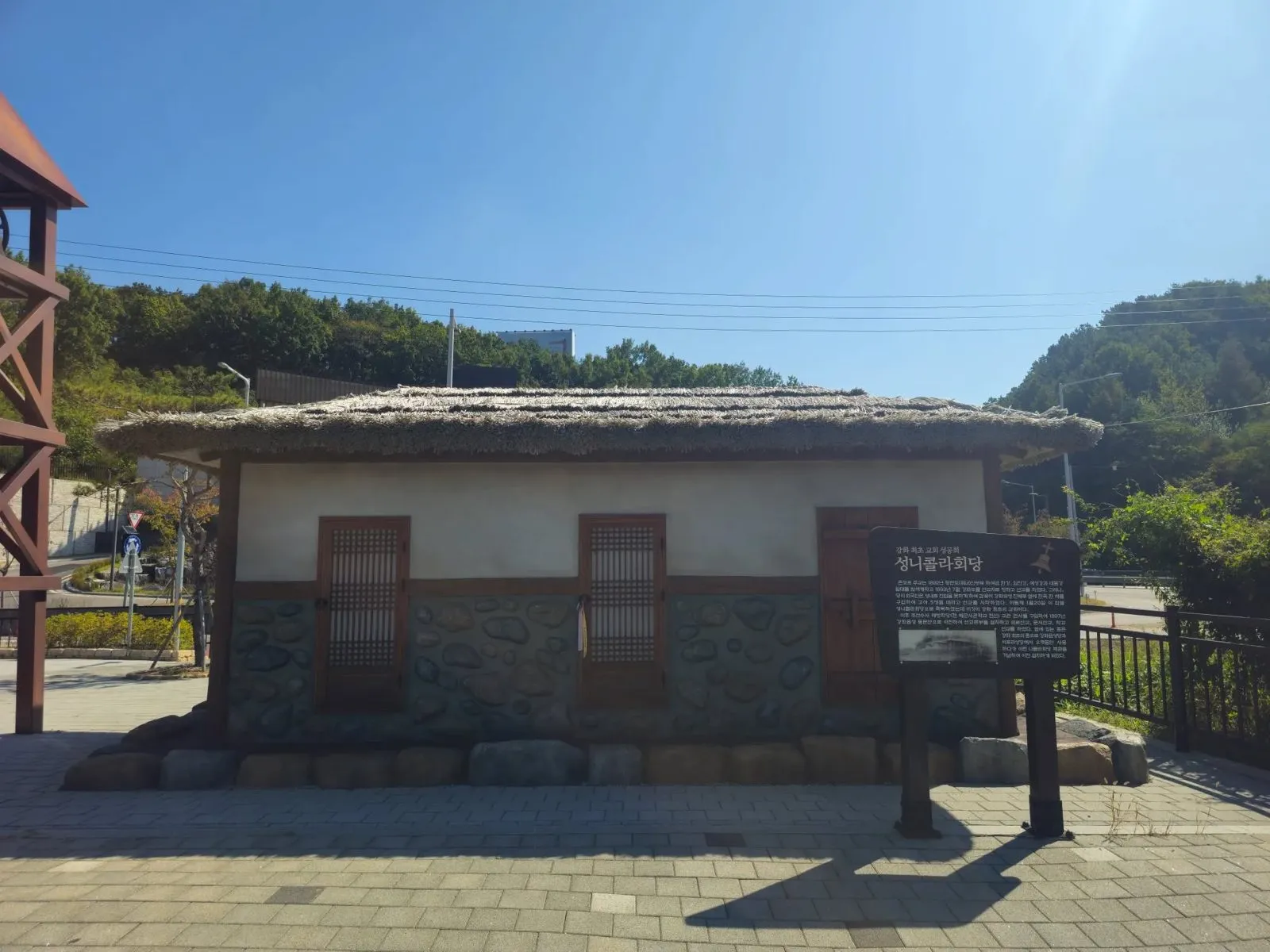 The restored St Nicholas Hall.
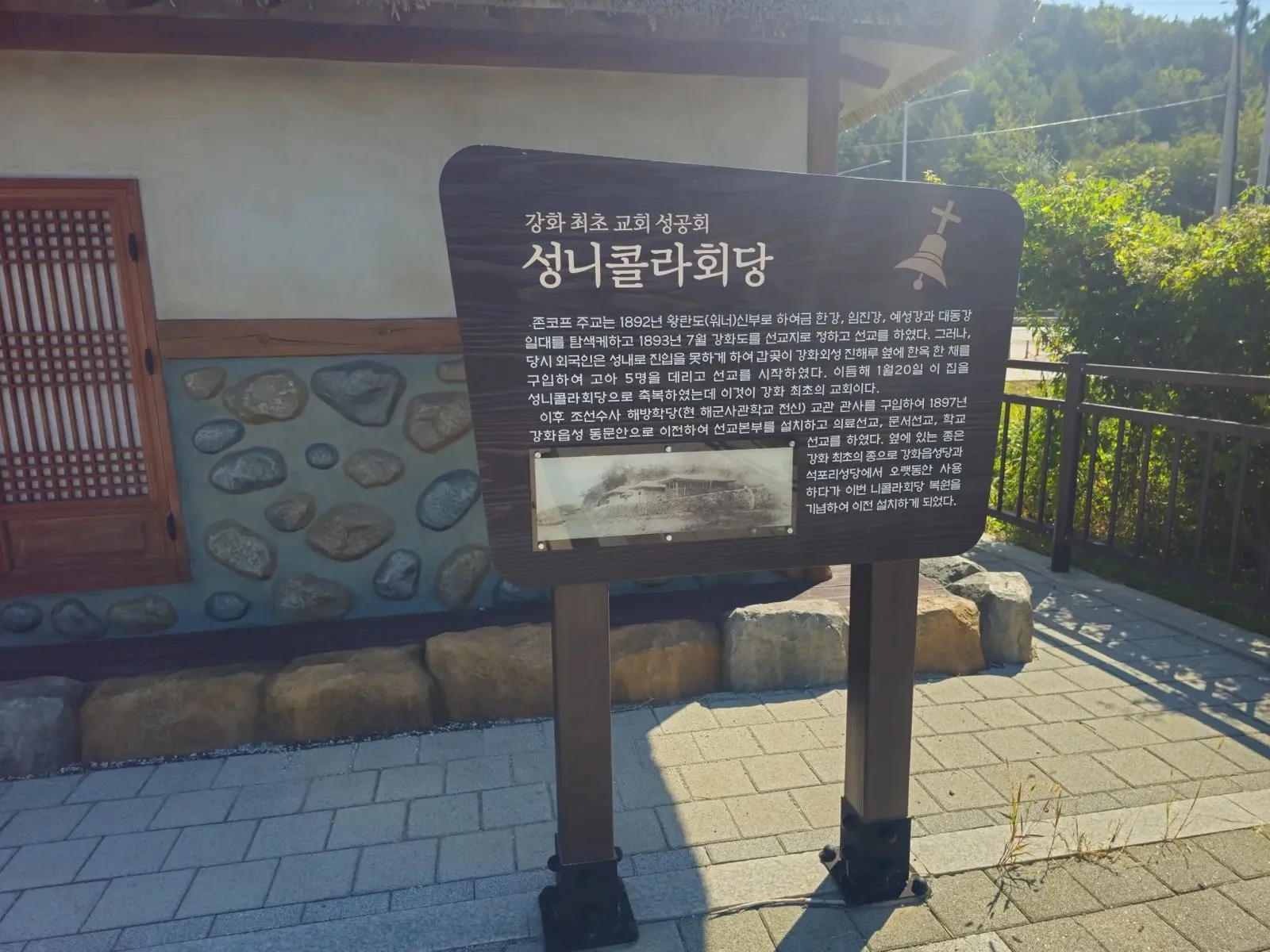 The board for St Nicholas Hall.
Next to it is a wooden bell tower topped with a cross. The board for St Nicholas Hall says the bell beside it was the first bell on Ganghwa, used for a long time at two other churches, and moved here to mark the restoration of the hall.
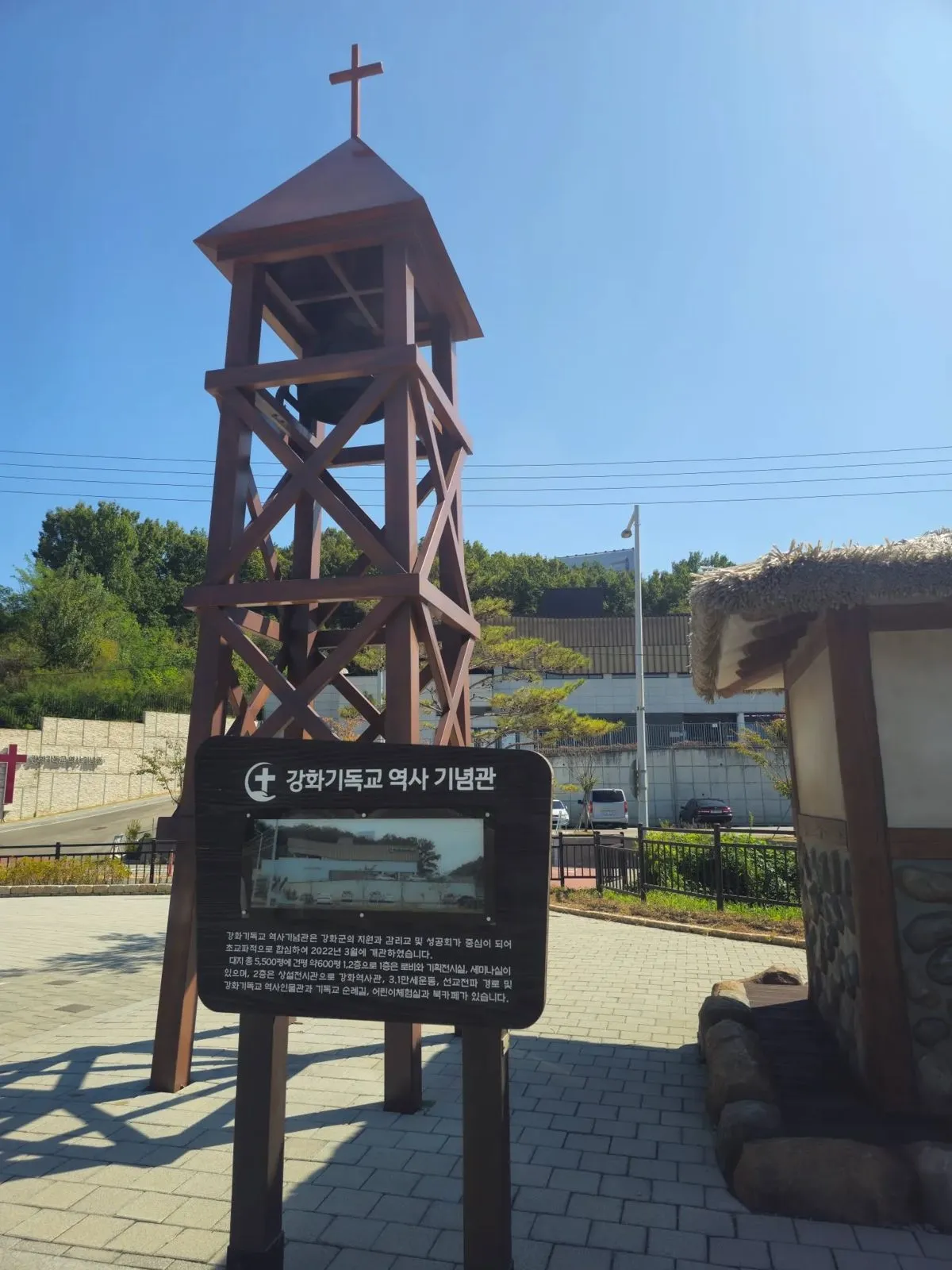 The bell tower, with the board introducing the museum.
Accounts of the boat baptism don’t all agree on the date, so treat the dates above as the museum’s own telling of the story.
Inside the museum
I didn’t go inside, so this part comes from the museum’s own information board. It says the museum opened in March 2022, with support from Ganghwa County and led by the Methodist and Anglican churches on an interdenominational basis. The site is about 5,500 pyeong (a Korean unit of area, roughly 18,000 square metres), with exhibitions on two floors. On the first floor are a lobby, a special exhibition room and a seminar room. The second floor has the permanent exhibitions: a hall on Ganghwa history, the March 1st Movement of 1919, the routes by which Christianity spread, a hall on the people of Ganghwa’s Christian history and a Christian pilgrimage route, along with a children’s experience room and a book café.
Visiting
| Ganghwa Christian History Memorial Hall | |
|---|---|
| Hours | 9:00 to 18:00, last entry 17:30 (as I noted on my visit) |
| Closed | Sundays, 1 January, and Seollal and Chuseok Day (the main days of the Lunar New Year and autumn harvest holidays) (as I noted on my visit) |
| Admission | Adults 2,000 won (as I noted on my visit). I couldn’t confirm other fees |
| Parking | A very large free car park |
| Address | 12-21, Ganghwa-daero 154beon-gil, Ganghwa-eup, Ganghwa-gun, Incheon (lot-number address: 1086-3 Yongjeong-ri) |
Hours and fees can change, and I couldn’t confirm them from an official English source. If you’re making a special trip, call the Korea Travel Hotline (02-1330 from a Korean mobile) first.
How to get there
From Seoul: bus 3000 runs between Sinchon in Seoul and Ganghwa Bus Terminal, and also stops at Hapjeong Station. In Naver Map (October 2026) the Seoul end of the route is the stop 신촌오거리.2호선신촌역 (Sinchon Five-Way Junction, Line 2 Sinchon Station). The adult fare is 3,000 won by card (from August 2025). Routes, fares and timetables change, and I couldn’t confirm the journey time or how often it runs outside peak hours.
From the terminal to the hall: local buses change, so check the live route in Naver Map (switched to English): search Ganghwa Christian History Memorial Hall, or paste the Korean name, 강화기독교 역사기념관.
How to check buses in English: install Naver Map and switch it to English in its settings. When I checked it in October 2026, the English version showed bus routes, stop names and live arrival times (minutes and stops away) in English. Google Maps also gives public transport directions in Korea, but as of late September 2026 it still had no turn-by-turn walking or driving navigation here. Stuck? Call the Korea Travel Hotline: dial 02-1330 from a Korean mobile phone (+82-2-1330 from abroad). It has English-speaking staff.
By car: there’s a very large, comfortable free car park, which I found easy to use.
Tips
- Check the day. It’s closed on Sundays (not Mondays), so plan around that.
- Go in the daytime. The outdoor part is the easiest to enjoy in good light.
- Expect Korean-only boards outside. Use a translation app on the information boards, or the summary on this page.
- Also in Ganghwa: the Bugeun-ri dolmen, part of a UNESCO World Heritage site, and Daeryong Market on Gyodong Island.
Who it’s for
Likely to suit (estimate): anyone curious about how Christianity arrived in Korea, anyone interested in Ganghwa’s modern history, and visitors combining several Ganghwa sights on one trip.
Sources
Checked against the information boards at the site (photographed on my visit) and my own notes from the visit for hours, closing days and admission. I looked for an official English page and a second source and couldn’t find one, so those details are unconfirmed.