Home / Gyeongsang / Chungnyeolsa Shrine, Namhae
Namhae, South Korea: Chungnyeolsa, a shrine to Yi Sun-sin
Chungnyeolsa in Namhae, South Korea is a shrine to Admiral Yi Sun-sin. The board at the site says it stands where his body was first kept after the Battle of Noryang Strait. Free, open at all times, and not crowded when I went.
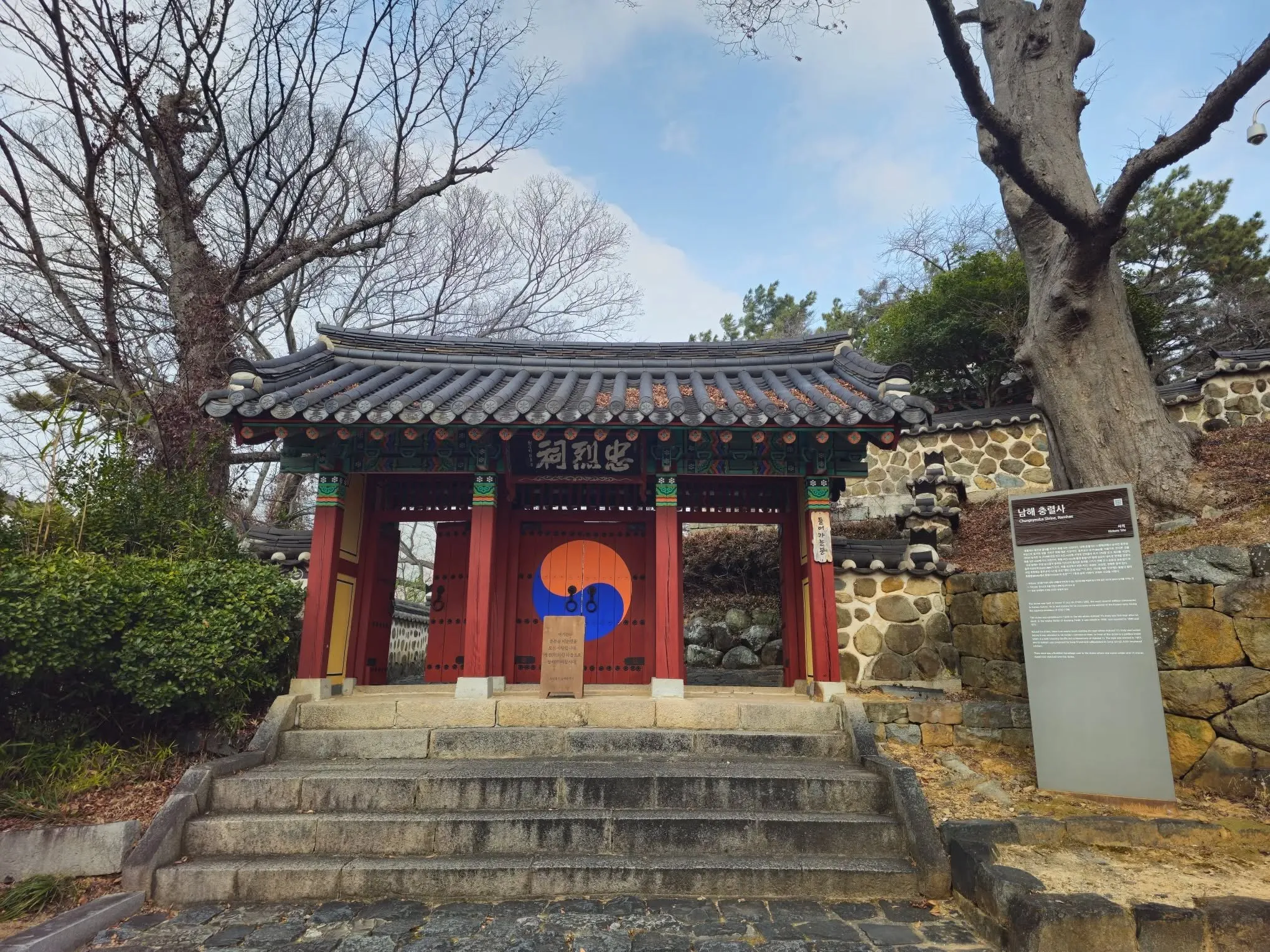
- Getting there
- In Noryang village, Seolcheon-myeon, on Namhae Island, South Gyeongsang. I drove. The Korea Tourism Organization lists free parking. We couldn't confirm bus connections.
- Cost
- Free (Korea Tourism Organization). The same KTO record lists a separate ₩500 fee for the turtle ship moored below the shrine (see my turtle ship note).
- Time needed
- 30 minutes to 1 hour (estimate)
- Best time
- No best season confirmed. The Korea Tourism Organization lists it as open at all times, every day.
Tap any Korean name on this page to hear it. Prefer Naver Map? In the app (set to English), search Chungnyeolsa Namhae, or paste the Korean name:남해 충렬사
Short version: On Namhae Island in South Gyeongsang, Chungnyeolsa is a shrine to Admiral Yi Sun-sin, built where, according to the board at the site, his body was first kept after he died in the Battle of Noryang Strait in 1598. You walk in through the gates, climb the stairs to the main hall and look out over the sea. It’s free, open at all times, and when I went there weren’t many people. If you’ve come to Namhae, it’s worth stopping by once.
Last checked: 2 November 2026. The history comes from the board at the site (photographed January 2026), the Korea Tourism Organization (KTO) listing (updated 29 October 2026) and the Encyclopedia of Korean Culture. Opening times, admission and parking come from KTO. What it was like is from my own visit. Tell me if anything has changed.
What it is
The board at the site, in Korean and English, is headed Chungnyeolsa Shrine, Namhae and marked as a Historic Site. It says the shrine honors Yi Sun-sin (1545–1598), “the most revered military commander” in Korean history, best known as an admiral of the Korean navy during the Japanese invasions of 1592–1598. KTO and the Encyclopedia of Korean Culture say it was designated a Historic Site on 11 June 1973, and KTO describes it as small in scale.
The board says the shrine stands on the site where Admiral Yi’s body was first kept after his death in the nearby Battle of Noryang Strait. KTO words this the same way, while the Encyclopedia of Korean Culture is more careful and says the remains are said to have been kept here at first. KTO and the encyclopedia agree that they were moved in February 1599 to Asan. The board adds that behind the shrine an empty tomb marks the spot where his body lay before it was moved (the Korean text calls it a provisional tomb).
The dates differ between sources. The board says the shrine was established in 1628, 30 years after his death, when local scholars built a thatched shrine and held rites. KTO and the Encyclopedia of Korean Culture both date the first thatched shrine to 1633. The board says it was rebuilt in 1658, and the encyclopedia says a proper shrine building went up that year to replace the thatched hut. The Korean text of the board and the encyclopedia say it received a royal name plaque in 1663, together with the Chungnyeolsa in Tongyeong; the English text of the board instead gives 1663 as the year the stele was erected. The English text also adds repairs in 1899 and 1973.
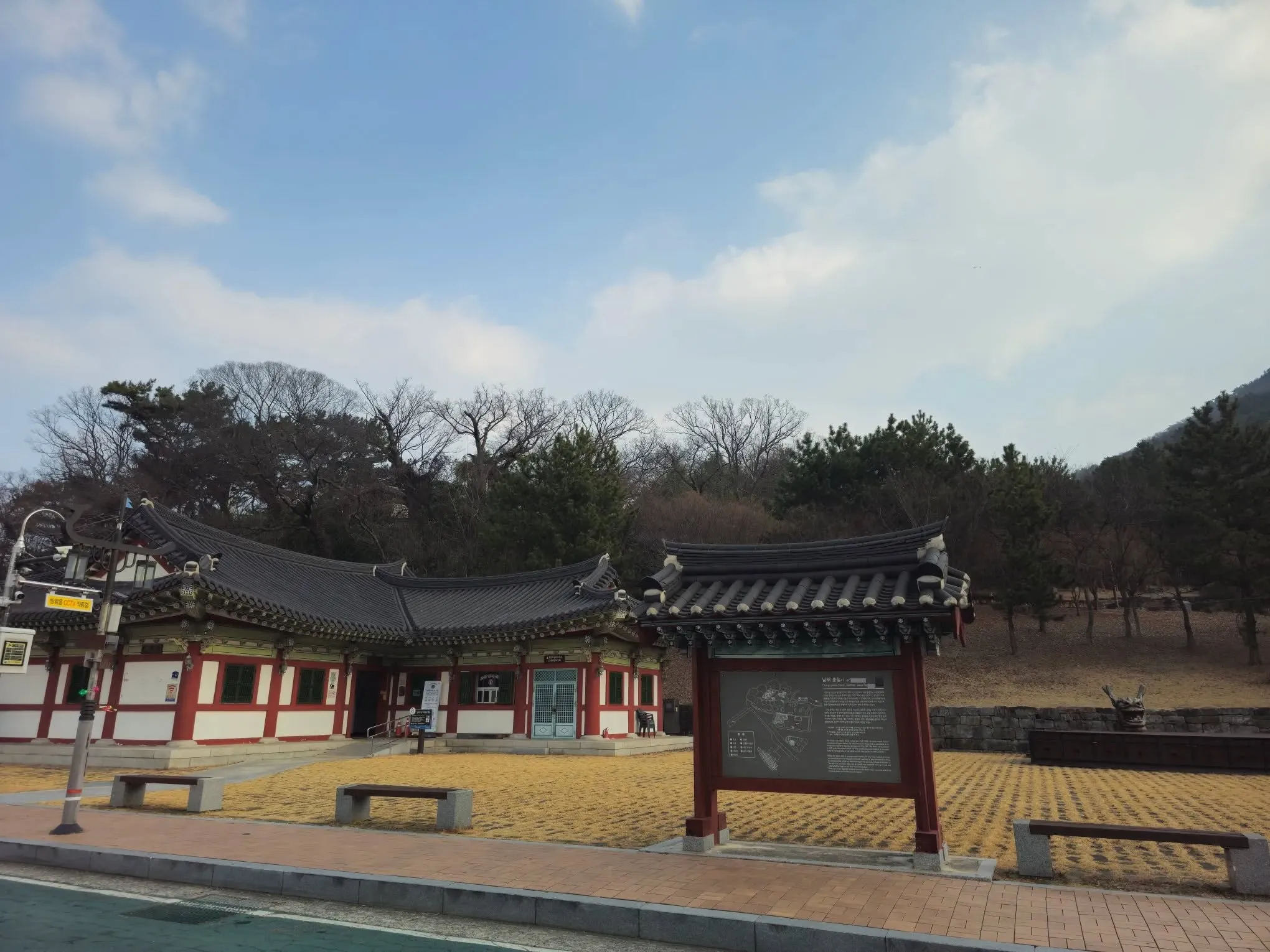 One of the red-and-white buildings by the plaza, with the site board in front.
A few details from the board:
- The stele. In front of the shrine there is a pavilion with a stele honoring Admiral Yi’s life and achievements. The board and KTO say the inscription was composed by Song Si-yeol and written in calligraphy by Song Jun-gil.
- The guards. Next to the shrine there was once a Buddhist hermitage, Hochung-am, where a monk-general and 10 monks from Hwabangsa temple took turns guarding the shrine (board; the encyclopedia says ten or so monks).
What you’ll see
Gates, stone steps and a quiet hillside of pines. When I walked in, the mood changed right away, and there are quite a few stairs up to the main hall. The gate doors are painted with a large orange and blue taegeuk swirl, and the plaque above the gate carries the shrine’s name in Chinese characters.
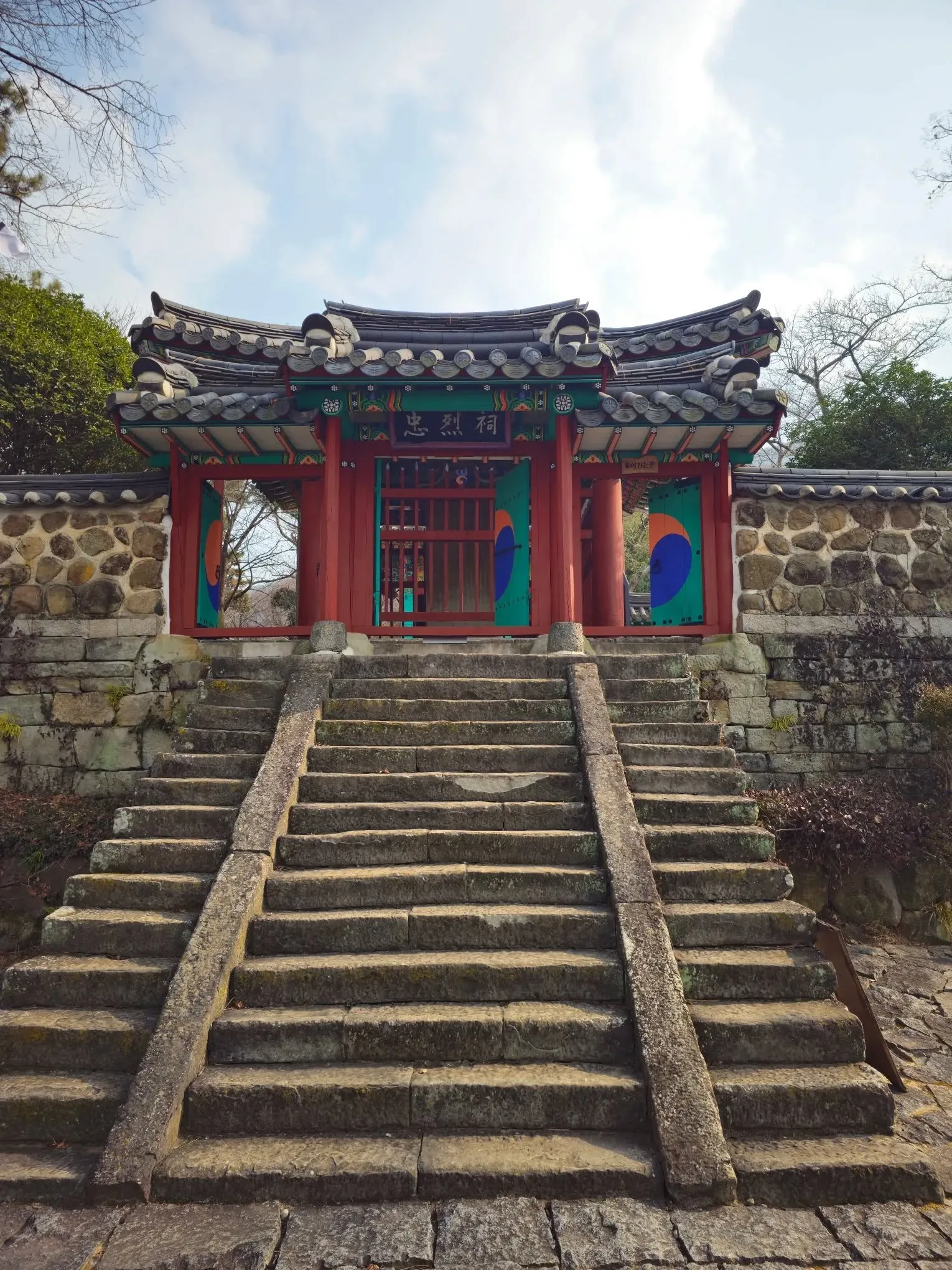 The stairs and gate.
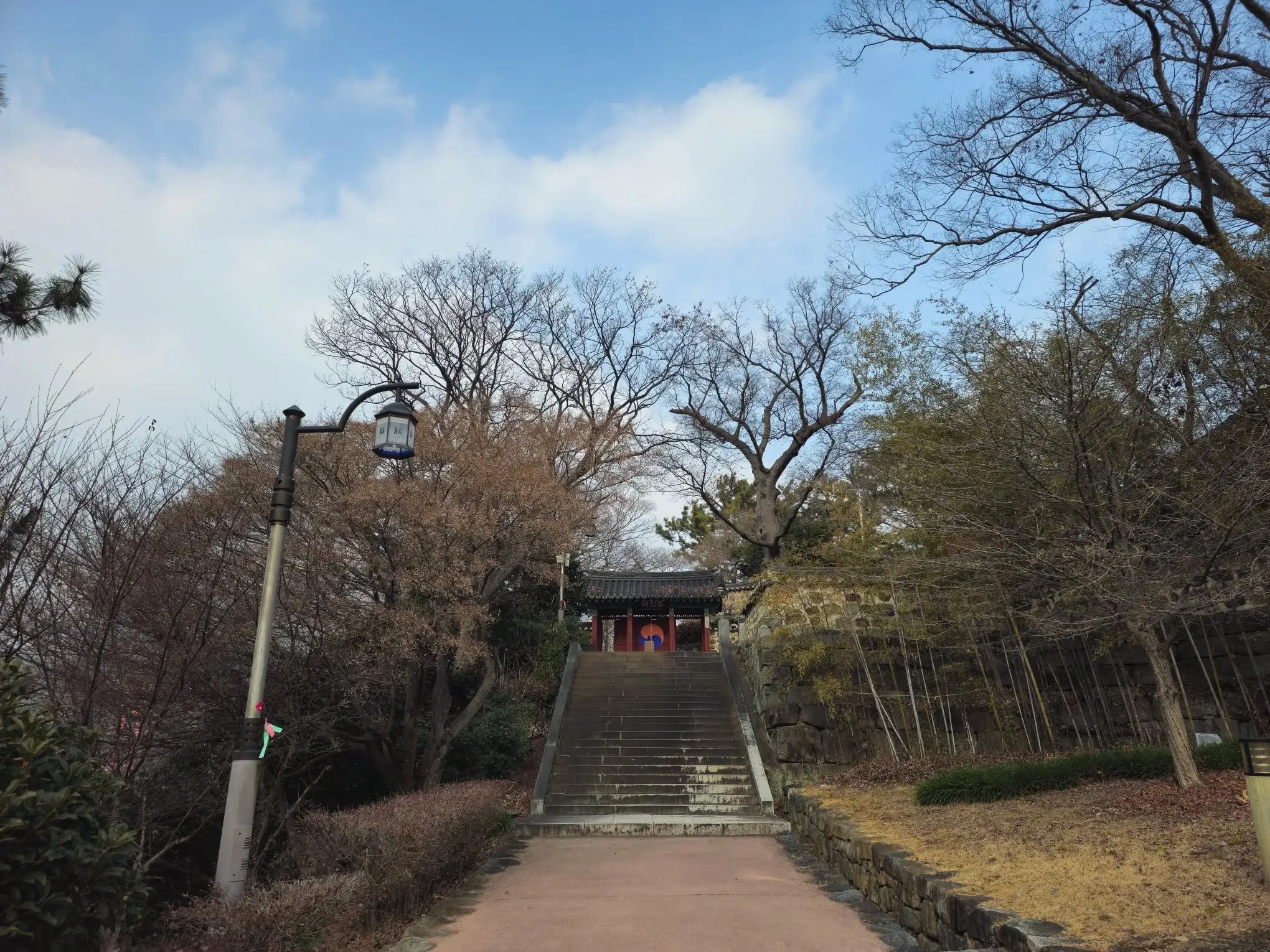 The approach, looking up the steps.
The site map on the board (Korean, with a legend) numbers nine features: the tomb behind the shrine, the shrine hall, the stele pavilion, the inner and outer gates, the Cheonghaeru pavilion and three more stone monuments (items 7 to 9 on the legend).
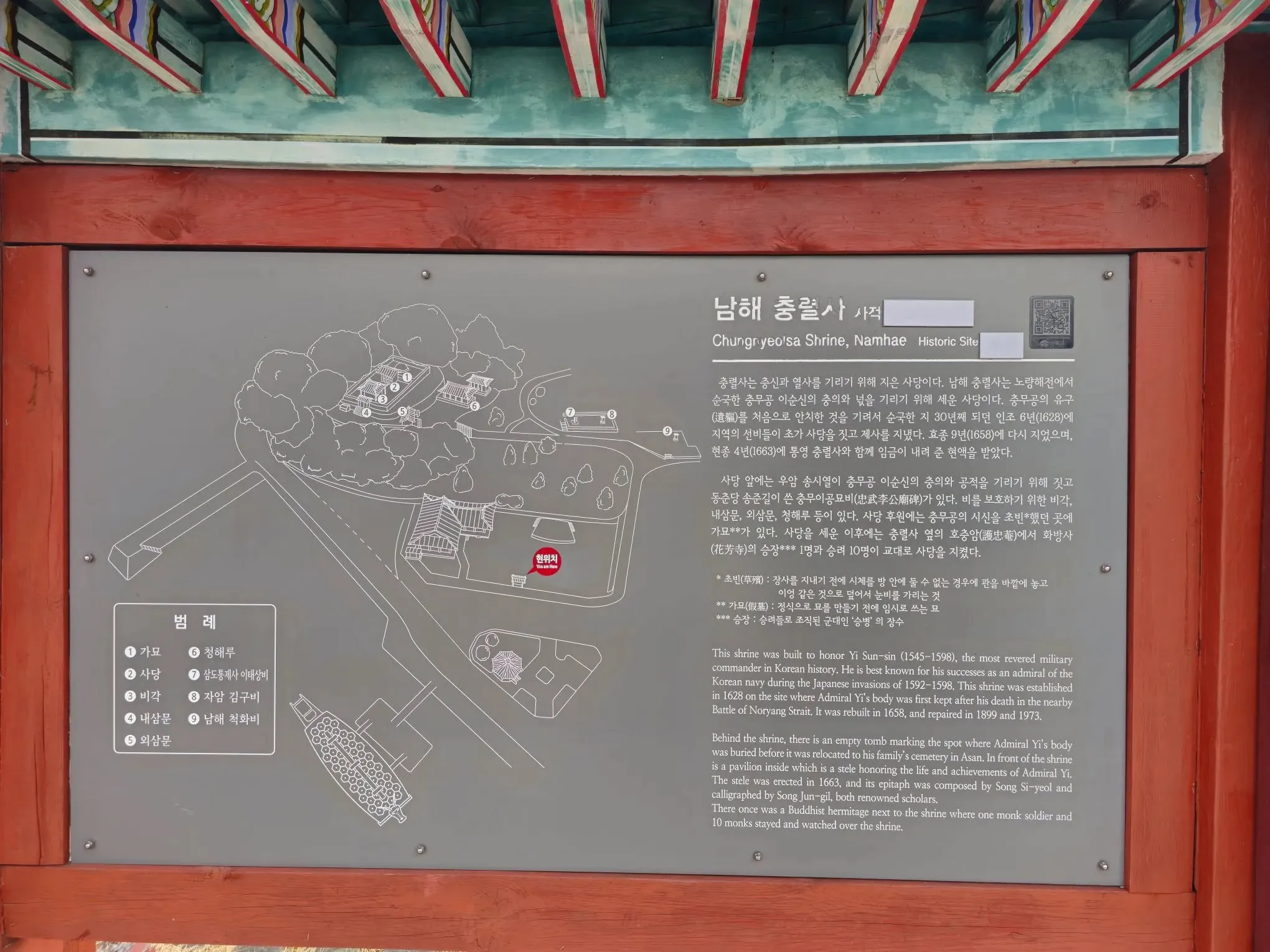 The site map and history on the board.
Visiting
| Chungnyeolsa Shrine, Namhae | |
|---|---|
| Hours | Open at all times, every day of the year (KTO; its record says to call for details, and we haven’t listed the number) |
| Admission | Free (KTO). KTO lists a separate ₩500 fee for the turtle ship in the same record; see my turtle ship note |
| Parking | Available, free (KTO) |
| Address | 27 Noryang-ro 183beon-gil, Seolcheon-myeon, Namhae-gun (KTO; the Encyclopedia of Korean Culture gives Noryang-ri, lot 350) |
- Which Chungnyeolsa? The Korean text of the board mentions another one, in Tongyeong. This one is in Namhae, in Seolcheon-myeon.
- Stairs: there are quite a few steps up to the main hall.
- Signs: the board at the site is in Korean and English.
- Crowds: when I went, there weren’t many people.
How to get there
By car: the shrine is in Noryang village, Seolcheon-myeon, Namhae County, South Gyeongsang. Search the Korean name, 남해 충렬사, in Naver Map and check that it’s the one in Namhae. KTO lists free parking.
By public transport: we couldn’t confirm bus connections, so we haven’t listed any. Check the live route in Naver Map before you go.
How to check buses in English: install Naver Map and switch it to English in its settings. When we checked it in October 2026, the English version showed bus routes, stop names and live arrival times in English. Google Maps also gives public transport directions in Korea, but as of late September 2026 it still had no turn-by-turn walking or driving navigation here. Stuck? Call the Korea Travel Hotline: dial 02-1330 from a Korean mobile phone (+82-2-1330 from abroad). It has English-speaking staff.
Tips
- The stairs: I found it nice to climb slowly and look around, and the view from above is refreshing.
- Go to unwind: for me it felt less like studying history and more like unwinding.
Who it’s for
Likely to suit (estimate): anyone interested in Admiral Yi Sun-sin and the Imjin War, road-trippers on Namhae Island, and travelers who like quiet historic sites.
Sources
Checked against the board at the site (photographed January 2026, Korean and English: Historic Site, Yi Sun-sin 1545–1598, shrine established 1628 where his body was first kept after the Battle of Noryang Strait, rebuilt 1658, repaired 1899 and 1973 in the English text, the empty tomb, the stele pavilion and its text, the monk guards, the 1663 plaque in the Korean text and the 1663 stele in the English text; the site map’s nine numbered features), the Korea Tourism Organization listing (updated 29 October 2026: the address, open at all times, every day, free admission and free parking, a ₩500 turtle ship, the 1633 thatched shrine, the 1973 designation, “small in scale”, the body first kept here, remains moved to Asan in 1599, the stele text) and the Encyclopedia of Korean Culture (the Historic Site designation of 11 June 1973, the Noryang-ri lot 350 address, the 1633 thatched shrine, the 1658 shrine, the 1663 plaque, the encyclopedia’s more cautious wording that the remains are said to have been kept here first, the move to Asan on 11 February 1599, Hochung-am and the guard monks). My impressions are from my own visit.