Home / Gyeonggi / Seoknamsa Temple (Anseong)
Goblin filming location: Seoknamsa Temple in Anseong, Gyeonggi
A quiet old temple in the hills of Anseong, known as a Goblin filming location. A Treasure hall, a rock-carved Buddha, and free entry and parking when I visited.
- Getting there
- 3-120 Sangchonsaemal-gil, Geumgwang-myeon, Anseong, Gyeonggi Province. I drove; parking was free. For buses, check the live route in Naver Map (in English).
- Cost
- Free admission and free parking when I visited (June 2026)
- Time needed
- About 1 hour, including the walk up to the rock-carved Buddha and back (estimate)
- Best time
- Opening hours: couldn't confirm
Tap any Korean name on this page to hear it. Prefer Naver Map? In the app (set to English), search Seoknamsa Temple Anseong, or paste the Korean name:석남사 안성
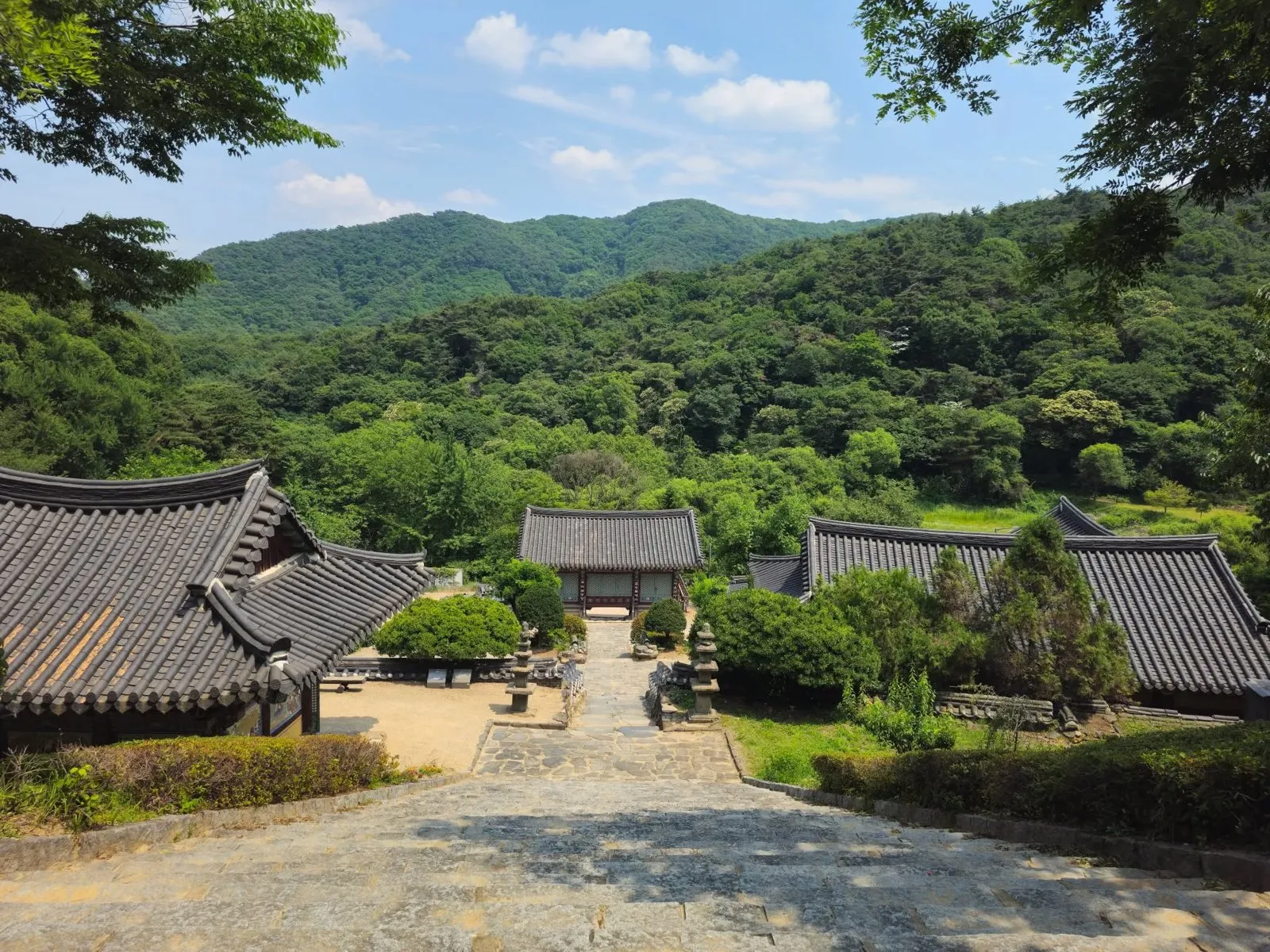
Short version: Seoknamsa is an old Buddhist temple in the hills of Anseong, Gyeonggi Province, well known as a filming location for the tvN drama Goblin (also called Guardian: The Lonely and Great God). One of its halls is a designated national Treasure, and a large Buddha carved into a boulder sits outside the temple, no more than a 10-minute walk up the mountain. I drove there in June 2026. My verdict: it’s better in person than in the drama. Honestly, I liked the air and the atmosphere more than the heritage. Admission and parking were free when I visited.
Last checked: 15 October 2026. The address and the temple’s history come from Anseong City’s English website and the Gyeonggi Cultural Foundation’s heritage institute. The Treasure listing comes from both, and the rock-carved Buddha’s details from the information board on site (photographed June 2026) and the Encyclopedia of Korean Culture. The Goblin link comes from Anseong City’s sign at the temple and a 2025 BBS news report. Free entry and parking are from my own visit. I couldn’t confirm opening hours. For public transport, use Naver Map’s live routes. Tell me if anything has changed.
Not the Ulsan one: there’s another Seoknamsa in Ulsan, in the far southeast. When you search maps, add “Anseong”.
What it is
Anseong City’s English website says Seoknamsa was built during the reign of King Munmu of Silla and rebuilt by the monk Hyegeo under King Gwangjong of Goryeo. The Gyeonggi Cultural Foundation’s heritage institute, citing the temple’s own records, gives the founding as 680, by a monk named Damhwa, and says no records or relics survive that show what the temple was like then. If the records are right, it’s more than 1,300 years old.
It sits at the foot of Seounsan mountain. From the entrance on, the atmosphere felt different: quiet and serene.
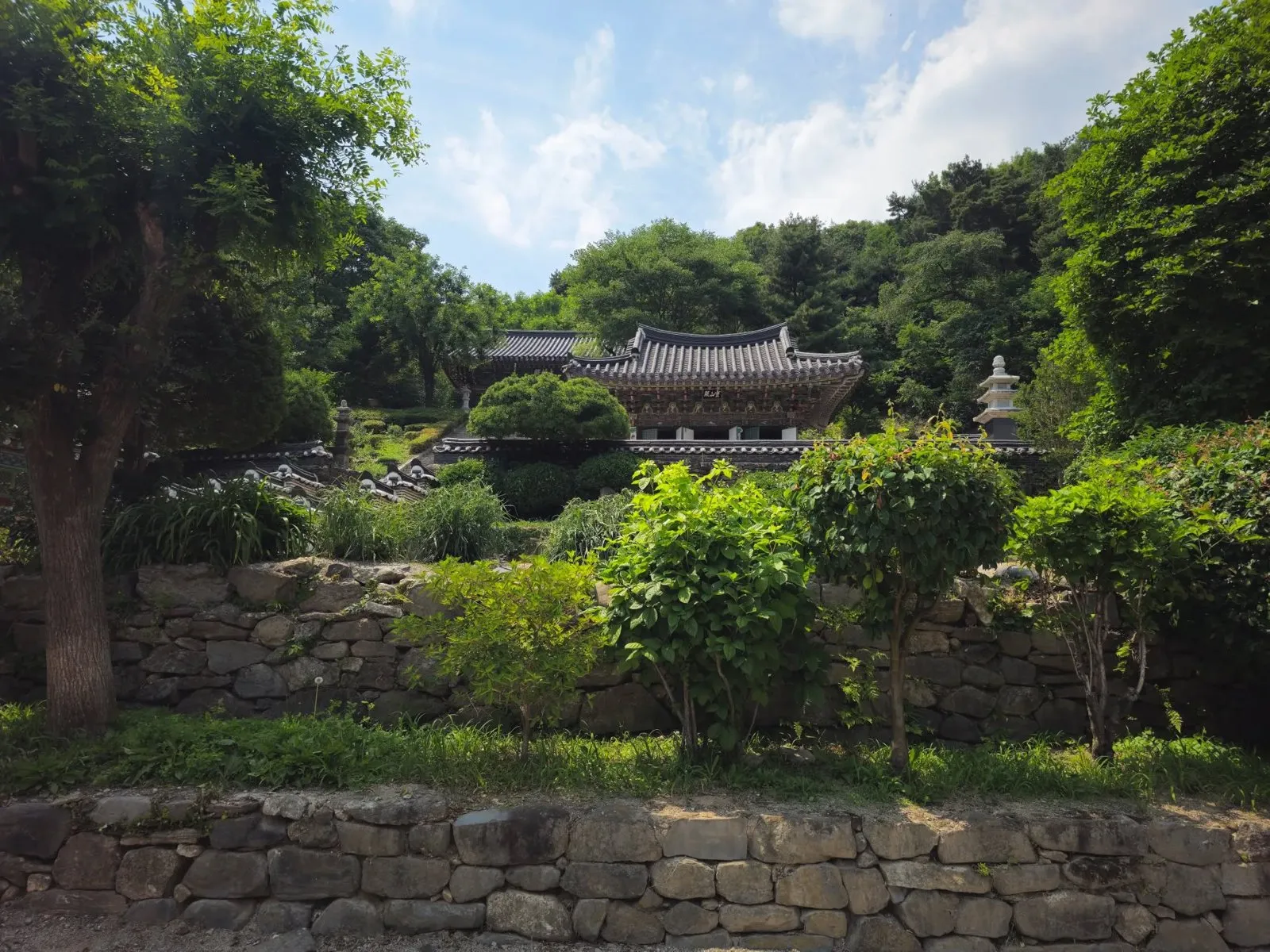 Yeongsanjeon Hall on its terrace above the stone walls.
Yeongsanjeon Hall is a designated national Treasure (heritage institute; Anseong City). The heritage institute says it’s thought to date from around the 17th century, judging by its style. The name plaque reads 靈山殿.
The main hall (Daeungjeon) has a triad of three Buddha statues inside.
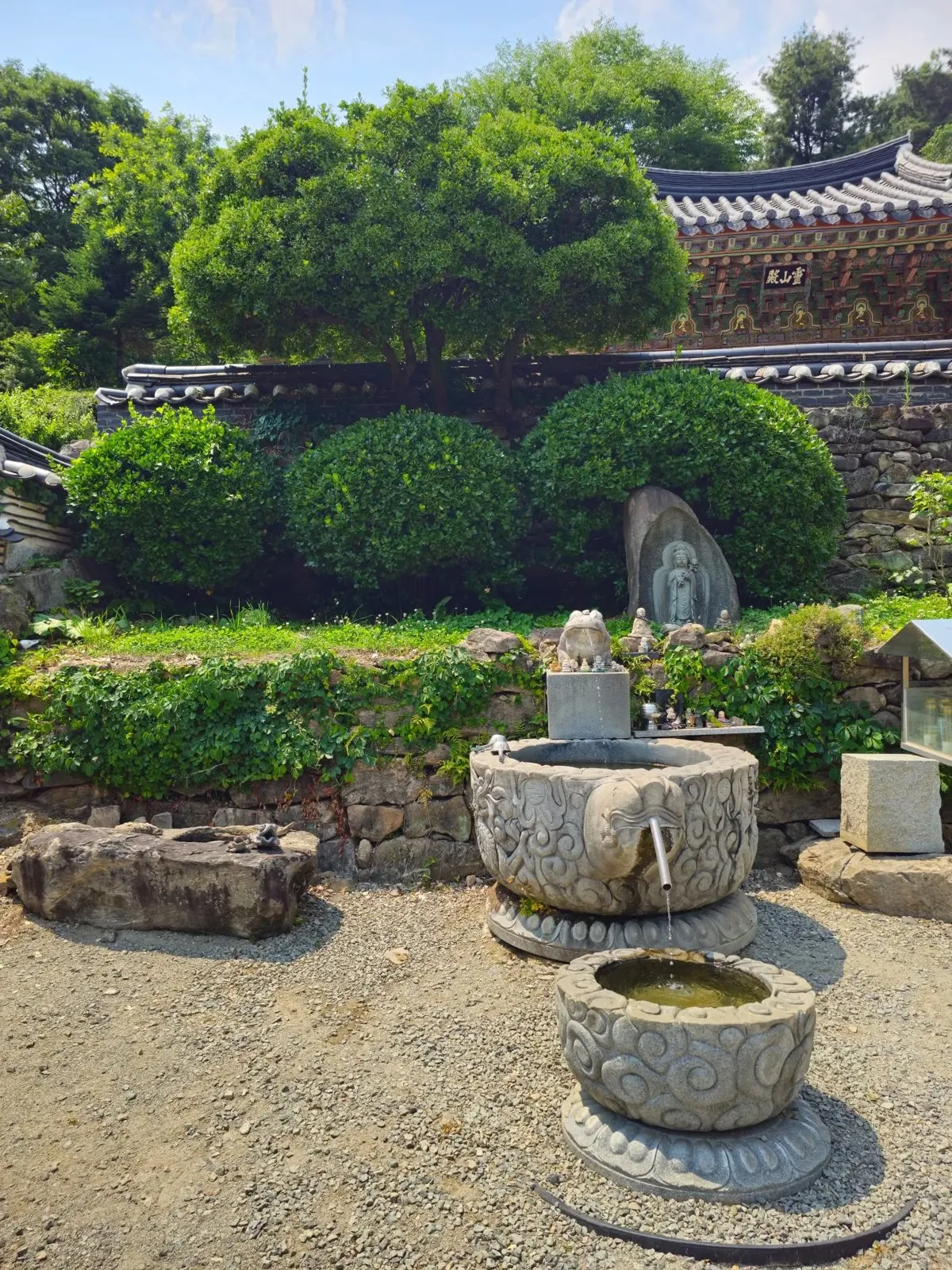 A stone water basin below Yeongsanjeon.
The rock-carved Buddha
A standing Buddha is carved into a huge boulder in the woods outside the temple. The Encyclopedia of Korean Culture says it’s about 1 km from the temple. It’s outside the temple grounds, so I had to climb a bit of the mountain to reach it, in that weather. Ten minutes on foot is plenty to get there. It’s carved into a natural rock face, so it’s pretty big, and that surprised me.
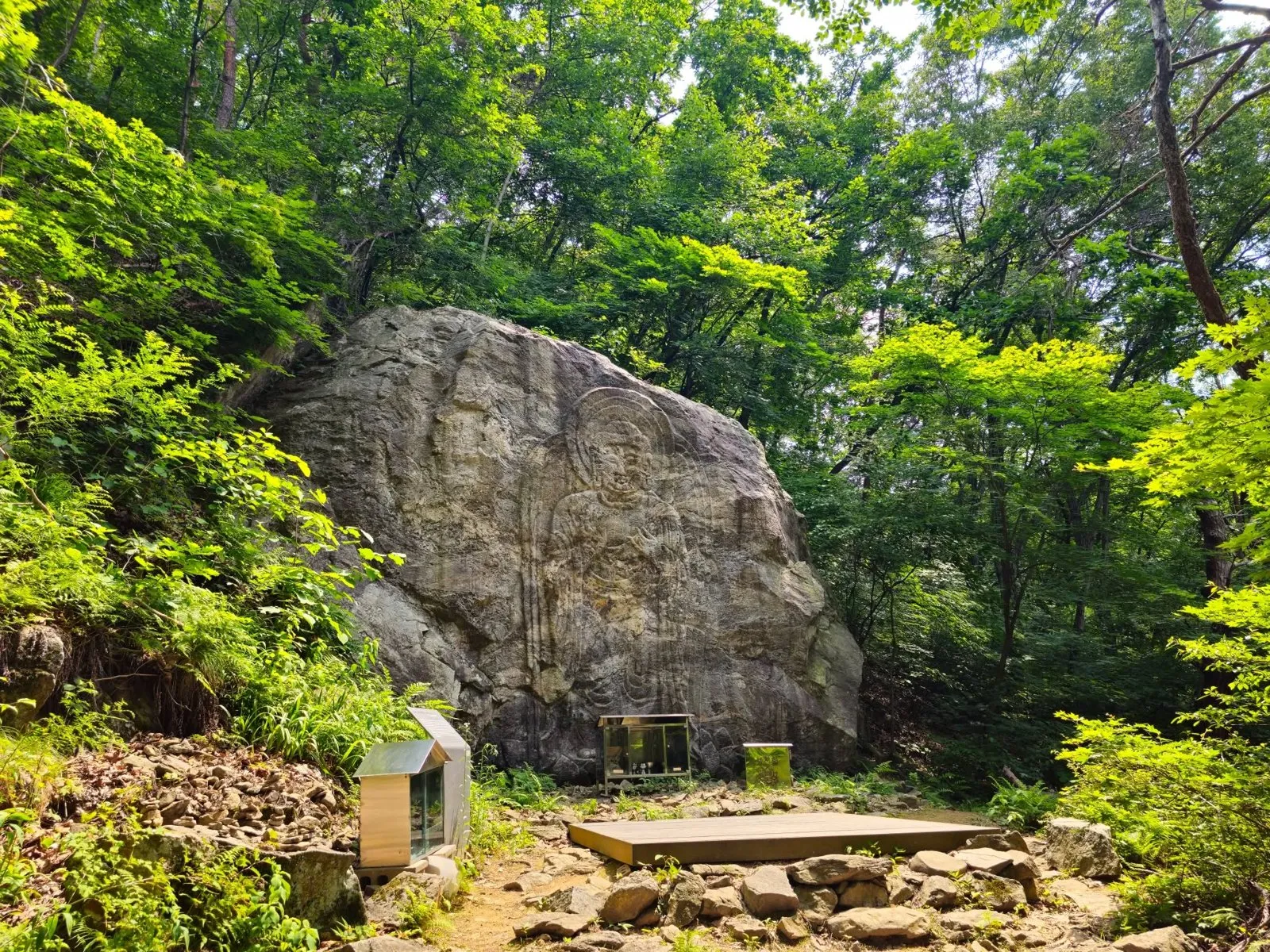 The boulder in the woods.
The information board at the site gives its height as 5.3 m and says it’s thought to date from the early Goryeo period, carrying on the style of Unified Silla rock-carved Buddhas. The Encyclopedia of Korean Culture gives 5.3 m for the whole carving and 4.5 m for the figure itself. It’s listed as a Gyeonggi Province Tangible Cultural Heritage (board and encyclopedia).
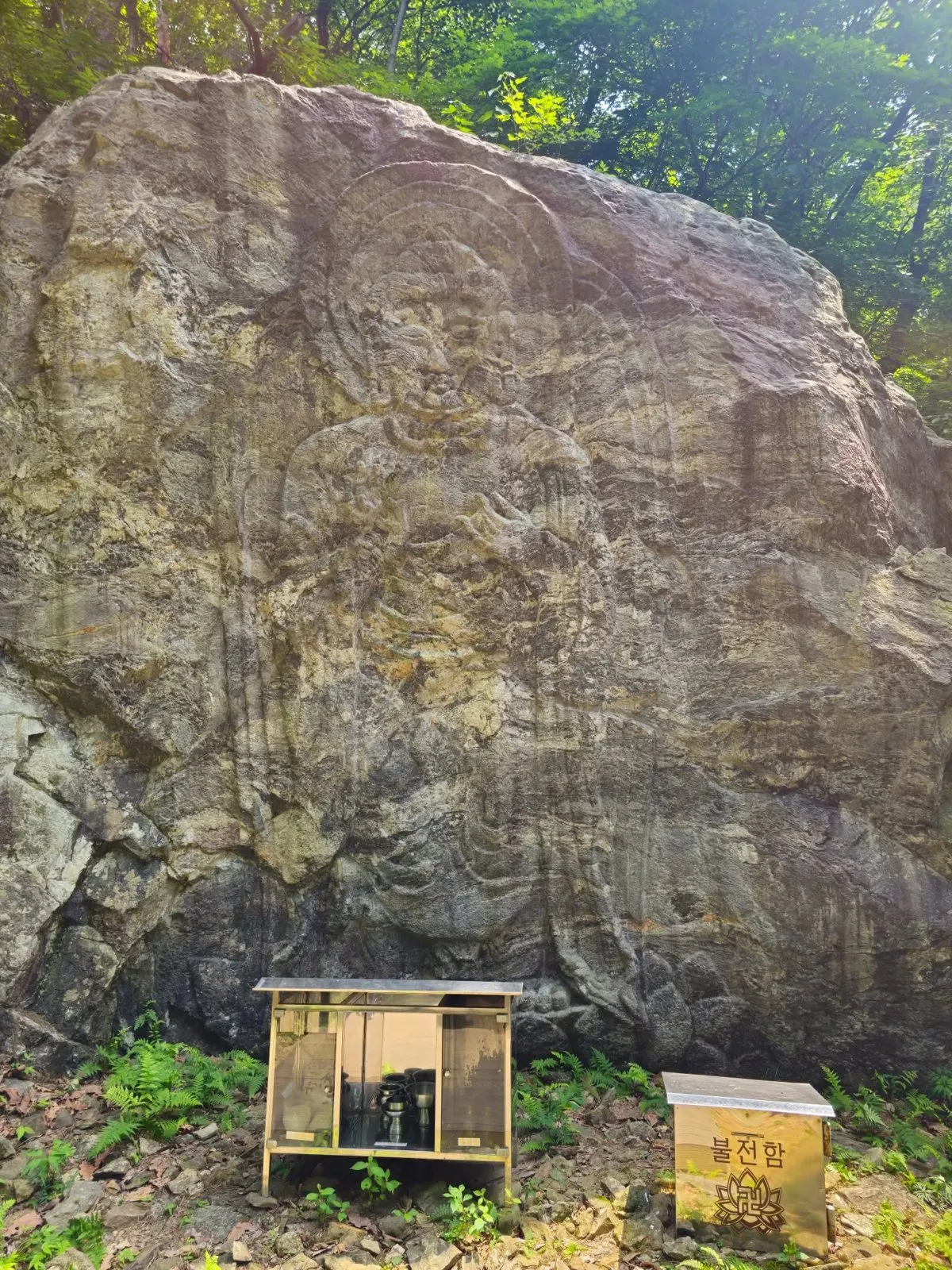 Closer to the carving.
The Goblin connection
A sign from Anseong City at the temple marks it as a filming location for the tvN drama Goblin. BBS, a Korean Buddhist broadcaster, reported in 2025 that the temple is well known as a filming spot for the drama. Seeing it in person, I liked it better than in the drama.
Visiting
| Seoknamsa Temple (Anseong) | |
|---|---|
| Address | 3-120 Sangchonsaemal-gil, Geumgwang-myeon, Anseong, Gyeonggi Province (Anseong City) |
| Hours | Couldn’t confirm |
| Admission | Free when I visited (June 2026) |
| Parking | Free when I visited (June 2026) |
It’s a working temple. Keep your voice down near the halls.
How to get there
By car: I drove. From Namanseong IC, follow the road up toward Seounsan Recreational Forest. Parking was free.
By public transport: check the live route in Naver Map (switched to English): search Seoknamsa Temple Anseong, or paste the Korean name, 석남사, and check it’s the one in Anseong.
How to check buses in English: install Naver Map and switch it to English in its settings. When I checked it in October 2026, the English version showed bus routes, stop names and live arrival times (minutes and stops away) in English. Google Maps also gives public transport directions in Korea, but as of late September 2026 it still had no turn-by-turn walking or driving navigation here. Stuck? Call the Korea Travel Hotline: dial 02-1330 from a Korean mobile phone (+82-2-1330 from abroad). It has English-speaking staff.
Tips
- Leave a little time for the rock-carved Buddha. It’s outside the temple, up the mountain; 10 minutes on foot is plenty.
- Bring water on warm days. The climb is uphill; I went in June.
- Take a moment to sit. I sat for a while and just zoned out. It felt like my head cleared a little.
Who it’s for
Likely to suit (estimate): Goblin fans, people who want a quiet mountain temple, and drivers exploring Gyeonggi Province.
Sources
Checked against Anseong City’s English website (address, history, Yeongsanjeon’s Treasure status), the Gyeonggi Cultural Foundation’s heritage institute page for Yeongsanjeon (Treasure listing, founding in 680, the hall’s approximate date), the information board at the rock-carved Buddha (photographed June 2026), the Encyclopedia of Korean Culture (height, designation, distance from the temple), Anseong City’s sign at the temple and a BBS news report from June 2025 (Goblin filming location). The visit, free admission and parking, the three statues in the main hall, the route from Namanseong IC, the climb and the walking time are from my own trip.