Home / Gyeonggi / Odusan Unification Observatory
See North Korea from Paju: Odusan Unification Observatory, free since 2024
Odusan Unification Observatory in Paju, near Seoul: look across the river mouth where the Han and Imjin meet to North Korea's Gwansan Peninsula. Free entry since January 2024; check opening days.
- Getting there
- On Odusan hill in Tanhyeon-myeon, Paju, northwest of Seoul. I drove. I couldn't confirm bus connections.
- Cost
- Free since 1 January 2024 (Ministry of Unification); it used to be 3,000 won for adults.
- Time needed
- 1–2 hours (estimate)
- Best time
- A clear day, for the view (my advice). KTO lists it as closed on Mondays; check before you go.
Tap any Korean name on this page to hear it. Prefer Naver Map? In the app (set to English), search Odusan Unification Observatory, or paste the Korean name:오두산 통일전망대
Short version: On a hill in Paju, northwest of Seoul, Odusan Unification Observatory looks out over the spot where the Han and Imjin rivers meet, straight across to North Korea. From the observation floors you can look into North Korea through telescopes. Entry has been free since January 2024. It was much closer than I expected: right in front of you, but you can’t go there. If you get the chance, go once, ideally on a clear day.
Last checked: 5 November 2026. Opening details come from the Korea Tourism Organization (KTO) listing (updated March 2026) and the Ministry of Unification; the rest is checked against Korean news reports and the boards inside. What it was like is from my own visit. Tell me if anything has changed.
What it is
The observatory opened on 8 September 1992 (KTO). From here, the KTO says, you can see the Han River from the south and the Imjin River from the north join and flow into the Yellow Sea, and the hills of North Korea’s Hwanghae Province just across the water. A 2026 report carried by the Maeil Shinmun puts North Korea “a little over 2 km” across the river.
It’s run by the Ministry of Unification’s National Institute for Peace, Unification and Democracy Education (its Korean name is on the building and on a wall inside). Entry became free on 1 January 2024; before that, adults paid 3,000 won (the institute’s press release, December 2023).
The view and the floors
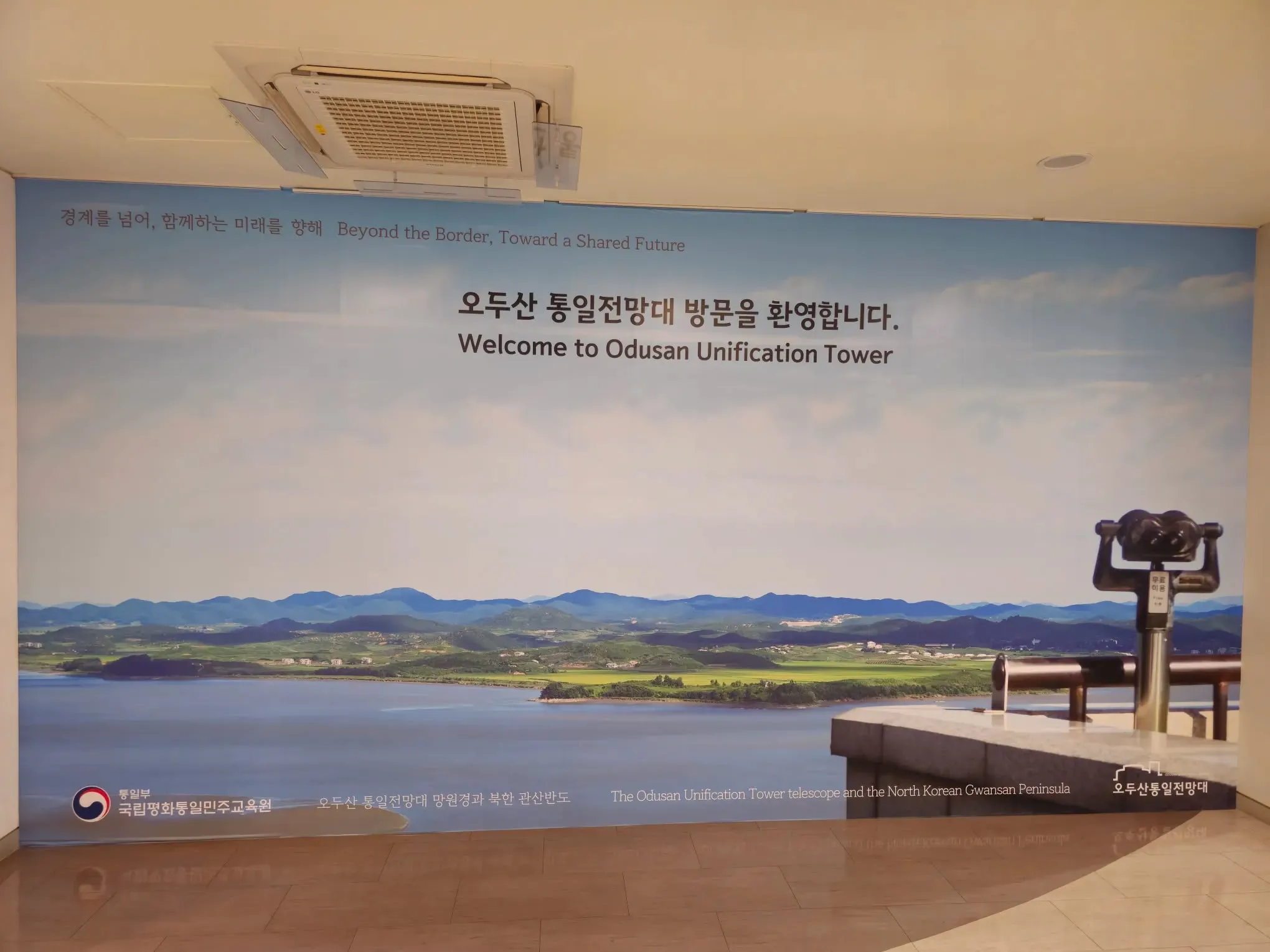
From the round observation rooms on the third and fourth floors you can see North Korean residents’ daily life through the telescopes. Kyeongin Ilbo (2025) and the Kyunghyang Shinmun (2024) also describe third- and fourth-floor observation areas, and the Kyunghyang Shinmun says the telescopes are all free. A wall inside names the land opposite as North Korea’s Gwansan Peninsula.
The Kyunghyang Shinmun also lists a permanent exhibition on the first floor, a children’s experience area in the basement and a café on the fourth floor.
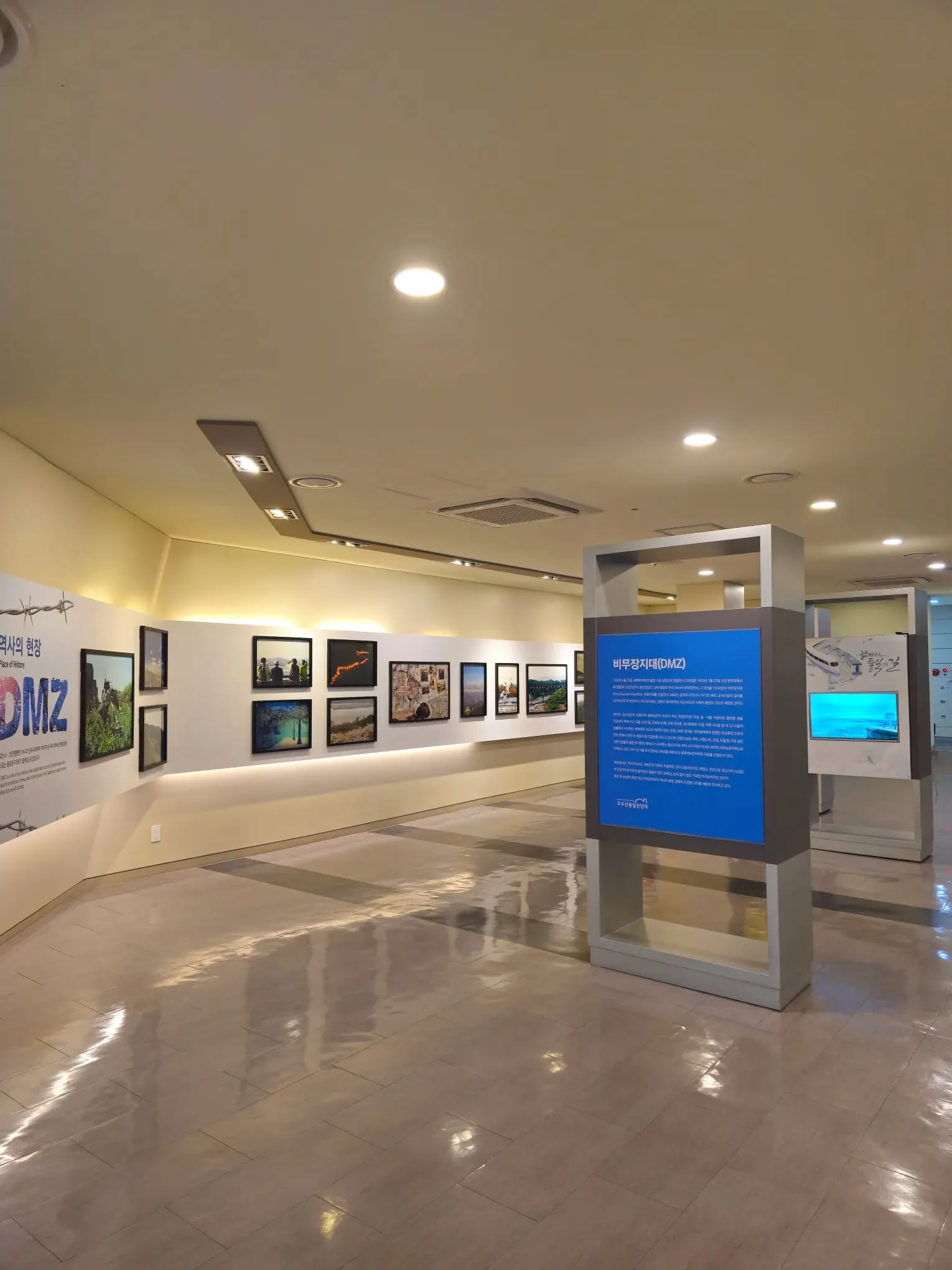 The DMZ photo gallery inside.
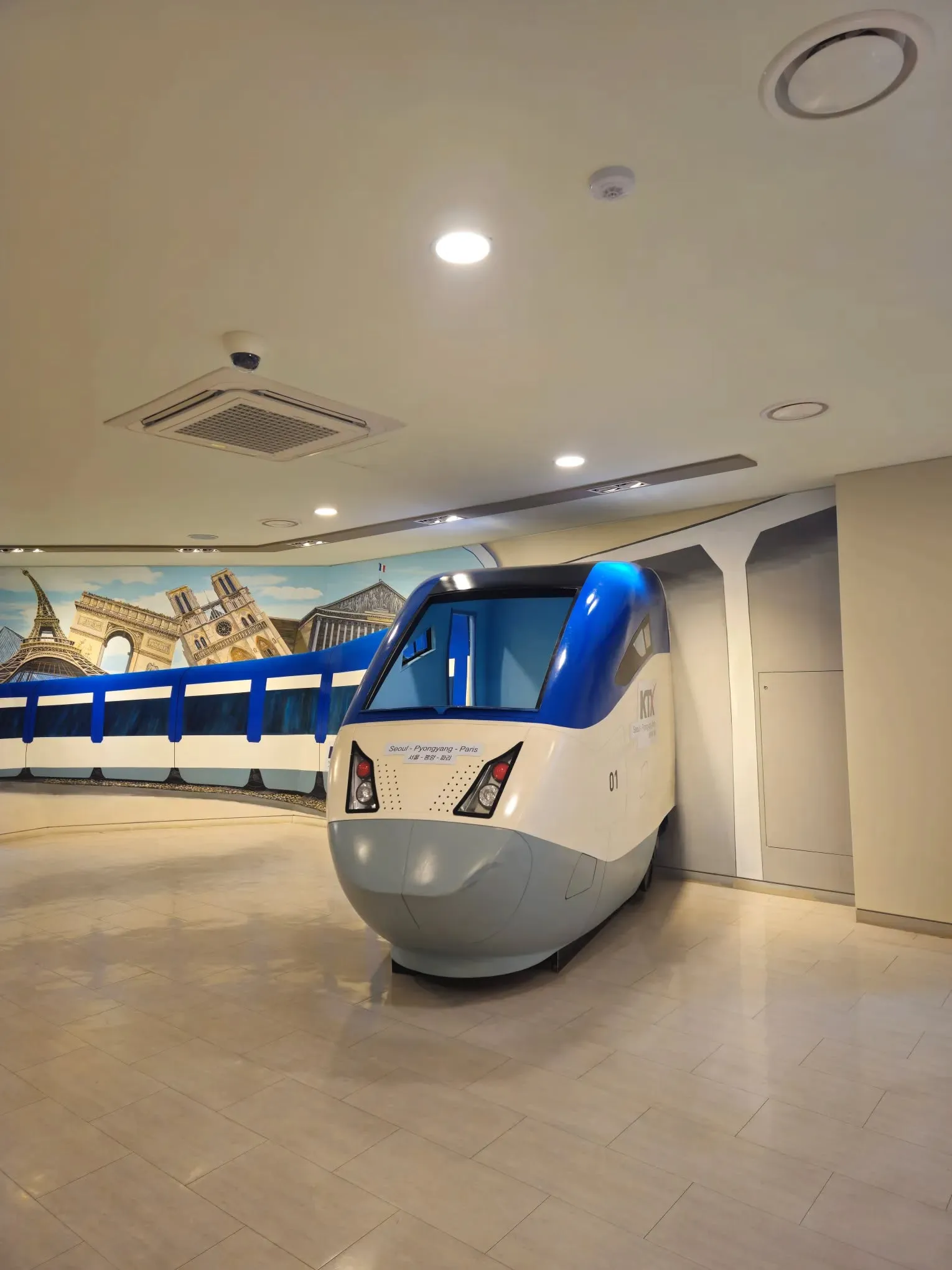 One of the exhibits: a KTX train front bound for Pyongyang and Paris, coming out of a wall of Paris landmarks.
Visiting
| Odusan Unification Observatory | |
|---|---|
| Hours | October–June 10:00–17:00 (last entry 16:30), per KTO’s Korean listing, which matches what I noted on my visit. KTO’s English listing gives 9:00–17:00 all year, and its Korean listing gives 9:30–17:30 for July–September, so check before you go |
| Closed | Mondays, per KTO (a 2025 news report says it opens every day), so check before you go |
| Admission | Free since 1 January 2024 (Ministry of Unification) |
| Parking | Available. KTO’s Korean listing says it’s free; its English listing lists a fee, so I couldn’t confirm |
| Address | 369 Pilseung-ro, Tanhyeon-myeon, Paju (KTO) |
- Ticket times: my notes say ticketing ended at 4 p.m. when I went; the KTO lists last entry at 4:30 p.m. in winter. Go early to be safe.
- Tickets: the Kyunghyang Shinmun (2024) says you print your free ticket yourself at an unmanned machine on the first floor.
How to get there
By car: the observatory is on Odusan hill in Tanhyeon-myeon, Paju. Search the Korean name, 오두산 통일전망대, in Naver Map.
By public transport: I couldn’t confirm bus connections, so I haven’t listed any. Check the live route in Naver Map before you go.
How to check buses in English: install Naver Map and switch it to English in its settings. When we checked it in October 2026, the English version showed bus routes, stop names and live arrival times in English. Google Maps also gives public transport directions in Korea, but as of late September 2026 it still had no turn-by-turn walking or driving navigation here. Stuck? Call the Korea Travel Hotline: dial 02-1330 from a Korean mobile phone (+82-2-1330 from abroad). It has English-speaking staff.
Tips
- Pick a clear day. I recommend going on a clear day.
- Check the day. KTO lists it as closed on Mondays, but one 2025 report says it opens every day.
Who it’s for
Likely to suit (estimate): anyone curious about the division of Korea, travelers based in Seoul who want a half-day trip, and people who want to see North Korea without joining a DMZ tour.
Sources
Checked against the Korea Tourism Organization’s Korean listing (updated March 2026: opened 8 September 1992, the river confluence and the view of Hwanghae Province, hours, closed Mondays, free entry, the address, parking free) and English listing (different hours, parking fee), the Ministry of Unification (December 2023 briefing: free from 1 January 2024) and its institute (December 2023 press release: previously 3,000 won; the fourth-floor observatory and the Gwansan Peninsula view; English name from its website), Kyeongin Ilbo (October 2025: third- and fourth-floor observation areas; it says the observatory opens every day), the Kyunghyang Shinmun (September 2024: built in 1992, free telescopes, self-service tickets, the floors), the Maeil Shinmun (August 2026: a little over 2 km to North Korea) and the wall inside (photographed around January 2026: the institute’s name, the Gwansan Peninsula, a telescope marked free). What it was like is from my own visit.